

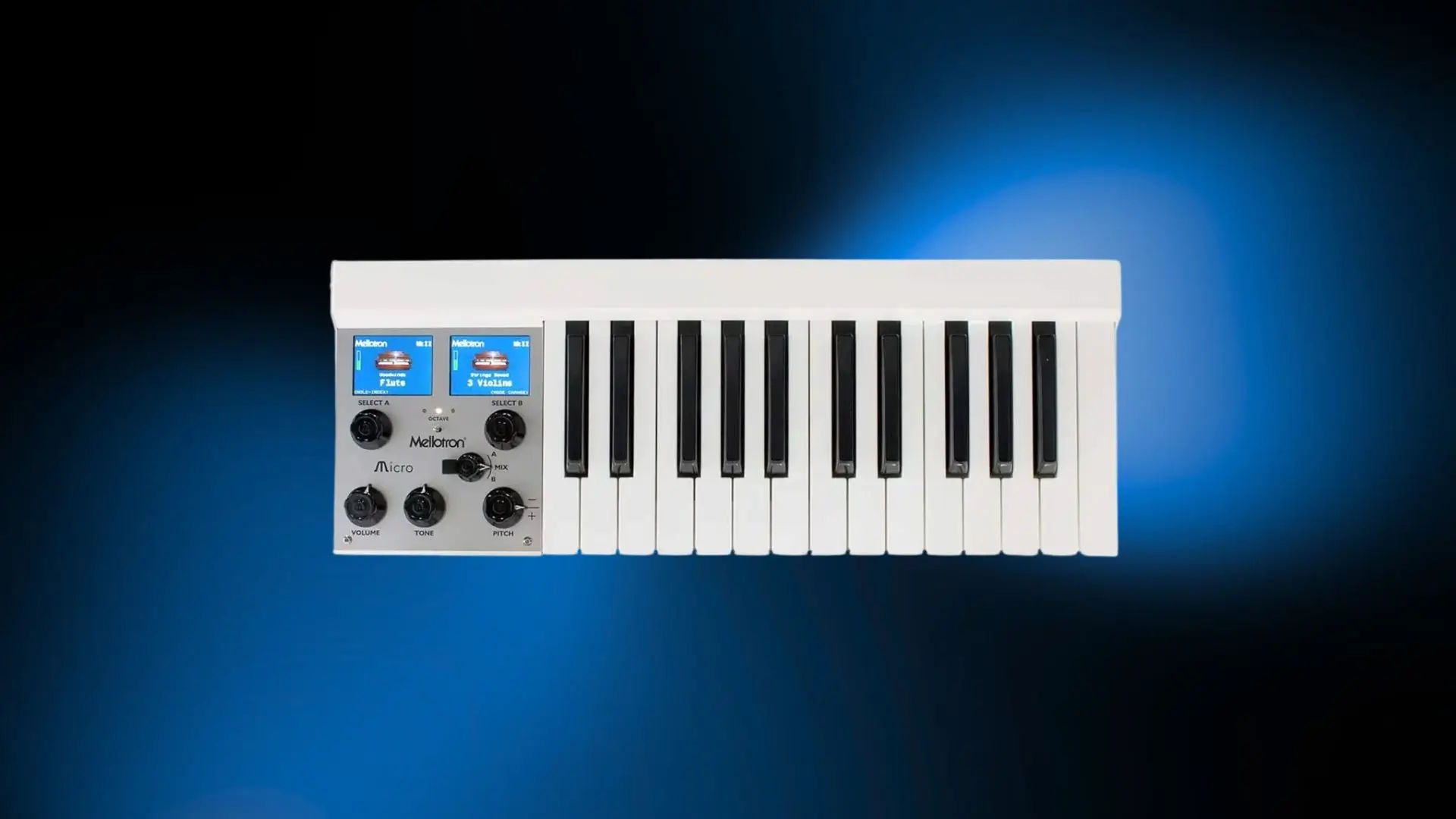
The Mellotron Micro is a compact digital sample-playback keyboard introduced by Mellotron in 2017, presented at NAMM that year and delivered from May 2017 onward. It is not a synthesizer in the oscillator-filter-envelope sense, but a small hardware instrument built around 100 uncompressed 24-bit Mellotron and Chamberlin sounds drawn from original first-generation tape libraries. Its importance lies in the way it translates one of the most historically charged keyboard sounds into a two-octave, stage-and-studio format without turning the Mellotron idea into a generic sampler.
Table of Contents
Mellotron Micro sound and character
The Mellotron Micro sounds less like a neutral sample player than a compact archive of tape-era musical memory. Its best sounds are the ones that reveal the old Mellotron paradox: they imitate orchestras, choirs, flutes, brass, organs, and other acoustic sources, yet they are most powerful when they fail to sound fully natural. The slight strangeness is the point. The tone is fragile, compressed, mournful, sometimes nasal, sometimes ghostly, and often more emotionally direct than technically realistic.
The instrument excels at flutes, strings, choirs, brass pads, chamber-orchestra colors, and hybrid textures made by blending two sound banks. The A/B mix control is central to its personality because it lets the player move between two historical colors rather than merely select one preset. A flute can sit inside a choir, a string tone can be thickened with organ, and a brass sound can be made less literal by pairing it with something more brittle. This is not modern synthesis as construction; it is arrangement by historical collision.
The Mellotron Micro’s tone comes from its digital playback of source material associated with the Mellotron and Chamberlin tape libraries. Because most of the sounds follow the non-looping logic of the original tape instruments, the notes do not behave like endless synth pads unless the player works around the limitation. That finite duration matters musically. It forces phrasing. It makes chords feel like gestures rather than static wallpaper. In a DAW era where a pad can last forever, the Mellotron Micro keeps some of the old tape instrument’s sense of breath and expiration.
It leans vintage by design, but not in the manner of an analog subtractive polysynth. There are no oscillators drifting against one another and no resonant filter shaping harmonics in the classic synth sense. The character is instead archival, cinematic, and slightly haunted. The Mellotron Micro is at its best when used as a color instrument: a line, a suspended chord, a background choir, a flute motif, or a fragile string layer that immediately places the music in conversation with late-1960s pop, progressive rock, psychedelic arrangements, and the later indie/film-score fascination with decayed orchestral sound.
Features and architecture
- Manufacturer: Mellotron.
- Year introduced: 2017.
- Production years: 2017 to present, based on current official availability as of June 2026.
- Synthesis type: Digital sample playback using uncompressed 24-bit Mellotron and Chamberlin sounds.
- Category: Compact digital Mellotron / sample-playback keyboard.
- Polyphony: Common retailer specifications list 25 voices, corresponding to the 25-key format.
- Original price and current market price: Vintage King listed the Mellotron Micro at $990 in its 2017 review; Mellotron’s current official US price is $1,000 for the white version, with the black version listed as $100 more.
- Oscillators: No conventional oscillators; sound generation is based on playback of recorded Mellotron and Chamberlin source material.
- Filter: No conventional synth filter is specified; tonal shaping is handled through a tone control rather than a subtractive filter section.
- LFOs: No conventional LFO section is specified.
- Envelopes: No standard ADSR synth architecture is specified; the instrument’s behavior is primarily governed by sample playback and performance controls.
- Modulation system: No modulation matrix; practical shaping comes from pitch, tone, octave selection, normal/half-speed playback, A/B mixing, and performance response.
- Sequencer / arpeggiator: No built-in sequencer or arpeggiator is specified.
- Effects: No onboard effects are listed by major retailers.
- Memory: 100 built-in Mellotron and Chamberlin sounds; the Mellotron Micro is not compatible with the compact-flash expansion sound cards used by the larger M4000D-series instruments.
- Keyboard: 25 semi-weighted keys; the octave selector provides access beyond the physical two-octave span.
- Inputs / outputs: 1/4-inch audio outputs, headphone output, sustain jack, and MIDI connectivity.
- MIDI / USB: MIDI In/Out/Thru; retailer specifications list no USB port.
- Display: Two displays for sound selection and navigation.
- Dimensions / weight: Retailer specifications commonly list approximately 490 x 63 x 182 mm and 2.9 kg.
- Power: External power supply connection; power adapter included in standard retail listings.
Strengths
- It gives the player direct hardware access to a historically specific sound world without requiring a vintage tape machine, a laptop, or a general-purpose sampler.
- The 100 built-in Mellotron and Chamberlin sounds cover the essential emotional vocabulary of the instrument: flutes, strings, choirs, brass, organs, and other period colors.
- The A/B sound structure is musically useful because it treats layering as a performance act, not merely as a preset-editing function.
- The two-octave format makes sense for melodic lines, drones, film-score gestures, and compact studio rigs where a full Mellotron-style keyboard would be physically disproportionate.
- The non-looping playback philosophy preserves part of the original instrument’s phrasing discipline, which helps the Mellotron Micro avoid becoming just another infinite pad machine.
- The pitch and half-speed behavior are not cosmetic; they connect directly to the Mellotron tradition of pitch manipulation, tape-speed transformation, and unstable orchestral coloration.
- The instrument has a strong identity. It does not try to be a workstation, VA polysynth, sampler workstation, or groovebox. That limitation gives it focus.
- Its physical immediacy can be more inspiring than a plug-in for players who want the Mellotron sound as an instrument rather than a library buried inside a DAW session.
Limitations
- The 25-key range is restrictive for two-handed playing, wide chord voicings, and conventional keyboard performance.
- It is expensive for a small sample-playback keyboard, especially when compared with Mellotron-style software instruments that offer larger libraries and deeper editing.
- It has no expansion-card support, so buyers who want the wider M4000D sound-card ecosystem should look at the larger models instead.
- It lacks the broad synthesis architecture of modern digital synths: no oscillator design, no filter section, no modulation matrix, no arpeggiator, and no onboard effects.
- The non-looping behavior is historically meaningful, but it can frustrate players expecting endless ambient pads without external processing or performance planning.
- The compact interface is immediate but not deep; this is a curated instrument, not a sound-design laboratory.
- Retailer specifications around aftertouch are not perfectly consistent, so buyers should verify the exact revision and keyboard behavior before purchasing.
- The Mellotron Micro is less attractive if the user already works comfortably with high-quality Mellotron plug-ins and does not need a dedicated hardware object.
Historical context
The Mellotron story begins before the Mellotron Micro and before digital sample playback. Harry Chamberlin’s tape-playback keyboard concept in the mid-20th century led to a family of instruments that placed recorded instrumental sounds under a keyboardist’s fingers. Mellotron refined and commercialized the idea in England, with sales beginning in the 1960s. By the late 1960s and early 1970s, the Mellotron had become closely associated with rock, psychedelia, progressive music, and studio orchestration.
The original Mellotron mattered because it offered an impossible fantasy for its time: flutes, strings, choirs, and orchestral colors without hiring an ensemble. But it also had a second, less intended legacy. Its mechanical imperfections, finite tape length, uneven timbre, and eerie approximation of acoustic instruments became a sound in themselves. The Mellotron did not merely imitate the orchestra; it invented a new kind of artificial nostalgia.
By the 1980s, the rise of string synthesizers, digital samplers, and more practical keyboard technology made the tape Mellotron feel heavy, fragile, and outdated. The later revival of the Mellotron brand under Markus Resch reframed the instrument for a new era. The M4000D, presented at NAMM 2010, brought the idea into high-quality digital form. The M4000D Mini followed as a smaller version, and the Rack version extended the concept into studio hardware.
The Mellotron Micro, presented at NAMM 2017, was a further reduction. It did not try to be the grand digital Mellotron. It asked a narrower question: how small can the modern Mellotron become while still feeling like a dedicated instrument? Its lack of expansion-card support was not incidental; it resulted from the different SD-card-based audio engine used for the Mellotron Micro. That design placed it below the larger M4000D instruments in flexibility, but also made it easier to understand as a compact, fixed-library Mellotron.