

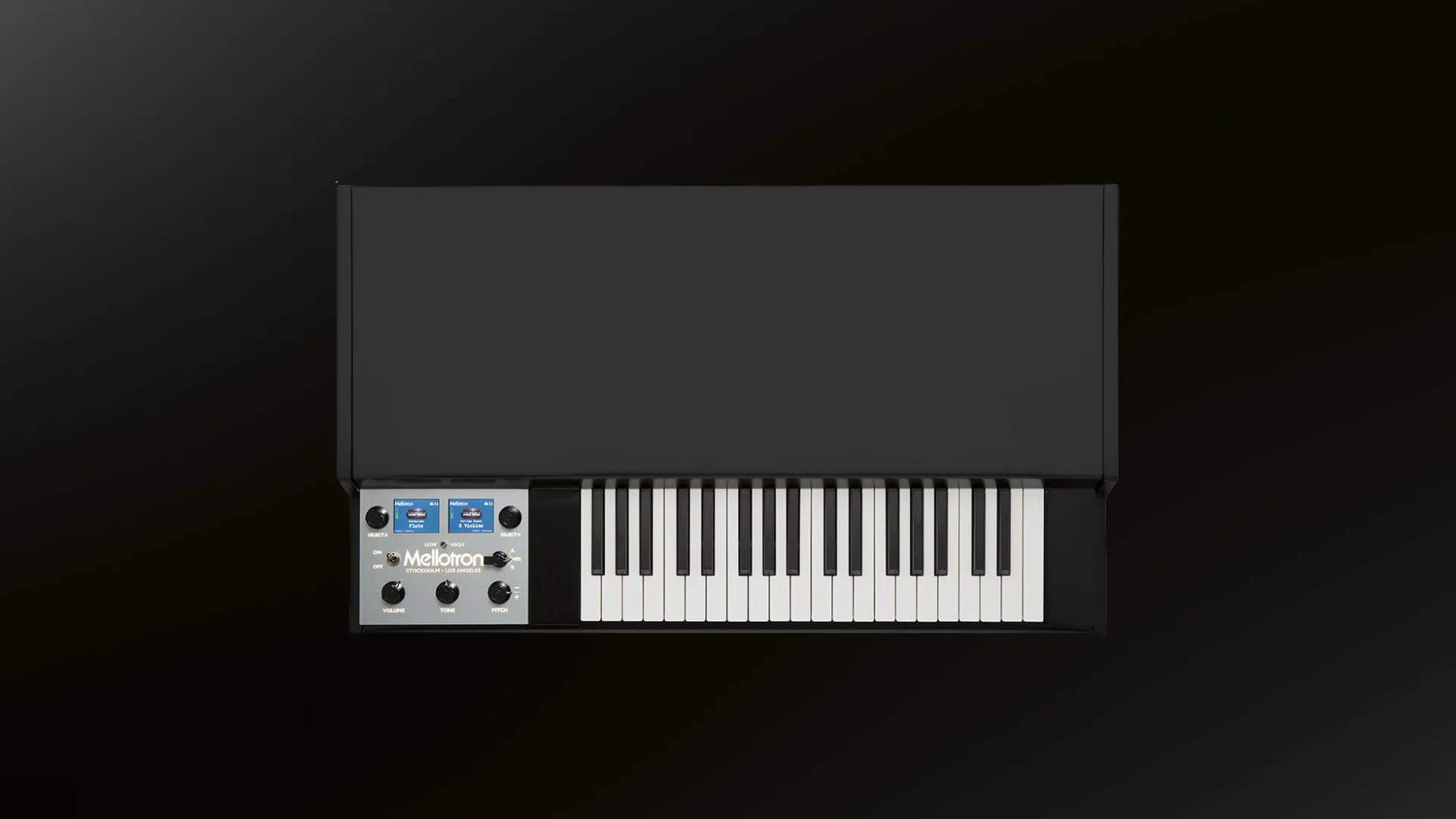
The Mellotron M4000D is a digital Mellotron built by Mellotron, the Swedish and American operation of Markus Resch and David Kean, first shown as a prototype at the Winter NAMM Show in January 2010. Instead of tapes, it streams 24-bit uncompressed samples of around 100 Mellotron and Chamberlin sounds taken from the first-generation tape library, played from a 37-note wooden keyboard with depth sensitivity and polyphonic aftertouch over MIDI. It keeps the traditional volume, tone and pitch controls, adds instant blending of any two sounds, a half-speed switch, three balanced XLR outputs and a card slot for expansion. It is the full-size flagship of a family that also includes the M4000D Mini and the M4000D Rack, and it is still sold new.
Table of Contents
Mellotron M4000D sound and character
The Mellotron M4000D’s sound starts from the same recordings that made the Mellotron famous. Mellotron describes its samples as coming from the original first-generation tape library, and the instrument plays them back as uncompressed 24-bit audio rather than through a looped, heavily processed sample engine. In the Mellotron M4000D family each key triggers its own sample of roughly eight seconds, as a real tape would, so notes end where the tape ends instead of sustaining indefinitely. That one decision does much of the work: phrasing, the slight variation between keys and the way chords decay unevenly all behave in the familiar Mellotron manner.
The library mixes the canonical Mellotron sounds (flutes, string sections, choirs, brass) with Chamberlin recordings, which tend to be drier and more varied, including instruments Mellotrons never carried. Two sounds can be loaded at once and blended with the Mix control, a quick version of what tape machines offered only between adjacent tracks. A high and low switch drops playback to half speed, an octave lower, and the pitch knob acts as the old motor-speed control, bending the whole instrument up or down. A tone control handles the high end.
What the Mellotron M4000D does not reproduce is the instability of tape itself. There is no wow, flutter, head wear, motor strain under big chords or slow decay in the tapes, unless it is already present in the recording. Some players see that as the point: Keyboard magazine’s review of the smaller M4000D Mini, published by MusicRadar, presented the digital line as the most affordable way to get the throwback sound of tape Mellotrons. Others prefer the unpredictability of a mechanical machine or a dedicated emulation with modeled tape artifacts.
In character, then, the Mellotron M4000D is vintage material delivered cleanly. It suits pop, rock and film work that wants authentic Mellotron and Chamberlin tones on a stage or in a studio without servicing tapes. It is weaker for anyone who wants deep sound editing, effects or synthesis: it is a playback instrument, close in spirit to the tape machines it imitates.
Features and architecture
- Manufacturer: Mellotron (Mellotron.com / Mellotron Archives, David Kean and Markus Resch), built in Stockholm according to Wikipedia
- Year introduced: 2010; a prototype appeared at Winter NAMM in January 2010, where it was named a Mix Certified Hit, and US distributor Big City Music expected stock in September 2010
- Production years: 2010 to the present; buyers reported delivery delays in 2011, and Thomann lists the model as available since December 2013
- Synthesis type: sample playback of original tape recordings
- Category: digital tape replay keyboard (digital Mellotron)
- Polyphony: 37 notes, one sample per key, as listed by Reverb
- Original price: $1,995 announced in August 2010; reader reports on Synthtopia describe a rise to $2,495 by January 2011
- Current market price: about $3,200 new in the United States (Chicago Electric Piano and Reverb new listings) and £2,555 at Thomann UK
- Sound source: about 100 built-in Mellotron and Chamberlin sounds, 24-bit uncompressed streaming audio, roughly eight-second samples without looping
- Expansion: compact flash card slot; each card adds 100 sounds from the archives, and around eight cards were planned
- Multitimbrality: two sounds (A and B) at once, blended with the Mix control
- Filter: none; tone control on the front panel
- LFOs / envelopes: none
- Voice modes: normal and half-speed playback via a high and low switch; pitch knob for master tuning and speed
- Effects: none onboard
- Memory: instant access to all internal sounds; a live playlist function is mentioned by owners
- Keyboard: 37 keys, custom wooden Mellotron-style action with ebony keytops (per the 2010 announcement), depth sensitivity, polyphonic aftertouch transmitted over MIDI; no wheels
- Inputs / outputs: three gold-plated balanced XLR outputs (A direct, B direct and master) with 1/4-inch alternatives, headphone output, sustain and expression or volume pedal inputs
- MIDI / USB: MIDI in, out and thru; MusicRadar’s Mini review credits the Mellotron M4000D with USB connectivity, but Thomann’s spec sheet lists no USB
- Display: two color displays that can show pictures of the original instruments (described as TFT by Mellotron, OLED by Thomann)
- Dimensions / weight: 859 x 501 x 135 mm, 17.5 kg, in a furniture-style wooden cabinet with hinged lid; hardwood, black and leg options offered
- Power: external power supply
- Related models: M4000D Rack, a 1.7 kg module (480 x 140 x 90 mm) with the same library, XLR outputs and pedal inputs; M4000D Mini, a 37-key metal-cased version
Strengths
- The source material is the real thing. Samples taken from the first-generation tapes, played back uncompressed, give it an authority that generic Mellotron patches on workstations lack.
- It plays like a Mellotron rather than a synth. The wooden action, the cabinet and the traditional knob set make it feel like a member of the family, and owners consistently single out the keyboard.
- It combines both archives. Having Chamberlin and Mellotron sounds in one instrument widens the palette well beyond what any single tape machine offered.
- It is far easier to live with than tape. At 17.5 kg it weighs roughly a quarter of Streetly’s 74 kg tape M4000, needs no tape maintenance, and changes sounds instantly.
- The studio connections are serious. Separate balanced outputs for each sound and the mix, plus MIDI with polyphonic aftertouch, make it useful both as an instrument and as a controller.
- The half-speed switch and two-sound mix cover the classic tricks of the tape era in seconds.
Limitations
- The 37-note range is authentic but short, and there are no pitch or modulation wheels.
- It is a playback instrument with almost no editing: no filter, envelopes or effects, and the eight-second note length is fixed by the samples.
- The price is high for a sample player. At around $3,200, it costs more than many workstations and much more than software libraries of similar recordings.
- The early years were troubled. Commenters on Synthtopia reported price rises and buyers waiting more than a year for units ordered in 2010, and one Thomann reviewer mentioned quality-control problems on earlier units.
- Documentation has been thin; at least one owner reported receiving a unit with no manual and questions about the playlist system.
- Expansion depends on the manufacturer’s card releases. A second card (Sound Card 02, $500 at the time of MusicRadar’s Mini review) has been sold, but the full set of around eight planned cards is not documented.
- The name invites confusion with Streetly Electronics’ tape M4000, a completely different instrument from a separate company.
Historical context
After Streetly Electronics closed in 1986, the Mellotron name passed through the American side of the business. Bonedo’s history of electronic music says David Kean bought the remaining parts and the name in 1990 and founded Mellotron Archives, and with Swedish partner Markus Resch developed the Mk VI, an improved tape M400 that Wikipedia dates to 1999. Mellotron says the digital concept had been in development since the mid-1990s, that the software and audio engine took about three years, and that the company bought parts of an earlier inventory from a firm called Mellotron Digital.
Resch introduced the Mellotron M4000D at the 2010 Winter NAMM Show as a prototype, with a front panel that Big City Music later said would change in production and a cabinet set to be slightly lower. Synthtopia reported in August 2010 that stock was expected in September at $1,995. Delivery proved slow: reader comments under that report describe price increases and buyers still waiting in 2011, with one owner reporting delivery through German distributor EMC in June 2012. By 2013 Mellotron was exhibiting at Frankfurt Musikmesse on EMC’s stand, and Thomann has listed the model since December of that year.