

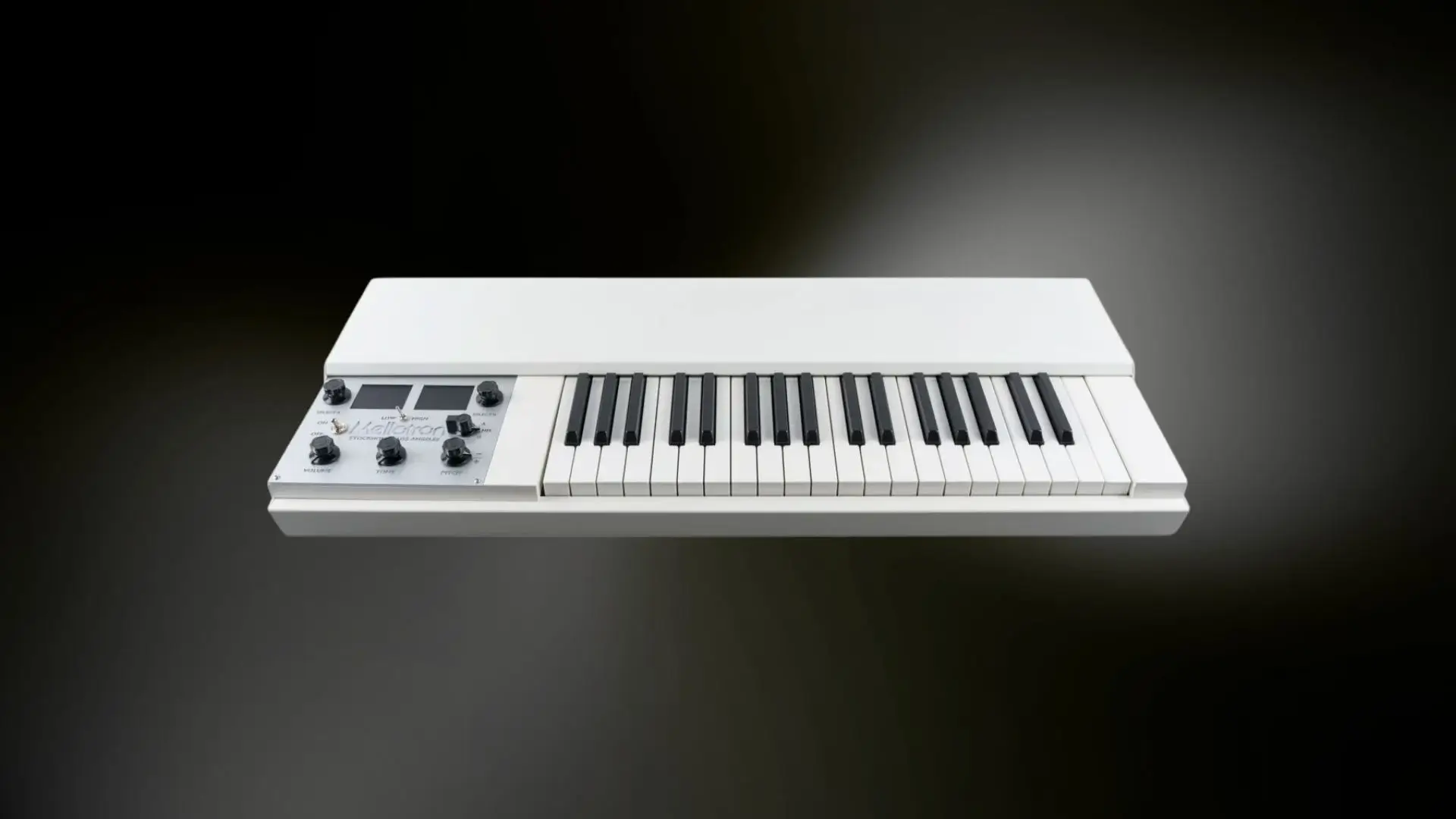
The Mellotron M4000D Mini is a compact digital Mellotron keyboard developed during 2012, sold from the end of that year, and officially presented at NAMM 2013. It takes the sound engine and front-panel concept of the larger Mellotron M4000D Mini and places them in a lighter 37-key format, using uncompressed digital playback of Mellotron and Chamberlin source material rather than magnetic tape. Its importance lies in a specific compromise: it does not try to become a modern workstation, sampler, or general-purpose synth. It exists to make one historically charged sound world portable, reliable, and immediately playable.
Table of Contents
Mellotron M4000D Mini sound and character
The Mellotron M4000D Mini sounds like a curated archive of tape-replay memory rather than a neutral sample library. Its core identity comes from the way Mellotron and Chamberlin recordings behave: strings that do not bloom like modern orchestral samples, choirs that feel suspended between realism and ghostliness, flutes with breath but not clinical detail, brass and reeds that arrive with the softened edge of old recording media. The Mellotron M4000D Mini’s appeal is not high-fidelity realism in the contemporary scoring-library sense. It is the opposite: a musical image of performance trapped inside tape-era technology.
That character is strengthened by the playback design. The built-in library draws from original Mellotron and Chamberlin sources, reproduced as 24-bit uncompressed audio. Most sounds do not loop, because the original Mellotron did not behave like a modern sample engine with infinite sustain. This matters musically: notes have a horizon. Chords feel like events, not static pads. Even when used in ambient music, the sound has a built-in sense of duration, decay, and fragility.
The A/B sound structure is central to the Mellotron M4000D Mini’s personality. Two sounds can remain active and be blended from the front panel, so a choir can be pulled into strings, or a woodwind color can sit inside a brass texture without becoming a complicated workstation patch. That directness gives the Mini much of its value. It is not deep in the modular sense, but it is immediate in the compositional sense.
The half-speed and pitch behavior also connect the Mini to the older Mellotron imagination. Slowing samples down does not merely transpose them; it changes their weight, attack, and emotional temperature. A familiar string patch can become darker and more monumental, while a flute or choir can move from nostalgic to uncanny. In practice, the Mini excels at orchestral pads, haunted choirs, vintage progressive-rock textures, cinematic drones, lo-fi chamber colors, and fragile lead lines that would sound too polite if played from a cleaner sample instrument.
Features and architecture
- Manufacturer: Mellotron, operated by Markus Resch and handbuilt in Sweden.
- Year: Developed during 2012; sold from the end of 2012; officially presented at NAMM 2013.
- Production years: Late 2012 to present, based on Mellotron’s active current product listing.
- Synthesis type: Digital sample playback using uncompressed Mellotron and Chamberlin source material.
- Category: Boutique digital Mellotron-style keyboard / sample-playback performance instrument.
- Polyphony: 37-note playback architecture; Reverb lists the model as 37-voice.
- Original price and current market price: MusicRadar listed a $1,999 street price in its review; Mellotron’s current direct US price is $2,000, with black finish costing more; Thomann and other retailers show prices close to that range.
- Oscillators: No oscillator architecture in the subtractive-synth sense; the sound source is recorded Mellotron and Chamberlin material.
- Filter: No conventional synthesizer filter; the Mellotron M4000D Mini provides tone control and software tonal simulations associated with vintage Mellotron/Chamberlin behavior.
- LFOs: No conventional synth LFO section; Mellotron describes motor-modulation-related behavior in the digital engine.
- Envelopes: No standard ADSR envelope section; expression comes from velocity, aftertouch behavior on later/current units, pedal control, pitch behavior, and the fixed duration of the source recordings.
- Modulation system: Pitch control, high/low speed behavior, motor modulation, ramp-time pitch behavior, velocity response, pedal control, and mono aftertouch on later/current Mini keyboards.
- Sequencer / arpeggiator: None.
- Effects: None built in.
- Memory: 100 built-in Mellotron and Chamberlin sounds; M4000D-series expansion cards can add further libraries, with one card inserted at a time.
- Keyboard: 37-key semi-weighted Fatar keyboard. Early information and older reviews describe the Mini as lacking aftertouch; Mellotron states that mono aftertouch was added in 2018.
- Inputs / outputs: Unbalanced 1/4-inch A, B, and Master outputs; 1/4-inch headphone output; sustain, volume, and expression pedal connections. Unlike the larger Mellotron M4000D Mini, the Mini does not provide balanced XLR audio outputs.
- MIDI / USB: 5-pin MIDI In, Out, and Thru; no USB port.
- Display: Two front-panel display screens, following the Mellotron M4000D Mini user-interface concept.
- Dimensions / weight: 807 x 329 x 76 mm; manufacturer-listed weight is 21 lb / 9.5 kg.
- Power: External power supply; Mellotron notes a 9–18 V, 1 A replacement range for emergency/non-original PSU use.
Strengths
- It preserves the focused Mellotron experience better than a generic sampler because the interface, sound selection, playback behavior, and physical design all point toward one musical tradition.
- The 24-bit uncompressed sound engine gives the Mini a stronger archival identity than many lower-cost Mellotron-style sample sets, especially when the goal is not just “strings” or “choir” but the specific old-tape vocabulary attached to the Mellotron and Chamberlin.
- The A/B blending system is musically useful rather than decorative, allowing two sounds to be combined quickly without turning the Mellotron M4000D Mini into a menu-heavy workstation.
- The compact cabinet makes the Mellotron idea more practical for studios and stages than vintage tape machines or the larger Mellotron M4000D Mini, while still retaining a recognizably premium physical presence.
- The 37-key format matches the historical Mellotron range more naturally than a generic full-range controller would, reinforcing the phrasing limitations that are part of the sound’s identity.
- Expansion cards give the Mellotron M4000D Mini a support ecosystem beyond the factory library, including additional Mellotron, Chamberlin, Optigan, Orchestron, and related archive material.
- Its lack of built-in effects can be a strength in serious production, because the raw mono source can be treated deliberately with external reverb, delay, tape emulation, chorus, saturation, or spatial processing.
Limitations
- It is expensive for a dedicated sample-playback instrument, especially when compared with software instruments, Nord libraries, or broader stage keyboards that include pianos, organs, effects, and user memory.
- It is not a general-purpose sampler, synthesizer, or workstation; its value depends on whether the Mellotron/Chamberlin sound world is central to the user’s music.
- The lack of USB feels deliberately old-school, but it limits convenience in modern computer-based studios.
- There are no built-in effects, sequencer, arpeggiator, or modern synthesis tools, so production polish must come from external processing or a DAW.
- The Mini omits the larger Mellotron M4000D Mini’s wooden Mellotron-style keybed and balanced XLR outputs, which makes it more portable but less luxurious and less fully equipped.
- Most core sounds do not loop, which is historically faithful but can frustrate players expecting infinite pad sustain.
- The 37-key range is authentic to the library but restrictive for players who want broad keyboard splits, extended piano-like performance, or large two-handed arrangements.
- Specifications around aftertouch can be confusing because early units and older reviews differ from Mellotron’s later/current statement that mono aftertouch was added in 2018.
Historical context
The M4000D Mini belongs to the second modern life of the Mellotron. The original Mellotron and its Chamberlin predecessor were tape-replay instruments: pressing a key triggered a strip of magnetic tape containing a recorded note. That made them ancestors of sampling, but with a character shaped by mechanical constraint. Their sounds entered popular music in the 1960s and 1970s through artists and groups associated with psychedelic rock, progressive rock, orchestral pop, and later experimental production.
By the 1980s, the old tape machines had been displaced by synthesizers and solid-state sampling technologies. Mellotron’s modern revival under Markus Resch kept one foot in the mechanical world through tape-based instruments such as the Mk VI and Mk VII, but the Mellotron M4000D Mini marked a major digital step. Mellotron’s own history places the Mellotron M4000D Mini’s public debut at NAMM 2010 and describes the Mini as the smaller follow-up, developed in 2012 and officially shown at NAMM 2013.
That timing mattered. By the early 2010s, musicians already had access to software samplers, high-quality virtual instruments, and digital stage keyboards. The Mini did not answer a lack of available samples. It answered a lack of focused physical context. It restored the Mellotron as an instrument one approaches with hands, knobs, screens, speed switches, pedals, and limitation, rather than as a folder of WAV files inside a DAW.