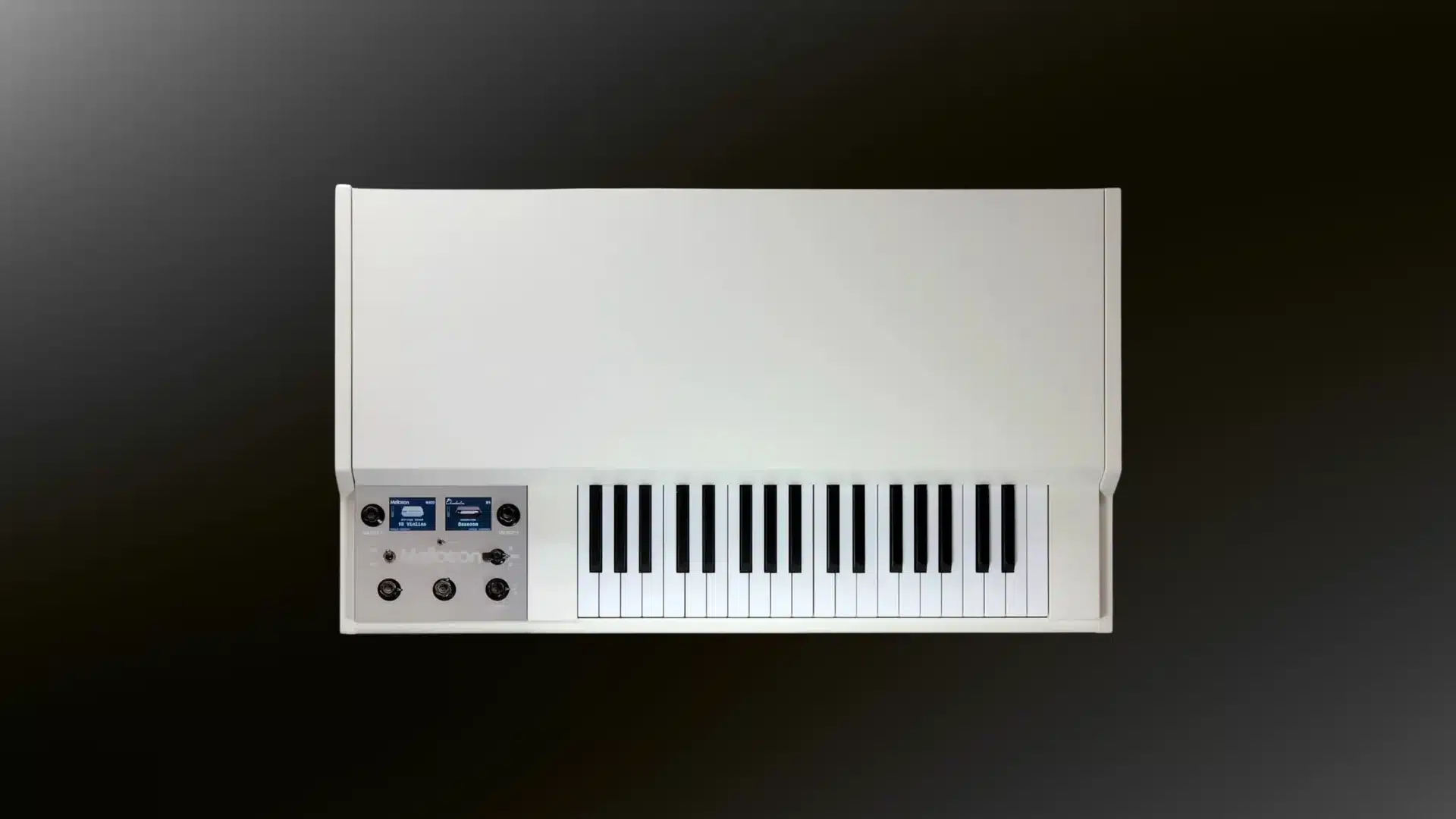
The Mellotron M4000 was the answer to a specific problem. Cycling Mellotrons such as the Mk II were the most desirable and the most difficult to keep alive; Smith told Sound On Sound that the company had never made a profit restoring them. Smith and Bradley designed a new instrument on a modified Novatron frame, with a deeper cabinet for the cycling mechanism, while Norm Leete wrote the microcontroller software that replaced the original sync tape and stepper motor.
Prototypes were shown and reviewed in 2007, orders were taken before production began, and Streetly announced initial deliveries in September 2009, describing it as the first cycling tape replay keyboard manufactured anywhere in nearly 40 years.
A double-manual M5000, with the two keyboards side by side as on the Mark V and 48 sounds, was projected in 2007 at £8,000 plus VAT. The Mellotron M4000 itself was never a volume product. Out of Phase’s tally of around 55 units by late 2021 suggests a handful per year, built to order near Birmingham. Streetly still presents it on its site, but whether it can currently be ordered new is not clearly documented.
Legacy and significance
The Mellotron M4000’s significance lies in what it reopened. When the M400 replaced cycling with removable three-sound frames in 1970, the cycling Mellotron effectively ended, and for decades the only way to own one was to buy and restore an aging Mk II, FX Console or M300. The Mellotron M4000 showed that the mechanism could be rebuilt with modern control electronics, better motors and safer interlocks, and it is the clearest example of the original makers treating the Mellotron as a living instrument rather than a museum piece.
The Mellotron M4000 also clarified a split that runs through the modern Mellotron world. Streetly kept faith with tape, refining the transport; the Kean and Resch operation, covered on this site through its digital models such as the M4000D Mini and the Micro, moved to sample playback. The similar model numbers sit on very different instruments, and Bonedo’s history of the Mellotron advises readers to check which company stands behind any given machine.
Streetly’s tape library, including backup masters of original recordings, feeds both Mellotron M4000 tape sets and replacement frames for vintage machines. Even software developers defer to it: a 2017 Mellotron history on the blog of GForce, maker of the M-Tron Pro plugin, called the Mellotron M4000 “the finest true Melly outside the MkII”, and it remains one of very few ways to hear the classic recordings reproduced by real tape and heads from a new machine.
Artists, users, and curiosities
Streetly’s own customer list for the Mellotron M4000 names Arcade Fire, The Kooks, Sigur Rós, Gary Barlow, Guy Chambers, Paul Bryan (producer and bassist for Aimee Mann) and Brazilian film composer Antonio Pinto, and Sonic State’s 2009 report also listed Paul Weller and John Medeski of Medeski, Martin & Wood. These are manufacturer claims, and the specific recordings are rarely identified. Streetly also points to a Danish television appearance in which Noel Gallagher and Tim Christensen performed with an Mellotron M4000.
The standard sound list doubles as a short history lesson. Alongside the Mk II flute and violins familiar from “Strawberry Fields Forever” and the Moody Blues, it carries the Watcher Mix associated with Genesis, the M300A Violins from a rarer late-1960s model, and the McDonald Flute.
Some of the curiosities are about the physical object. The Filtron air system, which gently pressurizes the cabinet so that stage smoke and dry ice cannot settle on the tapes and heads, was developed from an idea by Henry Dagg. Streetly says the Mellotron M4000’s profile was drawn on the workshop door to check it would pass through a standard doorway. Reid also noted that Streetly’s EMI tape stock was expected to last about another ten years.
Market value
- Current market position: a rare, handbuilt modern tape instrument aimed at purists, studios and collectors rather than a mainstream stage keyboard
- New price signal: launched at about £4,900 to £5,300 depending on the date and VAT treatment (roughly $8,000 in 2009), with flightcase, custom tapes and non-standard finishes extra; Streetly does not publish a current price
- Used market signal: with around 55 built, used M4000s appear too rarely for Reverb or other guides to establish a reliable range; as context, Sotheby’s estimated a restored, celebrity-owned M400 at £5,000 to £7,000 in 2015
- Availability: very limited; most instruments are with original owners, and the realistic routes are Streetly itself, specialist Mellotron dealers and private sales
- Buyer notes: confirm the tape set fitted (standard or custom), check cycling operation across all eight stations, tape condition, head alignment and motor stability, and allow for crating and freight costs for a 74 kg cabinet
- Support ecosystem: unusually strong for a tape instrument, since the maker also restores Mellotrons and supplies parts and tapes, and the frame shares parts with M400s and Novatrons
- Market character: niche and relationship-driven, with values set by private negotiation more than public listings
- Long-term position: likely to hold interest as one of the very few newly built cycling Mellotrons, with value tied to Streetly’s continued support and the supply of tape
Conclusion
The Mellotron M4000 matters less as a commercial product than as proof that the cycling tape Mellotron could be built again, properly, by the people closest to the original. Streetly took the most valued and least reliable layout in the Mellotron family and rebuilt it with a modern motor, a microcontroller, an optical safety interlock and a keyboard that players praised, while keeping the defining limitation: real tape, real heads, eight seconds per note. Fewer than a hundred appear to exist, and the digital alternatives are far easier to own. For those who care where the sound physically comes from, it remains the most complete answer available.
Sources
- Streetly Mellotron M4000 (review by Gordon Reid, October 2007), Sound On Sound
- M4000, Out of Phase
- Links: Mellotron (Streetly Electronics and Mellotron.com), Out of Phase
- M4000 Mellotron (new instruments), Streetly Electronics
- Original Mellotron Makers Ship New Model, Sonic State
- Streetly Electronics Introduces A New Mellotron, Synthtopia
- Die Geschichte der elektronischen Musik #7, Bonedo
- The polyphonic keyboard emblematic of the sixties: History of the Mellotron, Audiofanzine
- Mellotron M400S, Jack Bruce Band (Rock and Pop auction, 2015), Sotheby’s
- Mellotron: The Original Instrument, GForce Software
- Mellotron, Wikipedia