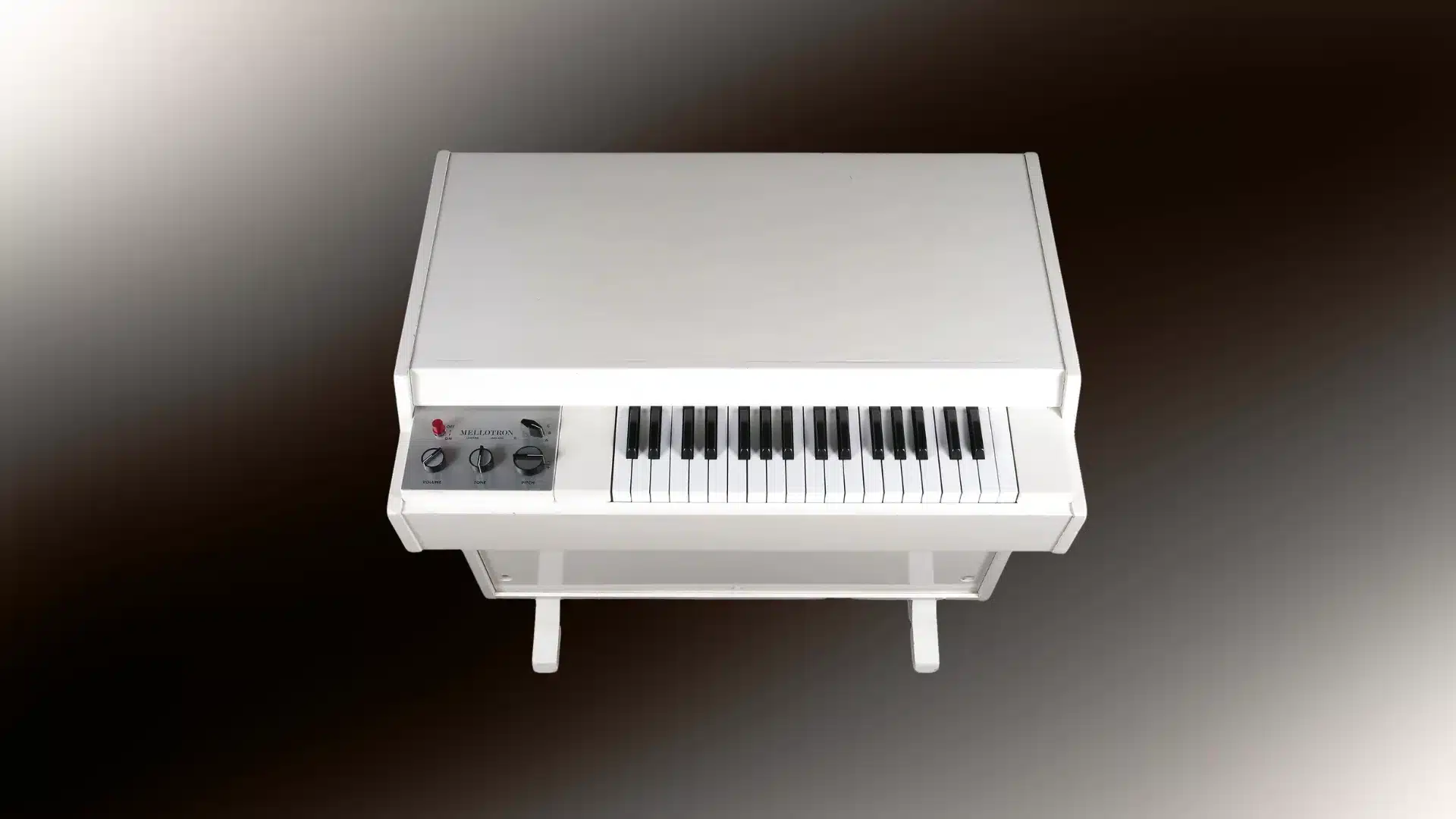
Mellotron M400: The portable tape-replay keyboard that defined the sound of 1970s progressive rock
The Mellotron M400 is a 35-note electro-mechanical keyboard introduced in 1970 by Streetly Electronics, the Birmingham-area firm that manufactured Mellotrons for the London-based Mellotronics company.
The Mellotron M400 is a 35-note electro-mechanical keyboard introduced in 1970 by Streetly Electronics, the Birmingham-area firm that manufactured Mellotrons for the London-based Mellotronics company. It is not a synthesizer in the strict sense: it generates no tone electronically, but plays back strips of pre-recorded tape, one per key, which is why it is often described as an analog ancestor of the sampler.
Smaller and lighter than the two-manual Mk II and the M300 that preceded it, the Mellotron M400 became the bestselling Mellotron by a wide margin and the model most bands carried on tour, which is why its strings, flutes, and choirs are so closely tied to the sound of 1970s progressive rock.
The M400 sounds like recorded acoustic instruments heard through a mechanical playback system, and the second half of that description matters as much as the first. Its string, flute, brass, and choir tapes are real performances, but they reach the listener through a capstan, pinch rollers, pressure pads, and individual playback heads. The result is recognizably orchestral yet unmistakably not an orchestra: slightly veiled, faintly unsteady in pitch, and dense in a way real sections rarely are, since every note of a chord starts at exactly the same moment.
Its most famous voice, the three violins, was not new: it was taken from the Mk II tape bank and re-equalized for the Mellotron M400, while new recordings, including an eight-voice choir, were also made. It excels at sustained block chords, flute lines, and choral swells, and is far less convincing on fast, articulated passages, because each key simply starts its tape from the beginning.
Much of the instrument’s character comes from its mechanical constraints. Each key’s tape lasts roughly eight seconds before it runs out and falls silent, so long chords decay abruptly rather than naturally, and players learned to move between inversions to keep a texture going. A worn return spring can leave a tape short of its starting point, producing the clicky attack many listeners associate with the instrument. Early M400s also used a CMC-10 motor control board that could slow down when six or seven notes were held at once, pulling the pitch flat. These are flaws, but they are also why the Mellotron M400 sounds alive.
Features and architecture
Manufacturer: Streetly Electronics, for Mellotronics
Year introduced: 1970
Production years: about 1970 to 1977 as a Mellotron; continued as the Novatron 400 until Streetly closed in 1986; US-built M400SM units from Sound Sales from 1977
Synthesis type: none in the electronic sense; electro-mechanical tape replay
Category: tape-replay keyboard, often described as an early analog sampler
Polyphony: each of the 35 keys has its own tape and playback head, so chords are limited by hand span rather than voice count; early motor boards struggled with six or seven notes held at once
Original price: £795 in 1976, including one tape frame, with additional frames at £195; launch-year pricing is less clearly documented
Current market price: see Market value
Sound source: 3/8-inch tapes, one per key, each carrying three recorded tracks (A, B, C) selected by sliding the head block sideways
Playback duration: around eight seconds per key before the tape runs out
Tape frames: removable, pre-threaded frames holding 35 tapes; a frame swap takes about two minutes with practice
Sound library: roughly 48 tape sounds offered in the 1970s; custom frames could be ordered
Filter: none as such; a passive tone control shapes the output
LFOs: none
Envelopes: none; the attack and decay are those of the recording itself, plus the abrupt stop at the end of the tape
Controls: volume, tone, pitch, and track selector
Modulation system: none beyond the pitch control and a volume pedal
Sequencer / arpeggiator: none
Effects: none onboard
Memory: none; the tape frame is the memory
Keyboard: 35 notes, G to F, single manual
Inputs / outputs: unbalanced 1/4-inch output on the rear; later units, from around 1973 to 1974, add a balanced XLR output; volume pedal input on the front
Amplification: no internal amplifier or speaker, only a solid-state preamp
MIDI / USB: none
Display: none
Dimensions / weight: approximately 86 × 82 × 57 cm; about 55 kg (around 122 lb)
Power: mains powered, driving a belt-coupled motor and a capstan with flywheel; from 1973 to 1974 the SMS-2 motor control board replaced the unreliable CMC-10
Strengths
It offers real recorded instruments rather than electronic approximations, at a time when synthesizers could not produce a convincing string section or choir.
It was portable by Mellotron standards. Dropping the bank-cycling mechanism, accompaniment sections, and built-in amplification brought the weight down to around 55 kg, still heavy, but manageable enough for touring bands.
Removable tape frames made the library open-ended. Three sounds per frame is limited, but frames could be swapped, custom tapes ordered, and personal recordings transferred.
Its imperfections are musically useful. The abrupt tape stops, slight pitch instability, and mechanical attack give it a recognizable signature.
It is serviceable. Original instruments can still be restored with new tapes, frames, pinch rollers, and motor boards.
Limitations
The eight-second tape limit shapes everything. Long sustained notes are impossible, and players have to plan voicings and inversions around the moment each tape runs out.
Only three sounds are available per frame. Changing to a different set means lifting the keyboard and swapping the frame, which is practical between songs only with preparation.
It is still heavy. Around 55 kg is light for a Mellotron, but a 1995 retrospective noted that moving it was still not a one-person job.
Pitch stability depends on the motor system, and early CMC-10 units drag the pitch when several notes are held.
Maintenance is unavoidable. Pressure pads, pinch rollers, return springs, and tape alignment all need adjustment, and tape frames must be kept to fine tolerances or they go out of true.
The cabinet height is awkward. Sound On Sound noted that the iconic shape is too low to play comfortably standing yet uncomfortable to play seated.
Historical context
By 1970 the Mellotron already had a recording history. The two-manual Mk II of 1964, with its bank-cycling tape mechanism, had been heard on landmark records of the late 1960s, and the 52-key M300 followed in 1968. But these instruments were large, heavy, and complex, poorly suited to life on the road.
The Mellotron M400 answered a specific problem: musicians wanted the Mellotron’s orchestral sounds on stage. The new design stripped away bank cycling, accompaniment features, and internal amplification, leaving a single 35-note keyboard, a removable tape frame, and four controls. That simplification turned the Mellotron from a piece of studio furniture into something a progressive rock band could reasonably put on a truck.
The business around the instrument was turbulent. Streetly Electronics built the machines, while Mellotronics in London owned the brand. When Mellotronics collapsed in the late 1970s, the Mellotron name passed to the American company Mellotron Sound Sales, which went on to build its own M400SM. Streetly, financially sound but now without the trademark, kept manufacturing the same design as the Novatron 400 until it closed in 1986. The M400 outlived its own name.
Legacy and significance
The Mellotron M400 matters because it was the Mellotron most people actually heard: the earlier models created the sound, but the Mellotron M400 distributed it. With roughly 1,800 to 2,000 units built depending on whether Novatrons and licensed EMI units are counted, it was produced in far greater numbers than any other Mellotron, and it was the version present on stages throughout the 1970s.
It also clarifies a distinction easy to blur in synthesizer history: unlike the Moog or ARP instruments of the same years, the Mellotron M400 did not synthesize sound, it replayed it. In that sense it anticipated the sampler more than it resembled the synthesizer, and its limitations, short playback, fixed recordings, small sound sets, are exactly the problems that digital sampling later set out to solve.
Finally, the M400 shows how mechanical constraints can harden into an aesthetic. Musicians did not choose it for accuracy but because nothing else sounded like it, and its specific way of failing, the stop at eight seconds, the wavering pitch, the cluster of identical attacks, became a sonic vocabulary of its own.
Artists, users, and curiosities
Genesis and King Crimson are the bands most often linked to the Mellotron M400, and both connections are documented. Tony Banks moved from a Mk II to an Mellotron M400 for Selling England by the Pound in 1973, and Genesis continued to use the instrument from that point. Yet the Genesis Mellotron moment most fans remember, the introduction to “Watcher of the Skies,” was played on the earlier Mk II.
King Crimson used M400s as well: a history of the band’s Mellotrons identifies one of the earliest M400s on Islands and the 1971 to 1972 US tours, and a later ebony-finished Mellotron M400 that toured from late 1973 into 1974 and is associated with “Starless.”
Rick Wakeman is another central figure: a double Mellotron built for him in 1973 from two M400s was used with Yes in the mid-1970s. A 1995 retrospective’s list of notable Mellotron M400 players also includes Chris Franke of Tangerine Dream, Patrick Moraz, and Orchestral Manoeuvres in the Dark, whose “Maid of Orleans” is credited as an M400 recording; OMD’s Andy McCluskey is documented as having bought a second-hand Mellotron M400.
The Mellotron M400’s removable frames produced some of its best stories. Paul McCartney had a left-handed Mellotron M400 built. Jack Bruce had voice tapes recorded for Mellotron M400 frames, and his own M400S, still in a flight case stenciled with the Jack Bruce Band name and accompanied by three cases of extra tape reels, came up at Sotheby’s in 2015. Other rarities include a transparent Plexiglass M400 built in 1972, around 100 teak-finished units assembled by EMI from Streetly kits, and the 400FX, a broadcast variant with a monitor control in place of the tone knob and a large set of sound-effects frames.
Mellotron M400 market value
Current market position: a discontinued, historically central vintage instrument, valued both as a working tool and as a collectible
New price signal: no original-spec M400 in regular catalog production; Streetly Electronics says it can build classic M400-style instruments to order, and Mellotron.com sells the Mk VI, a modified M400-derived design in production since 1999, from about $6,800
Used market signal: Sound On Sound put used M400s at around £3,000 in 2007; a Jack Bruce-owned M400S carried a Sotheby’s estimate of £5,000 to £7,000 in 2015; a restored unit was listed on Reverb at about $15,675 in 2026, a single listing rather than a market average
Availability: hard to find; listings are infrequent and condition varies widely
Buyer notes: check which motor control board is fitted (CMC-10 units are prone to pitch drag), the condition of tapes, pinch rollers, pressure pads, and return springs, whether the tape frame runs true, and how many frames and sounds are included
Support ecosystem: unusually strong for a 1970 instrument; Streetly Electronics services and restores Mellotrons, and Mellotron.com sells new Mellotron M400 tape sets, frames, pinch rollers, capstans, and motor control boards
Market character: collectible and rising, with provenance from known artists adding a significant premium
Long-term position: secure as one of the defining keyboard instruments of the 1970s, supported by an active restoration infrastructure
Conclusion
The Mellotron M400 is best understood not as a failed attempt at realism but as a successful act of translation. It took recorded orchestral sound and made it playable, portable, and repeatable on stage, at the cost of eight-second notes, three sounds per frame, and constant mechanical care. Later Mellotrons, from Streetly’s M4000, which reuses the Mellotron M400’s control panel and accepts its frames, to compact digital models like the M4000D Mini and Micro, build directly on the sound the M400 made indispensable. It remains the reference point: the instrument that turned the Mellotron from a curiosity into a language.
His connection with music began at age 6, in the 1980s, when his father introduced him to Jean-Michel Jarre's Rendez-Vous on vinyl. He works professionally in the legal field, while synthesizers became his space for abstraction and creative exploration. Founder of The Synth Source.