

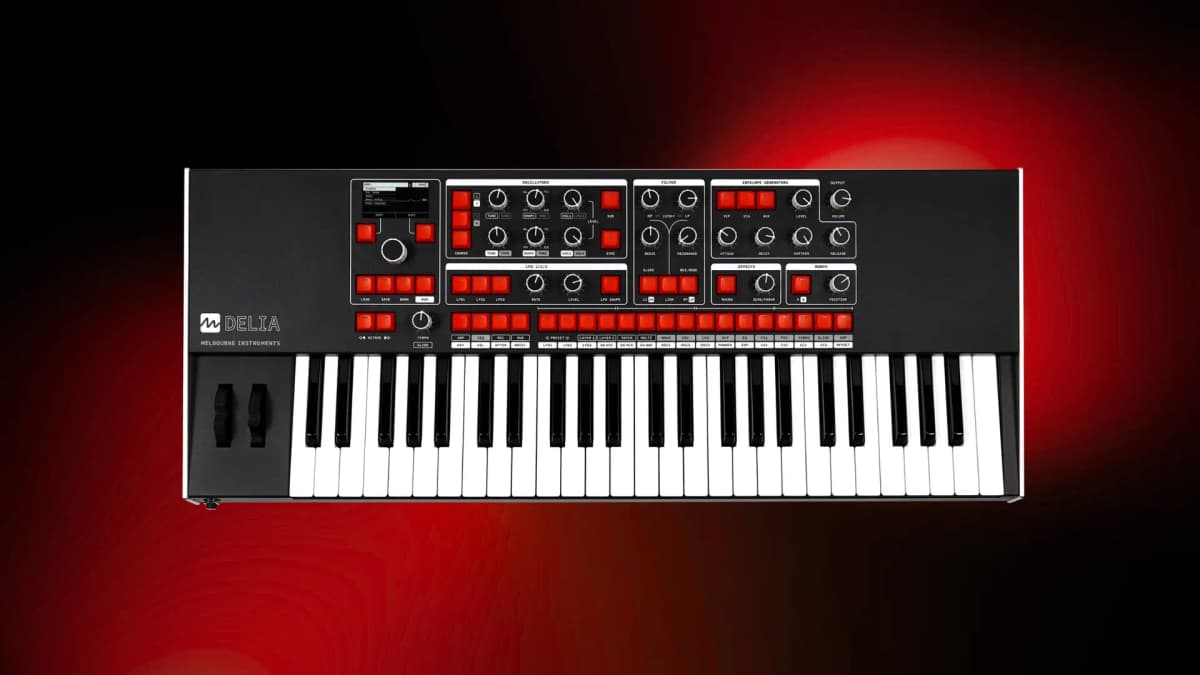
The Melbourne Instruments Delia is a bi-timbral hybrid keyboard polysynth introduced at Superbooth 2024 and released worldwide later that year. It combines a digital oscillator front end with six analog filter and VCA circuits, a 49-key aftertouch keyboard, motorized knobs, patch morphing, and a 12 Note Mode that expands the available oscillator banks beyond its six physical analog voice paths. Its importance is not simply that it mixes analog and digital methods. Many instruments do that. Melbourne Instruments Delia matters because it tries to make a deeply programmable modern synthesizer physically explain itself while you play it.
Table of Contents
Melbourne Instruments Delia sound and character
Delia is not a vintage clone disguised as a modern instrument. Its sound begins with digitally modelled VCOs, wavetable synthesis, noise and auxiliary sources, then reaches an analog low-pass ladder filter, analog drive stage, and stereo VCA section. That division of labour gives it a particular identity: relatively stable and precise at the oscillator level, but capable of becoming thick, compressed, rough-edged, and unstable once the analog filtering and drive are pushed.
The low-pass ladder filter is the centre of its personality. At restrained settings, Melbourne Instruments Delia can produce focused pads, rounded basses, controlled brassy patches, and polished electronic textures. With its drive engaged and resonance increased, it can become more forceful and congested, especially in bass and lead territory. It does not chase the loose imperfections of a vintage VCO polysynth. Instead, it lets the player introduce movement and imperfection through modulation, vintage variation, filtering, morphing, and saturation.
Its filter structure is especially useful because the analog low-pass stage is paired with a digital high-pass ladder model. The two filters can operate independently or be linked, allowing the player to create band-pass and notch-like behaviour. Musically, that makes Melbourne Instruments Delia more flexible than a conventional low-pass polysynth. It can move from warm foundational pads to focused, vocal-like sweeps, nasal leads, thin rhythmic plucks, or aggressive filtered sequences without relying on external processing.
The A/B Morph system is equally central to its sound. Melbourne Instruments Delia does not simply fade between two patches. It interpolates parameters between A and B states, including modulation settings. That makes morphing useful not only for performance transitions but also for finding intermediate timbres that would be difficult to program directly. A pad can move toward a metallic wavetable texture, a bass can become a distorted lead, or a restrained chord sound can acquire rhythmic modulation under aftertouch or LFO control.
Firmware 2.0 made the sound palette wider still. Its Macro Oscillator Mode added 45 waveform models based on the open-source Mutable Instruments Braids code, bringing additive, formant, FM, granular, physical-model-inspired, and other digital synthesis approaches into the Delia architecture. That update made the Melbourne Instruments Delia less tied to the usual virtual-analog versus wavetable distinction and more capable of moving between familiar synth roles and stranger, more deliberately synthetic textures.
Features and architecture
- Manufacturer: Melbourne Instruments.
- Year introduced: 2024, first shown at Superbooth 2024 and released worldwide in July 2024.
- Production status: 2024 to present. The Melbourne Instruments Delia remains listed by Melbourne Instruments and receives official firmware and preset support.
- Synthesis type: Hybrid digital and analog synthesis. Oscillators, wavetable generation, and high-pass filtering are digital; the low-pass filter, drive stage, and stereo VCA section are analog.
- Category: Bi-timbral keyboard polysynth with motorized parameter recall and patch morphing.
- Polyphony: Six physical analog filter and VCA circuits. Its 12 Note Mode provides twelve oscillator banks that share six analog filter paths.
- Launch price: US$2,399 at the July 2024 worldwide release.
- Current new-price signal: US$2,169 at Perfect Circuit during June 2026 research, discounted from a listed US$2,699 regular price.
- Oscillators: Four sound sources per voice: two virtual-analog modelled VCOs, one wavetable oscillator, and one Noise/XOR/Aux oscillator. Firmware 2.0 also adds Macro Oscillator Mode with 45 waveform models.
- Filter and drive: Analog low-pass transistor ladder filter with selectable 12dB and 24dB slopes, analog three-stage overdrive, digitally modelled high-pass ladder filter, separate high-pass and low-pass resonance controls, and a linked high-pass/low-pass mode for band-pass and notch-style operation.
- LFOs: Three LFOs with sine, triangle, square, rising ramp, falling ramp, and random shapes.
- Envelopes: Three ADSR envelopes assigned to VCA, VCF, and auxiliary duties.
- Modulation system: Twenty modulation sources, forty destinations, unlimited routing slots, bipolar modulation amounts, morphable modulation settings, and Morph itself available as a modulation destination.
- Sequencer and arpeggiator: Sixteen-step programmable polyphonic sequencer, Phrase Looper with overdubbing, and an arpeggiator with up, down, up-down, random, and played-order modes.
- Effects: Two digital effects processors configurable in parallel or series, with chorus, delay, and reverb algorithms.
- Memory: Up to 16,129 presets arranged in 127 banks of 127 presets, plus support for up to 127 wavetables and USB import/export.
- Keyboard: Forty-nine full-size semi-weighted keys with velocity sensitivity and channel aftertouch.
- Inputs and outputs: Two assignable line outputs, stereo main outputs, headphone output, and two assignable line or CV inputs.
- MIDI and USB: MIDI In, Out, and Thru; USB-C device connection; two USB-A host ports; class-compliant USB MIDI.
- Display: 2.95-inch LED-backlit LCD with 854 × 480 resolution.
- Dimensions and weight: Melbourne Instruments currently lists 810 × 320 × 140 mm and 8.7 kg. Its older v1.0.4 manual lists different physical figures, so buyers should confirm current shipping specifications with the dealer.
- Power: 12V, 8A AC/DC adapter supplied; 30W nominal consumption and 60W peak consumption.
Strengths
- Motorized recall solves a real hardware problem. The controls move to show stored parameter values when patches, layers, modulation sources, and morph positions change. This reduces the usual disconnect between a hardware panel and the actual state of a digital preset.
- Morphing is musically deeper than a performance gimmick. Because A/B Morph can interpolate the modulation matrix as well as ordinary patch parameters, it can function as a compositional tool, a sound-design tool, and a live-control system.
- The hybrid architecture has a clear sonic logic. Digital oscillators provide stable tuning, wavetable flexibility, and expanded synthesis modes, while the analog low-pass filter and drive stage supply the more tactile, nonlinear part of the voice.
- The multi-mode filter design is unusually broad for this category. Independent high-pass and low-pass control gives Delia more tonal sculpting range than a standard low-pass-only analog polysynth.
- The Melbourne Instruments Delia is strong for layered performance setups. Two layers can be assigned different MIDI channels, note ranges, output routes, and voice allocations, which makes splits and layered arrangements practical without immediately requiring another keyboard.
- Its Phrase Looper changes the role of the Melbourne Instruments Delia. The ability to record, overdub, save, and recall phrases turns Delia into something closer to a self-contained composition and performance device than a conventional preset keyboard.
- Firmware 2.0 materially expanded the architecture. Macro Oscillator Mode brought a more experimental vocabulary to the Melbourne Instruments Delia, including formant, FM, additive, granular, and physical-model-inspired structures.
Limitations
- Melbourne Instruments Delia should be understood as a six-analog-circuit instrument. Its 12 Note Mode is clever and useful, but it does not provide twelve fully independent analog filter and VCA voices. Twelve oscillator banks share six analog filter paths.
- 12 Note Mode involves trade-offs. The manual notes that enabling it slightly lowers output level and that the drive setting can noticeably alter the resulting timbre. It is a practical voice-management solution, not a free doubling of analog polyphony.
- The two timbral layers share one effects chain. This limits independent effect processing when using complex splits or layered setups. Producers who need radically different ambience or delay treatment for each layer may prefer external effects or separate outputs.
- The keyboard offers channel aftertouch rather than polyphonic aftertouch. It is expressive enough for filter sweeps, morph control, and performance modulation, but it does not provide per-note pressure expression from the internal keybed.
- The workflow is intelligent but not immediately transparent to everyone. The motorized knobs gain their power because their roles can change between normal editing, modulation, layers, and morphing. Players who want a completely fixed knob-per-function layout may need time to adapt.
- Firmware version matters more than usual. Version 2.0 adds Macro Oscillator Mode and includes motorized-knob reliability improvements. A used buyer should treat firmware status as part of the Melbourne Instruments Delia’s condition check.
- Documentation has not remained perfectly synchronized. The older manual and current product page differ on physical dimensions and weight, which is a minor issue musically but relevant for road cases, shipping, and installation planning.
Historical context
Delia arrived two years after Melbourne Instruments introduced NINA at NAMM 2022. NINA attracted attention because of its motorized control surface, which challenged a long-running compromise in synthesizer design. Traditional knob-per-function instruments are immediate but often poor at patch recall. Digital instruments preserve complex patches but can obscure the real state of the sound behind screens, menus, and soft controls.
Melbourne Instruments Delia was Melbourne Instruments’ first keyboard synthesizer, but it was not simply NINA with keys. It changed the voice architecture, adopted a digital oscillator front end, introduced a new multimode filter structure, added Phrase Looper functionality, and shifted the emphasis toward bi-timbral performance. The result is not a smaller flagship or a simplified derivative. It is a different answer to the question of what a modern polysynth should prioritise.
Its timing also mattered. By 2024, the Melbourne Instruments Delia market was already crowded with analog recreations, hybrid digital-analog instruments, and increasingly powerful software-inspired hardware. Delia did not compete by offering another famous vintage circuit or another nostalgic visual identity. Its distinctive contribution was an interface argument: deep synthesis does not have to mean an invisible state hidden behind menus.