

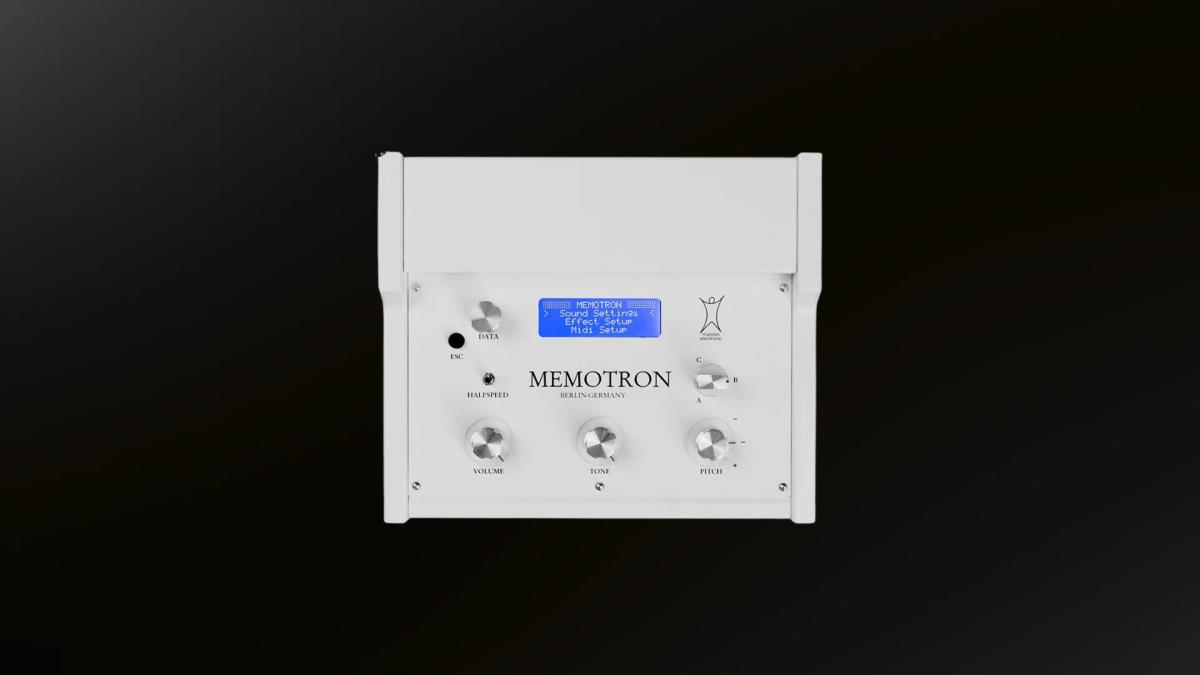
The Manikin Memotron is a digital Mellotron made by Manikin Electronic, a small Berlin company previously known for its Schrittmacher step sequencer. First shown at the NAMM show in January 2006 and launched in 2007, the original Manikin Memotron copied the look and front panel of the white Mellotron M400 but replaced its tape frames with samples of the original tapes, loaded from CD-ROM or Compact Flash into three sound slots that could be blended with a selector knob. It was fully polyphonic, weighed about 12kg and needed none of the tape maintenance of the real thing. Manikin describes it as the world’s first digital Mellotron, and it stayed in production until the m2k and m2d replaced it in 2016.
Table of Contents
Manikin Memotron sound and character
The Manikin Memotron sounds like a clean, well-recorded Mellotron. Its library came from Klaus Hoffmann, who supplied Manikin with roughly 28 hours of recordings of original tape sets, each capturing the full duration of all 35 notes. Gordon Reid, reviewing it for Sound On Sound in September 2009, reported that the samples were down-sampled to 32kHz, giving a bandwidth of about 14kHz, a choice that sounds limiting on paper but matches the useful range of the original tapes, above which there was mostly hiss. Processing was deliberately light: some denoising, removal of clicks and pops, and tuning correction.
What it reproduces best are the familiar Mellotron colors: strings, flutes, choirs and brass, with the slightly wavering pitch and soft attack that come from the original playback. A passive-style 12dB/octave low-pass tone control darkens the sound as on the M400, and the half-speed switch drops pitch by an octave while narrowing the bandwidth further, a trick that produces the grainy, slowed-down textures associated with tape. The eight-second limit is preserved: hold a note longer and it stops, as on a real machine, while releasing before eight seconds allows a programmable synth-style release.
It does not imitate everything. Reid noted the absence of the original’s slight pressure sensitivity, which players used for vibrato, as well as the pitch droop when many notes are held and the glitching that comes with fast playing. He considered those omissions acceptable for stage and studio use. The Manikin Memotron therefore sits between the vintage instrument and a sample patch in a workstation: it has the Mellotron’s limits and sound, but it is quieter, steadier and more consistent than most surviving machines.
Features and architecture
- Manufacturer: Manikin Electronic, Berlin, Germany
- Year introduced: first shown at NAMM in January 2006; launched in 2007 according to Manikin and Vintage Synth Explorer
- Production years: 2007 to 2016, when the Manikin Memotron m2k keyboard and m2d desktop module replaced it
- Synthesis type: sample playback of digitized Mellotron and related tape sets
- Category: digital tape-replay keyboard (Mellotron emulation)
- Polyphony: fully polyphonic; KMR Audio’s listing gives up to 105 notes across three stacked sounds
- Multitimbrality: monotimbral over MIDI; three internal sound slots (A, B and C) play as one setup
- Original price: €1,990 including VAT in Germany at the time of Sound On Sound’s 2009 review
- Current market price: discontinued; secondhand prices are sparsely documented, and the current m2k sells for about £1,369 at Thomann UK, €1,589 at Schneidersladen and $1,699 at Kraft Music
- Oscillators: none in the Manikin Memotron sense; sample playback of up to three sounds at once, with each sample limited to about eight seconds like the original tapes
- Sample memory: sounds loaded into three slots from CD-ROM through a front-panel slot or from Compact Flash; about 15 seconds to load each slot
- Filter: tone control acting as a 12dB/octave low-pass filter
- LFOs: none
- Envelopes: per-slot attack and release, with release effective only before the eight-second sample end
- Modulation system: none beyond the selector knob blending A, B and C, plus pitch control and the half-speed switch
- Sequencer / arpeggiator: none
- Effects: one effects unit with 15 algorithms, including reverb, delay, chorus, flanger and rotary speaker; only the algorithm and send level are adjustable
- Memory: per-slot volume, attack, release and pan; operating system 1.3 added Frames to save complete setups
- Keyboard: short M400-style keyboard without velocity-controlled timbre or aftertouch; published key counts for the Manikin Memotron family vary between 35 and 37, and the samples cover the original 35-note range
- Inputs / outputs: stereo outputs, headphone output, swell (volume) pedal input
- MIDI / USB: MIDI In, Out and Thru; no USB
- Display: small LCD with a rear-panel contrast knob, data knob and Escape button
- Dimensions / weight: about 12kg; cabinet modeled on the white Mellotron M400 with a deep lacquer finish; a small run in black was sold through Schneidersladen
- Power: mains powered; Manikin’s later models use an internal 90 to 240V supply
Strengths
- It delivers the Mellotron sound without the tape mechanism. Samples replace the frames, motors and pressure pads, so there is no tape stretch, no capstan wear and none of the regular servicing an original needs.
- It is portable in a way a Mellotron never was. At about 12kg, one person can carry it easily, and Sound On Sound described it as far lighter and more practical than an original Mellotron.
- Three sound slots and a blend knob extend the original concept. Any two or three tape sets can be mixed or crossfaded, which a single-frame M400 cannot do.
- The library is carefully sourced. Klaus Hoffmann’s recordings preserve the full eight-second notes, and Manikin sold additional Vintage, Studio and Berlin School collections on disc.
- The panel keeps the M400’s controls and logic, including volume, tone, pitch and half-speed, so players familiar with a Mellotron can use it immediately.
- Sound On Sound’s reviewer praised the keyboard feel as having the right degree of weight and a slight thunk at the bottom of the key travel.
Limitations
- It is monotimbral over MIDI. The three slots play as one setup, so it cannot act as a multitimbral expander in a sequenced rig.
- Loading is slow by current standards. Each slot takes about 15 seconds from disc, which makes quick changes between songs awkward until Frames arrived with a software update.
- The effects are basic, with only an algorithm choice and a send level, and Reid suggested ignoring them unless ambience was needed on stage.
- It lacks the original’s pressure-sensitive vibrato, so one of the expressive techniques of Mellotron playing is missing.
- Storage media have aged badly. CD-ROM and Compact Flash are inconvenient today, and the later m2d’s switch to SD cards and internal memory makes the original look dated.
- The keyboard range is as short as the original’s, which suits the concept but limits it as a general controller.
- It was expensive for a single-purpose instrument, a point Sound On Sound raised alongside its monotimbral design.
Historical context
By the mid-2000s, Mellotron sounds were back in demand, helped by bands such as Radiohead, but original machines were heavy, costly and difficult to keep in working order. new tape-based Mellotrons were being built again, with Sound On Sound pricing the M4000 at more than £5,000, while software such as G-Force’s M-Tron and M-Tron Pro provided samples on a computer. Manikin Electronic, founded in Berlin and known since 2003 for the Schrittmacher sequencer, aimed between the two: a dedicated hardware instrument that looked and played like a Mellotron but used digital memory.
The Manikin Memotron made its first public appearance at NAMM in January 2006 and went on sale in 2007. It was modeled on the white Mellotron M400, with a lacquered cabinet, the M400’s control layout and a library assembled from Klaus Hoffmann’s tape recordings. Manikin developed it through software updates, including version 1.3, which introduced Frames for storing complete setups, and expanded the library with optional collections, including a Berlin School set with Tangerine Dream sounds. A 1U Memotron Rack followed in 2010 with six tracks instead of three and Compact Flash loading in place of the CD drive.
The original keyboard’s main weaknesses, slow loading, aging media and basic effects, set the agenda for its replacement. In 2016 Manikin introduced the Manikin Memotron m2k keyboard and the m2d desktop module, with internal memory for around 700 sounds, SD card import, more capable effects and near-instant loading. The m2k, covered separately on this site, took over the keyboard role, and the original Manikin Memotron went out of production.