

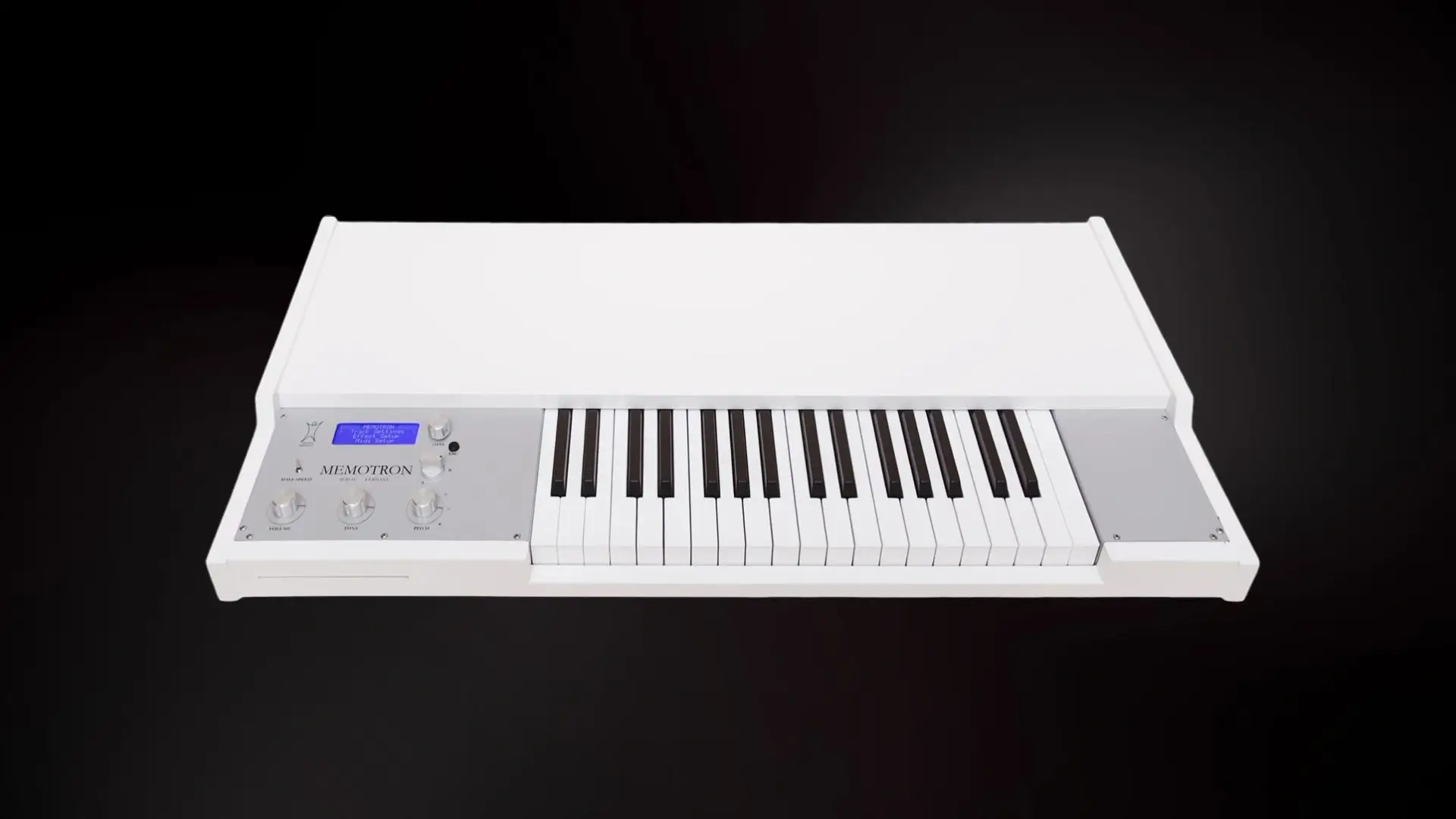
The Manikin Electronic Memotron m2k is a digital tape-replay keyboard introduced in 2016 as part of the second-generation Memotron family, following Manikin’s original 2007 Memotron. It is not a conventional synthesizer in the subtractive sense. It is a dedicated digital recreation of the Mellotron idea: a compact, stage-ready instrument built around sampled sounds from original 1960s and 1970s tape-based instruments, with the visual language and control logic of the classic Mellotron M400 translated into a modern hardware format.
Table of Contents
Manikin Electronic Memotron m2k sound and character
The Manikin Electronic Memotron m2k is built around a specific kind of imperfection. Its appeal does not come from oscillator drift, analog filter saturation, or modular-style modulation. It comes from the recorded instability of tape-replay instruments: softened attacks, narrow-band orchestral color, choir tones with a haunted human edge, pitch irregularities, level inconsistencies, and the peculiar emotional compression that happens when real instruments are captured through the technology of another era.
In practice, the Manikin Electronic Memotron m2k is strongest when used for sounds that benefit from historical coloration rather than realism. Strings, choirs, flutes, brass, woodwinds, accordions, vibraphone-like tones, and hybrid orchestral textures are its natural territory. It does not try to replace a modern orchestral library. That would miss the point. The Manikin Electronic Memotron m2k is closer to an instrument of memory: it gives the player access to the mediated sound of recordings, tapes, and progressive-rock studio language.
Its character comes partly from the source material and partly from the way the instrument preserves the working concept of the Mellotron. Up to three sounds can be loaded and used together, echoing the old tape-frame idea in which different sounds lived side by side. The half-speed control is especially important because it turns familiar tape-replay timbres into darker, slower, more spectral material. That makes the Manikin Electronic Memotron m2k useful not only for Beatles, Genesis, Moody Blues, Pink Floyd, Klaus Schulze, or Tangerine Dream references, but also for cinematic ambient, experimental pop, darkwave, and any production that needs historical distance rather than polished realism.
The onboard effects are not the main reason to buy the instrument, but they help place its tones into a more complete musical space. Distortion, phaser, flanger, chorus, tremolo, echo, and delay can push the Manikin Electronic Memotron m2k away from museum-piece behavior and toward arrangement-ready texture. Used carefully, the effects reinforce the illusion that the sound is coming from a physical, aging playback system rather than a neutral sample engine.
Features and architecture
- Manufacturer: Manikin Electronic.
- Model: Manikin Electronic Memotron m2k.
- Year introduced: 2016.
- Production years: 2016 to present as an active catalog product.
- Synthesis type: Digital sample playback / digital tape-replay emulation.
- Category: Dedicated digital Mellotron-style keyboard.
- Polyphony: Listed as fully polyphonic with 111 voices.
- Sound structure: Up to three sounds can be loaded and used at the same time.
- Original price: Not included here because a reliable launch price could not be confidently verified.
- Current new price signal: Around the mid-€1,000 range in European listings, with US-oriented listings generally appearing around the upper standard/professional keyboard range.
- Current used market signal: Sparse compared with mass-market synthesizers; listings appear less frequently than for mainstream polysynths.
- Oscillators: No conventional oscillators; the instrument uses digital playback of sampled tape-replay sounds.
- Filter: No traditional synthesizer VCF is specified; the front panel includes a tone control.
- LFOs: No dedicated LFO architecture is documented in the verified sources used here.
- Envelopes: Attack and release settings can be saved as part of user frames.
- Modulation and performance controls: Volume, tone, pitch, frame selection, half-speed, volume-pedal input, and effects parameters.
- Sequencer / arpeggiator: No onboard sequencer or arpeggiator is specified.
- Effects: Adjustable internal effects processor with effects including distortion, phaser, flanger, chorus, tremolo, echo, and delay.
- Memory: Internal memory for approximately 700 sounds.
- Factory sounds: 100 included sounds, including the Studio and Vintage 1 collections, selected sounds from other collections, and additional new sounds.
- Expansion: SD card slot for importing sounds and saving settings.
- Keyboard: 37-key Fatar keyboard, lightly weighted.
- Inputs / outputs: Stereo line outputs, headphone output, and volume-pedal input.
- MIDI / USB: MIDI In, Out, and Thru are specified; USB is not listed as a supported connection in the verified retailer data.
- Display: LC display with Data / ESC menu navigation.
- Dimensions / weight: 870 mm wide, 80 mm high, 335 mm deep; approximately 10 kg.
- Power: Internal power supply rated for 90–240V AC, 50–60Hz; manual-derived listings specify a maximum power consumption of 7W.
Strengths
- It captures a historically specific sound world rather than offering generic sample playback. The Manikin Electronic Memotron m2k matters because it focuses on the tape-replay vocabulary that shaped progressive rock, psychedelic pop, Berlin-school electronic music, and later alternative revivals.
- The three-sound structure gives it more than one-dimensional nostalgia. Layering or switching between sounds lets the player move beyond single famous presets and into combinations that feel closer to the physical tape-frame concept.
- Its immediacy makes it more playable than a purely software-based Mellotron library. The dedicated controls, 37-key format, half-speed switch, and frame workflow turn the instrument into a performance object rather than a menu buried inside a DAW.
- The internal memory and SD expansion make it more practical than the original tape model. The old Mellotron’s romance came with mechanical fragility, weight, maintenance, and limited tape frames. The Manikin Electronic Memotron m2k keeps the sonic idea while removing the most punishing logistical problems.
- It is compact but not toy-like. At roughly 10 kg, with a metal housing and full-size 37-key Fatar keyboard, it sits in a useful middle zone: substantial enough for stage use, but far easier to handle than a vintage tape machine.
- The preserved tape artifacts are musically valuable. Wow, flutter, level variation, and unstable pitch are not defects in this context. They are part of the emotional grammar of the instrument.
Limitations
- It is not a general-purpose synthesizer. There are no conventional oscillators, resonant filter architecture, deep modulation matrix, or subtractive synthesis engine. Buyers expecting a flexible polysynth will misunderstand the instrument.
- The keyboard range is intentionally limited. The 37-key format suits Mellotron-style playing, but it will feel restrictive for players who want broad splits, pianistic range, or large two-hand arrangements.
- Its realism is not the point, which can be a limitation in modern production. If the goal is convincing orchestral emulation, modern sample libraries will go much further. The Manikin Electronic Memotron m2k is valuable because it sounds mediated, aged, and stylized.
- The interface is specialized. The dedicated controls are useful, but deeper work still depends on display and encoder navigation rather than a broad one-knob-per-function synthesizer panel.
- It has a narrower market than mainstream synths. Its value is obvious to players who want Mellotron character, but less obvious to those looking for a first hardware instrument or a broad studio workhorse.
- The used market appears thin. That can help value stability, but it also means fewer comparison points and less opportunity to buy cheaply.
Historical context
The Manikin Electronic Memotron m2k belongs to a lineage that starts before digital sampling became ordinary. The Mellotron M400, launched in 1970, used strips of magnetic tape to play back recorded instruments under each key. It became the best-known Mellotron model, with a 35-note keyboard, three sounds per tape frame, and a reputation that crossed progressive rock, psychedelic pop, art rock, and electronic music.
The original Mellotron was powerful because it gave bands access to orchestral and choral colors without hiring an ensemble. But its sound was never simply “orchestra.” It was orchestra filtered through tape, mechanics, limited bandwidth, tuning instability, and the theatrical imagination of rock musicians. That is why its flute, strings, and choir sounds became cultural signs in themselves.
Manikin Electronic entered this history from a different angle. The company introduced the first Memotron in 2007 and later updated the line in 2016 with the more powerful Manikin Electronic Memotron m2k keyboard and m2d desktop versions. That timing matters. By the mid-2010s, musicians already had many software Mellotron options, but hardware instruments were again becoming culturally important. The Manikin Electronic Memotron m2k responded to a specific need: not just access to samples, but access to the physical ritual of playing a dedicated Mellotron-style machine.