What synth does Lady Gaga use? Her keytars, pianos and the producers’ synths
Lady Gaga has no single signature synth. Here is what is documented: her custom Roland keytars, her stage pianos, her synth credits and how to get her sounds.
What synth does Lady Gaga use? She has no single signature synthesizer. What is documented is that she is a pianist first, that she has played customised Roland keytars on stage (a modified AX-Synth on The Fame Ball Tour and a Roland AX-7 dressed up by designer Gary Card in 2010), and that the synth sounds on her records come from her and her producers, with album credits listing her on synthesizers, keyboards and piano but rarely naming specific models. If you want her sound, think in terms of classes of synths (bright virtual analog for The Fame, 1990s house keyboards for Chromatica, analog-style polysynths and basses for Mayhem) rather than one magic instrument.
Below we separate what is confirmed by credible sources from what is merely repeated online, and then explain how to get close to the sound of each era.
What synth does Lady Gaga use? She is a pianist first
Gaga began piano lessons at the age of four and, by her own account, learned largely by ear. Her listed instruments are voice, piano and keyboards, and she has said that good music should still sound like a hit when played on a piano. That idea runs through her live shows: almost every tour has a piano segment, and many of her TV performances are built around a piano rather than a synth.
The Monster Ball Tour (2009–2011): she played “Speechless” on piano, and in the revamped staging a piano was wheeled out for “Brown Eyes” and “Speechless” and shot flames during the song.
Super Bowl LI (2017): she sat at a piano for “Million Reasons”, the same song she had performed at the piano on Saturday Night Live in 2016.
The Chromatica Ball (2022): a smaller second stage held her piano, decorated with branches and compared by critics to H. R. Giger’s designs; she played “The Edge of Glory” there in the slow arrangement she says she originally intended, plus “Shallow” and “Always Remember Us This Way”.
The Mayhem Ball (from 2025): she performed “Die with a Smile” at the piano and added one or two surprise songs on piano at most shows, drawing on every era from The Fame to Mayhem.
Which pianos? Roland’s own artist feature on the Monster Ball Tour says she often played a white Roland RG-7 digital grand on TV appearances, including a rain-soaked Today Show set. Equipboard lists a white Roland digital piano for the same era under a different model name, and a Yamaha C3X silent grand for her first live performance of “Gypsy” in Berlin in 2013. Treat the Equipboard entries as plausible but secondary; the Roland article is the stronger source for the RG-7.
The keytars: the closest thing to a “Gaga synth”
If any synth is visually linked to Gaga, it is the keytar. The documented trail looks like this:
The Fame Ball Tour (2009): photos from the tour show a keytar based on a modified Roland AX-Synth.
The Monster Ball Tour: Roland describes her playing the AX-Synth “guitar-style” in one of the show’s big numbers. Synthtopia reported in September 2010 that her keytar had been customised by designer Gary Card and appeared to be a Roland AX-7 underneath. In the reworked 2010–2011 show she played a keytar she called “Emma”, including an extended solo in “Money Honey”.
Born This Way Ball (2012–2013): the tour credits list her on piano, keytar and guitar.
Super Bowl LI (2017): she performed “Just Dance” with a keytar.
Two caveats matter. First, the shells were so heavily customised that identifying the exact Roland model from photos is guesswork, which is why sources sometimes disagree between AX-7, AX-Synth and later the AX-Edge (Equipboard lists customised AX-Edge units, without a strong primary source). Second, an onstage keytar is usually a controller as much as a sound source, so what you hear may come from the band’s rig rather than from the instrument in her hands.
Her band’s synths on tour
Roland’s Monster Ball feature and its “Geared Up” video with keyboardist Brockett Parsons and bassist/keyboardist Kern Brantley give the clearest picture of the keyboards behind her live sound in that era:
Player
Instrument
Role reported by Roland
Lady Gaga
Roland AX-Synth (customised)
Played onstage, guitar-style
Lady Gaga
Roland RG-7 digital grand (white)
TV appearances
Brockett Parsons
Two Roland Fantom-G7
Main keyboard rig
Brockett Parsons, Kern Brantley
Roland GAIA SH-01
Effects and bass patches
Kern Brantley
Roland V-Synth GT
Main bass sounds
Kern Brantley
Roland AX-Synth, Lucina AX-09
Mobile keytar bass parts
This is manufacturer marketing, so it shows what Roland supplied, not everything on stage. It is still the most specific gear information available. If the GAIA interests you, our Roland GAIA SH-01 profile covers why it was a popular live tool.
Who made the synth sounds on the records?
Here the honest answer is that producers and credits rarely name models. What is documented:
The Fame (2008) and The Fame Monster (2009): the album credits list Gaga on piano, synthesizers and keys, and RedOne on instruments and programming. Wikipedia’s summary says she worked on the melodies and synth work with RedOne, and critics described the uptempo songs as clipped beats over sawing electronics. For “Bad Romance”, RedOne handled instrumentation and programming; reviewers heard new wave and rave-style synths. RedOne has talked in interviews about writing melodies and tracks with her but has not, in what we found, listed specific synths.
Artpop (2013): credits show Gaga on synth arrangement for “Do What U Want”, and Madeon and Nick Monson on synth parts for “Venus”. Critics described pulsing, stuttering synths that echoed The Fame.
Chromatica (2020): made mostly with BloodPop at her home studio, with Burns shaping the early-1990s house direction and contributions from Axwell, Tchami, Madeon, Skrillex and Boys Noize. On “Stupid Love”, BloodPop and Tchami are credited with keyboards and programming; on “Rain on Me”, Burns plays keyboards. No synth models appear in the credits.
Mayhem (2025): the most hands-on record for Gaga as a keyboard player. Credits list her on synth pads, keyboards on most tracks, piano, Rhodes and synthesizer. Gaga named analog synthesizers among the album’s influences, and Pitchfork described it as a maximalist record with analog synths. Andrew Watt says “Abracadabra” began with Gaga finding the melody at the piano before the track was built up with layered synthesizers; Cirkut is credited with synths and keyboards, and Gesaffelstein with synthesizers on “Killah”. On “Die with a Smile”, Gaga played piano while Bruno Mars and Watt played guitar.
Commonly claimed but not confirmed
Gear sites list a Korg Triton Studio 88 (based on a video) and an Akai MPC 1000 built into a custom instrument. These may be accurate, but they lack a primary source such as an interview or manufacturer statement. Posts claiming specific plugins or hardware for “Poker Face” or “Bad Romance” also circulate widely; we found no interview with RedOne or Gaga confirming them, so we have left them out.
How to get Lady Gaga’s synth sounds
Because the exact instruments are unknown, the useful approach is to match the sound family of each era. Most modern polysynths and soft synths can cover all of it.
The Fame and Born This Way era electropop
Think bright, detuned sawtooth chords, short plucky stabs and tight, punchy synth bass, usually with heavy compression and a lot of reverb on the leads. Any virtual analog or wavetable synth does this well. Hardware options with the right bite include the ASM Hydrasynth Explorer and the Arturia MiniFreak, and the Roland Jupiter-X family offers ready-made supersaw and analog-style models; see our Jupiter-X vs Jupiter-Xm comparison.
Chromatica: early-1990s house
The album deliberately chases a 1990s house sound: organ-style basslines, house piano stabs, filtered chords and big pads. The Korg M1’s piano and organ presets defined that era of house, so an M1 emulation or any rompler with classic house patches gets you close. Our Korg M1 story explains why those presets became so iconic.
Mayhem: analog synth-pop with an industrial edge
Mayhem leans on 1980s synth-pop, warm analog-style pads, aggressive mono basses and, on “Don’t Call Tonight”, talk box effects. A six-voice analog or a Juno-style polysynth for pads and chords, plus a Moog-style mono for bass, covers most of it. Good starting points are our Roland Juno-X and Minimoog Model D pages.
And do not forget the piano
For the ballads and the live arrangements, a weighted stage piano matters more than any synth. Many of her best-known performances are just voice and piano.
FAQ
Does Lady Gaga play keyboard?
Yes. She has played piano since childhood, plays piano in nearly every tour, and is credited on keyboards and synthesizers on several albums, most extensively on Mayhem.
What keytar does Lady Gaga use?
Heavily customised Roland keytars. Sources point to a modified AX-Synth on The Fame Ball Tour and an AX-7 customised by Gary Card around 2010; later units are often reported as AX-Edge models, which is less well documented.
What piano does Lady Gaga play?
It varies by show. Roland documents a white Roland RG-7 digital grand used for TV appearances around 2009 and 2010. Tour pianos are usually custom-dressed, so the make underneath is rarely confirmed.
Who produced Lady Gaga’s synth-pop records?
RedOne on The Fame era hits, BloodPop and Burns (with others) on Chromatica, and Andrew Watt, Cirkut and Gesaffelstein, alongside Gaga, on Mayhem.
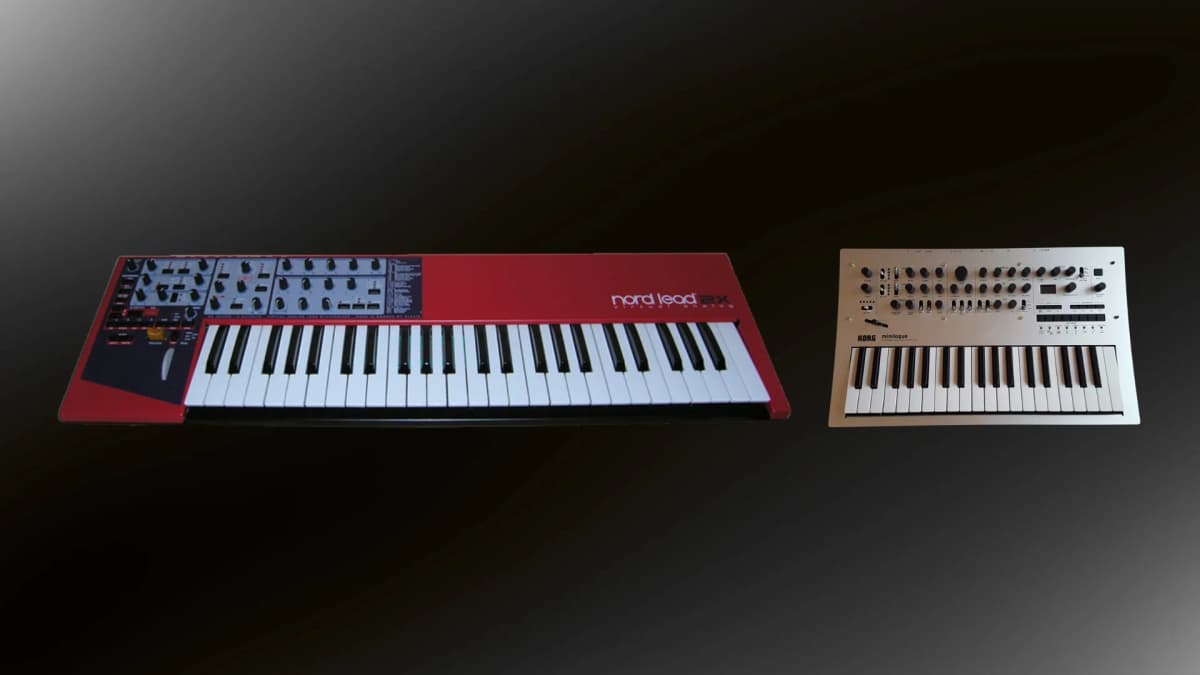
Image credits: Clavia Nord Lead 2x photo by Candyman777, Wikimedia Commons, CC BY-SA 3.0; Korg minilogue photo by Aeternus, Wikimedia Commons, CC BY-SA 4.0. Photos were cropped, cut out and placed on a gradient background for the featured image.
His connection with music began at age 6, in the 1980s, when his father introduced him to Jean-Michel Jarre's Rendez-Vous on vinyl. He works professionally in the legal field, while synthesizers became his space for abstraction and creative exploration. Founder of The Synth Source.