

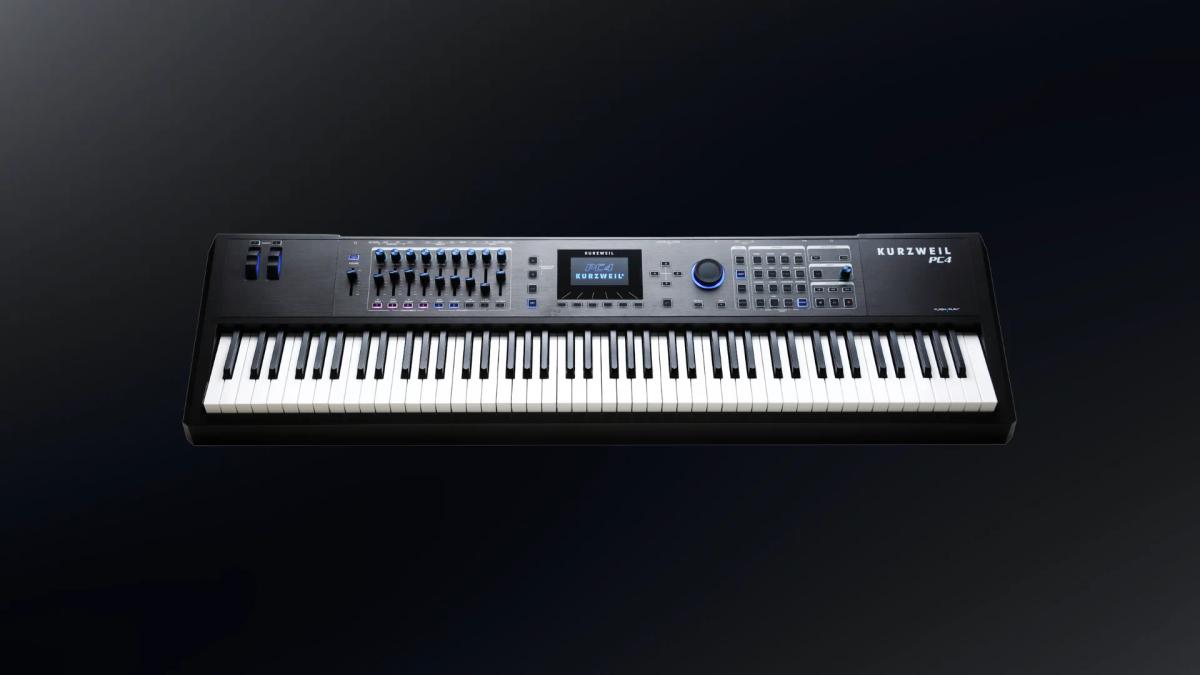
The Kurzweil PC4 is an 88-key performance controller and workstation that Kurzweil Music Systems announced in April 2019 and began shipping that November, followed in September 2020 by the PC4-7, a 76-key version with a semi-weighted action. Both run the company’s VAST engine, the sample-based modular synthesis architecture introduced with the K2000 in 1991, alongside a new six-operator FM engine that loads classic FM SysEx files, VA-1 derived virtual analog oscillators, and the KB3 tonewheel organ model. They offer 256-voice polyphony, 2GB of factory samples plus 2GB of user sample flash, a 16-track sequencer, and 36 physical controllers. The Kurzweil PC4 matters as the generation that brought Kurzweil’s deepest synthesis into its mid-priced stage keyboard line.
Table of Contents
Kurzweil PC4 sound and character
The Kurzweil PC4 sounds like a modern Kurzweil, which means detailed, realistic acoustic instruments built on a synthesis engine far deeper than its stage-keyboard appearance suggests. The factory set of more than 1,000 programs in 13 categories includes German 9-foot and Japanese 7-foot concert grands with Kurzweil String Resonance, legacy pianos from earlier instruments, and wide coverage of strings, winds, brass, guitars, basses, drums, and organs. Sound On Sound’s Robin Bigwood praised the breadth and quality of the set, singling out the pipe organs as excellent, while Bonedo’s review of the PC4-7 found the pianos, KB3 organ, and FM and VAST pads the strongest areas and the strings and brass weaker.
VAST is the reason the instrument rewards programming. A program can stack up to 32 layers, each with its own DSP chain of filters, shapers, and modulators, and Cascade mode lets one layer’s signal run through another layer’s DSP, up to 32 deep. Sound On Sound described it as a sound engine of prodigious complexity and potency. Layers can use samples, 22 types of anti-aliased virtual analog oscillator, or the FM engine, which uses DX7-derived algorithms and imports SysEx files from 1980s and 1990s FM synthesizers. That makes the Kurzweil PC4 capable of the glassy electric pianos, basses, and bells associated with FM as well as large hybrid pads that combine samples, analog-style waves, and FM.
The KB3 organ uses a different approach: lower tonewheels are generated by DSP and upper ones are sampled, with nine drawbars, percussion, chorus/vibrato, and rotary speaker control from the panel. It uses around 45 voices, and only one instance can run at a time. Effects are generous, with 32 effect units available at master, part, and layer levels and more than 1,000 effect chains.
In character, the Kurzweil PC4 is polished and studio-ready rather than raw. It sits between a stage piano and a synthesizer workstation: excellent for covering many styles in one keyboard, very deep for sound design, but less immediate than synthesizers built around one engine and one-knob-per-function editing.
Features and architecture
- Manufacturer: Kurzweil Music Systems (part of the Young Chang group)
- Year introduced: PC4 announced in April 2019 and shipping from November 2019; PC4-7 announced in September 2020
- Production years: PC4 2019 to present (Kurzweil still lists it and published an OS update in 2026, though several US retailers list it as no longer available); PC4-7 now listed by Kurzweil as a legacy model; a reduced PC4 SE followed in 2021
- Synthesis type: VAST (Variable Architecture Synthesis Technology) sample-based synthesis, six-operator FM, VA-1 derived virtual analog oscillators, and KB3 tonewheel organ modeling
- Category: performance controller and synthesizer workstation
- Polyphony: 256 voices, dynamically allocated across layers and engines (the KB3 organ uses about 45)
- Multitimbrality: 16 parts, with 16 keyboard zones in Multi mode
- Original price: PC4 $1,999 in the US and £1,799 in the UK; PC4-7 listed at €1,798 by Thomann in Bonedo’s 2021 review
- Current market price: new PC4 listings around $1,690 to $2,499 depending on retailer in October 2026; used units around $1,400
- Oscillators: up to 32 layers per program, each using samples, one of 22 virtual analog oscillator types, or FM operators; Cascade mode chains layer DSP up to 32 deep
- Sample memory: 2GB factory sample flash and 2GB non-volatile user sample flash, accepting WAV and AIFF files up to 16-bit/96kHz and Kurzweil formats including .KRZ, .K25, .K26, and .P3K
- Filter: per-layer VAST DSP algorithms offering a range of resonant filter types alongside shapers and other functions
- LFOs and envelopes: VAST provides per-layer LFOs and envelopes as assignable control sources, and the FM engine has its own operator envelopes
- Modulation system: VAST control sources assignable to most DSP parameters, along with 36 programmable physical controllers and a ribbon controller input
- Sequencer / arpeggiator: 16-track sequencer at 960 PPQ; 16 arpeggiators, 16 MIDI CC step sequencers, and 16 riff generators per Multi
- Effects: 32 effect units, more than 1,000 effect chains, master three-band EQ and compression, and effects on the audio input
- Memory: more than 1,000 factory programs and 50 factory Multis; 4,096 user programs and 4,096 user Multis
- Keyboard: PC4 88-key RPHA hammer action with velocity and aftertouch; PC4-7 76-key semi-weighted action with velocity and aftertouch
- Controllers: nine sliders, nine knobs, ten switches, LED-backlit pitch and mod wheels, Variation button, tap tempo, transpose, and transport controls; two switch-pedal inputs (each able to carry two switches or a half-damper) and two continuous pedal inputs
- Inputs / outputs: four balanced 1/4-inch outputs (two stereo pairs), two 1/4-inch inputs and a 3.5mm stereo input routed through effects, 1/4-inch headphone output
- MIDI / USB: MIDI In and Out; USB Type A for storage and Type B for computer MIDI
- Display: 4.3-inch 480 x 272 color LCD
- Dimensions / weight: PC4 130.2 x 37.5 x 16.5 cm and 13 kg; PC4-7 118.2 x 35.8 x 10.8 cm and 8.8 kg
- Power: external 15V DC, 2.5A adapter
Strengths
- It combines four engines in one keyboard. VAST samples, FM, virtual analog, and KB3 organ can be used alone or layered, giving a single instrument real range from acoustic pianos to classic FM and analog-style leads.
- VAST remains one of the deepest synthesis architectures in a hardware keyboard. Up to 32 layers per program, each with its own DSP chain and Cascade routing, allow sounds that most workstations cannot build.
- The FM engine reads classic six-operator SysEx files, so libraries from 1980s and 1990s FM synthesizers can be loaded and then processed through VAST.
- Compatibility with older Kurzweil content is broad. Programs from the PC3 and Forte series, SP6 and Artis sounds, and sample formats back to the K2000 era can be imported, protecting players’ existing libraries.
- It is well equipped for live and theater work. Sixteen zones, 36 controllers, four outputs, audio inputs with effects, and generous pedal inputs make it a capable master keyboard for complex rigs.
- Flash sample memory means sounds load almost instantly, and Sound On Sound noted that held notes often survive a program change.
Limitations
- The gap between surface and depth is wide. Sound On Sound described a split between simple front-panel operation and laborious deep programming, and Bonedo called the structure complex.
- The keyboard actions divide opinion. Sound On Sound found the Kurzweil PC4’s hammer action good but somewhat noisy, while Bonedo found the PC4-7’s semi-weighted keys had a springy rebound unsuited to expressive piano playing.
- Multis reference programs rather than storing their own copies, so editing a program changes every Multi that uses it, an approach Sound On Sound called old-fashioned.
- The onboard sequencer is basic for a workstation, with a limit of about 50,000 events per song, no tempo or time signature changes within a song, and no undo.
- It uses an external 15V power adapter, which reviewers criticized on an instrument meant for stage use.
- Early firmware had problems: Sound On Sound found several out-of-tune notes in the flagship piano on version 1.06, and Bonedo noted occasional first-note latency on some sounds.
- There is no touchscreen, and organizing more than 1,000 programs on a 4.3-inch display can be slow.
Historical context
Kurzweil Music Systems was founded in 1982 by Ray Kurzweil, with Stevie Wonder and software developer Bruce Cichowlas also credited as founders, and made its name with the K250 sampling keyboard in the mid-1980s. Young Chang acquired the company in 1990, and in 1991 the K2000 introduced VAST, the architecture that has defined Kurzweil instruments since. The PC line began with the PC88 in the mid-1990s as a master keyboard and stage instrument, continued with the PC2, and was transformed by the PC3 in spring 2008 and the PC3K in 2011, which brought VAST editing and sampled content into the stage line. The Forte stage piano followed in 2014 as the company’s flagship.
The Kurzweil PC4 was announced in April 2019. Gearnews highlighted the surprise of an all-new six-operator FM engine alongside VAST, 2GB of factory and 2GB of user samples, and 256-voice polyphony, a large step from the PC3 generation. Kurzweil gave it its UK debut at SynthFest in October 2019, and the instrument shipped in November 2019 at a street price of about $2,000. Sound On Sound placed it between Kurzweil’s SP stage pianos and the more expensive Forte and Artis series.