

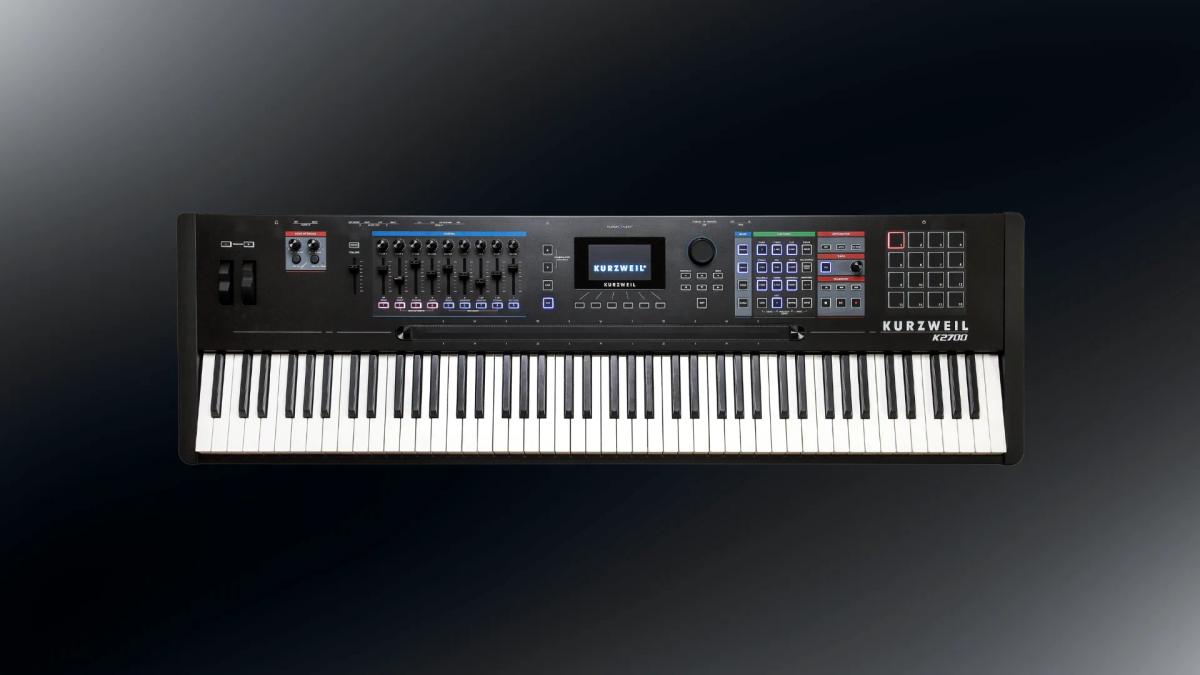
The Kurzweil K2700 is an 88-key synthesizer workstation unveiled in January 2021 and launched at Summer NAMM in July 2021, built around an updated version of the V.A.S.T. (Variable Architecture Synthesis Technology) engine that first appeared on the K2000 in 1991. Alongside FlashPlay sample playback, it combines a 6-operator FM engine, the VA1 virtual analog oscillators, and the KB3 tonewheel organ simulation, all sharing 256 voices of polyphony. Its significance is easy to state: it was the first new K2-series instrument since the 61-key K2661 of 2004, and it brought Kurzweil’s most programmable architecture back to the center of the company’s lineup.
Table of Contents
Sound and character
The Kurzweil K2700 sounds polished, dense, and deliberately studio-grade rather than raw. Its center of gravity is the classic Kurzweil blend of high-quality acoustic and electric instrument samples with a synthesis layer deep enough to transform them. Former Keyboard magazine editor Stephen Fortner singled out its pianos and electric pianos as special, and its main grands draw on German D and Japanese C7 sample sets. Delamar’s reviewer judged most of its 48 piano sounds to be good. Kurzweil String Resonance modeling adds to the realism of the acoustic pianos, although Sound On Sound’s Gordon Reid felt the grands were not the best Kurzweil has offered.
The organ is one of its strongest areas. The KB3 engine models tonewheels rather than replaying samples, and Audiofanzine described it as a superbly successful engine. Fortner felt it had more depth than the Roland and Korg alternatives, and Delamar’s reviewer went as far as saying it can match or beat Nord.
The synthesis side gives the Kurzweil K2700 its real identity. V.A.S.T. lets each layer of a program run through its own chain of DSP functions, and up to 32 layers can be stacked or cascaded so that one layer’s signal feeds another’s processing. The VA1 oscillators add anti-aliased waveforms that Fortner described as incredibly smooth, a welcome contrast with legacy Kurzweil content, which he noted can still alias in the top octave or so. The FM engine loads original DX7 patches as SysEx and can be layered with sample-based and VA layers inside one program, which gives the K2700 a hybrid character that few rivals offer in a single instrument.
What it is less good at is equally telling. Audiofanzine found the reduced Yamaha C7 piano showed audible multisample breakpoints, and Delamar’s reviewer considered the brass and guitar sounds less convincing. Its overall voice is refined and flexible, and depends heavily on the programmer.
Features and architecture
- Manufacturer: Kurzweil (made in South Korea)
- Year introduced: 2021 (officially introduced in January 2021 ahead of that month’s online NAMM show, then launched at Summer NAMM in July 2021)
- Production years: 2021 to present; still sold new in 2026
- Synthesis type: V.A.S.T. sample-based synthesis with FlashPlay sample playback, 6-operator FM, VA1 virtual analog oscillators, and KB3 tonewheel organ modeling
- Category: 88-key synthesizer workstation
- Polyphony: 256 voices; 16-part multitimbral
- Original price: street price of about $2,999 in the U.S. (£2,499 in the UK) when it reached reviewers in early 2022
- Current market price: about $3,299 new in the U.S. in late 2026
- Oscillators: 4.5GB of factory samples; VA1 anti-aliased oscillators; 6-operator FM with the 32 original FM algorithms and DX7 SysEx import
- Filter: filters available as modular DSP functions within V.A.S.T., including new types added for this model
- Programming depth: up to 32 layers per program, with a Cascade mode that routes layers through the DSP of other layers
- Envelopes / modulators: envelopes within each V.A.S.T. layer; the FM engine’s envelopes are faster than the rest of V.A.S.T., according to Fortner
- Modulation system: V.A.S.T. routing with configurable DSP chains per layer and more than 60 physical controls available for real-time assignment
- Sequencer / arpeggiator: 16-track sequencer at 960 PPQ; up to 16 arpeggiators, 16 MIDI CC step sequencers, and 16 riff generators in Multi mode
- Effects: 32 effect units and more than 1,000 effect chains, largely carried over from the Forte, plus a global Master FX section with 3-band EQ and compression
- Memory: more than 1,500 factory programs and over 700 factory multis; 3.5GB of non-volatile user flash for WAV, AIF, and Kurzweil-format samples; no internal sampling
- Keyboard: 88-key Fatar TP/40L weighted hammer action with velocity and mono aftertouch
- Controllers: 9 sliders, 16 velocity-sensitive pads, a long three-section ribbon, pitch and mod wheels, and transport buttons
- Inputs / outputs: four balanced 1/4″ TRS outputs (two stereo pairs); two combo XLR/1/4″ inputs with mic preamps, Hi-Z switch, and +48V phantom power; rear-panel headphone output; pedal jacks for switch and continuous pedals
- MIDI / USB: 5-pin MIDI In and Out (no Thru); USB MIDI and a built-in stereo USB audio interface at 44.1 to 192kHz; USB host port for storage and updates
- Display: 4.3-inch 480 x 272 color LCD, not touch-sensitive
- Dimensions / weight: about 1295 x 394 x 140 mm; about 23.6 to 24 kg (52 lb)
- Power: internal universal power supply with IEC socket
Strengths
- The breadth of engines in one program is unusual. Sample playback, FM, virtual analog, and organ modeling can be combined inside the same V.A.S.T. structure, so hybrid sounds do not require layering separate instruments or external MIDI routing.
- V.A.S.T. remains one of the deepest programming environments in a hardware workstation. Up to 32 layers per program and the Cascade mode give sound designers a modular-style signal path that most preset-oriented workstations do not offer.
- The KB3 organ is a genuine highlight. Reviewers repeatedly placed it among the best workstation organ simulations, which makes the Kurzweil K2700 credible as a gigging organ as well as a piano and synth.
- The effects section is studio-grade. Audiofanzine placed its 32-unit processor at the level of the best dedicated studio processors, naming Lexicon and Eventide as reference points.
- FlashPlay sample memory removes loading times. Factory and user samples play instantly, and 3.5GB of non-volatile user flash keeps imported samples in place after power-down.
- It is a strong controller and studio hub. Sixteen zones, generous physical controls, two mic-capable inputs, and a USB audio interface let it serve as the center of a stage or home studio rig.
Limitations
- It exists only as a heavy 88-key instrument. At around 24 kg it is demanding to transport, and both Audiofanzine and Sound On Sound wished for a 76-key version.
- The interface shows its age. The small, non-touch 4.3-inch display and deep menus make editing slow to learn, Sound On Sound found the editor less clear than earlier Kurzweil designs, and Delamar’s reviewer noted there is no dedicated Enter button.
- It cannot sample internally. Samples must be imported, import runs at about 1MB per second according to Audiofanzine, and Sound On Sound found the sample editing short of graphics.
- Some factory content feels inherited. Many sounds came from the Forte, and the Yamaha C7 piano was trimmed compared with that instrument, with audible multisample breakpoints.
- Output options are modest for a flagship: two stereo pairs of analog outputs, no digital outputs, and stereo-only USB audio.
- Only one KB3 organ instance can run at a time in multitimbral setups, and the audio input can be routed through effects but not into V.A.S.T. processing.
Historical context
The Kurzweil K2700 belongs to one of the most respected lineages in sample-based synthesis. The K2000 of 1991 introduced V.A.S.T., which let any sample, waveform, or noise source be processed through configurable chains of synthesis functions. The K2500 and the K2600 of 1999 carried the architecture forward, the latter with KDFX effects. The 61-key K2661 of 2004 was, in Sound On Sound’s words at the time, essentially the soul of a K2600 in a lighter body. Then the K2 series went quiet; Sound On Sound counted some 14 years since its discontinuation. Meanwhile Kurzweil’s sound development continued in the PC3, PC4, SP6, and Forte, whose content fed into the new instrument.
That gap is what made the Kurzweil K2700 meaningful. Kurzweil’s own announcement framed it with the dates 1991 to 2021 as the evolution of the K2 series, and Australian Musician called it the company’s most complete set of music creation tools ever. It was not a reissue of the K2000 or the K2600, but a flagship that reunited modern engines (FM, VA1, KB3) with the K2 name.
Its timing is also revealing. Fortner set its price against the Korg Kronos, Roland Fantom, and Nord Stage 3. Kurzweil answered not with a touchscreen but with depth, sound quality, a substantial control surface, and a built-in audio interface, at a price whose value, in Fortner’s words, grabs attention.