

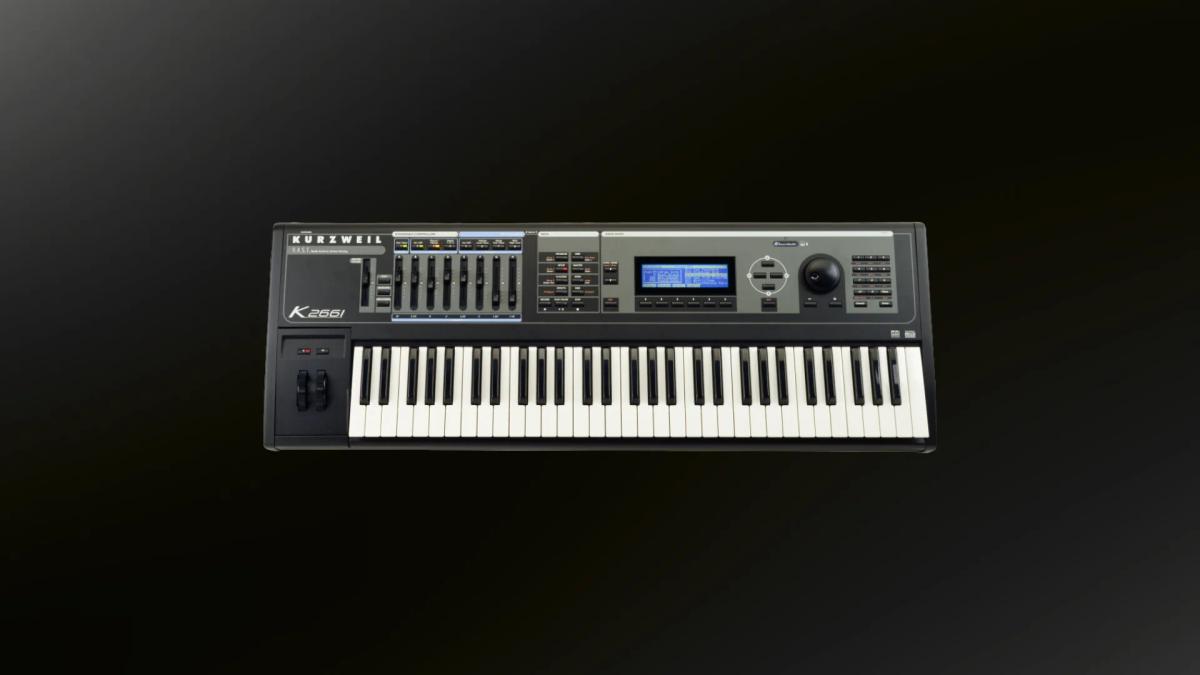
The Kurzweil K2661 is a 61-key synthesizer workstation that Kurzweil Music Systems, then owned by the Korean piano maker Young Chang, announced in January 2004. It is essentially the K2600 engine rehoused in a case close to the size of the original K2000: 48 voices of VAST (Variable Architecture Synthesis Technology) sample playback and synthesis, 16-part multitimbrality, Triple Modular Processing, the KB3 tonewheel organ mode, KDFX effects and a 768 ppq sequencer, with SmartMedia storage replacing the floppy drive. It matters as the portable, final keyboard form of the K2 platform before Kurzweil’s attention moved to the PC3, and as a rare way to get the full K2600 architecture under 15 kg.
Table of Contents
Kurzweil K2661 sound and character
The Kurzweil K2661 sounds like a K2600, because inside it is one. Its 32 MB base ROM combines the K2600 factory samples with the former Orchestral and Contemporary expansion blocks and a General MIDI set, and the character is the familiar Kurzweil one: clean, detailed and slightly forward, with strong strings, brass and orchestral percussion, and a depth of programming that turns those samples into far more than presets. Sound On Sound’s Paul Ward, reviewing it in May 2004, wrote that the sounds seemed to leap out of the speakers, and rated VAST as still one of the best sample-plus-synthesis implementations available.
What gives the instrument its range is VAST itself. Each program can stack up to 32 layers, and every layer runs samples through a chosen algorithm of DSP functions: filters of several types, waveshapers, distortion, oscillators and mixers arranged in configurable chains. Triple Modular Processing links three layers in series, so one layer’s output can feed another’s processing, and Kurzweil cites 126 algorithms in this mode. In practice this lets the Kurzweil K2661 make aggressive synthetic textures, ring-modulated and waveshaped sounds and evolving pads, not only realistic emulations.
KB3 mode adds a different voice. It models a tonewheel organ with nine blendable harmonics per voice, using the sliders as drawbars and KDFX for rotary speaker effects, and it is convincing enough that Keyboard magazine’s Stephen Fortner later said it let him leave a separate organ at home on smaller gigs.
The weaknesses are equally specific. Forty-eight voices is tight for dense arrangements with layered programs, the KDFX section has a shared processing budget that limits elaborate effect chains, and the factory pianos without the optional ROMs sound dated next to later instruments. The Kurzweil K2661 sits firmly in the early 2000s: precise, deep and studio-grade rather than warm or vintage.
Features and architecture
- Manufacturer: Kurzweil Music Systems (Young Chang)
- Year introduced: announced January 2004; Sound On Sound reviewed it in May 2004, when shipping units were due to gain 128 MB of sample RAM as standard
- Production years: 2004 to around 2008, when the K26xx line was discontinued with stock still in the channel
- Synthesis type: sample-based VAST synthesis with Triple Modular Processing, KB3 tonewheel organ modeling and optional sampling
- Category: 61-key synthesizer workstation and sampler
- Polyphony: 48 voices (192 oscillators); 16-part multitimbral, up to 32 layers per program
- Original price: £1,999 including VAT in the UK at launch; a US list price is not consistently documented
- Current market price: recent Reverb listings range from about $650 to $1,000 in the US, with a fully expanded European unit listed at €1,599 in 2026
- Oscillators: sample playback from 32 MB ROM (expandable to 48 MB) and up to 128 MB RAM, plus DSP oscillator functions within VAST algorithms
- Filter: multiple DSP filter types within VAST algorithms, including low-pass, high-pass, band-pass and notch variants, configurable per layer
- LFOs: two per layer plus global LFOs, freely assignable
- Envelopes: three envelopes per layer, including a dedicated amplitude envelope, with multi-segment shapes
- Modulation system: extensive source-to-destination routing across VAST, with FUNs (function generators) and ASRs
- Sequencer / arpeggiator: 16 song tracks plus 16 arrangement tracks, 768 ppq, pattern, linear, loop and step recording; arpeggiator syncable to MIDI clock
- Effects: KDFX, 24-bit, five stereo buses (four insert plus one master), sharing a fixed processing budget
- Sampling: optional SMP-61 board adds analog and additional digital inputs; sample editing and non-real-time DSP (time stretch, pitch shift, resampling) work without it
- Memory: 1.5 MB battery-backed program and sequence RAM; 575 factory programs per Sound On Sound (Kurzweil’s own page cites over 600)
- Storage: SmartMedia slot, one 25-pin SCSI port for external drives; no internal hard drive or floppy
- Expansion: two ROM slots for the Stereo Dynamic Piano and Vintage Electric Piano blocks; one 72-pin SIMM slot for sample RAM; optional ribbon controller
- Keyboard: 61-note unweighted synth action with monophonic aftertouch; pitch and mod wheels, eight sliders, two assignable buttons
- Inputs / outputs: stereo mix out plus four balanced 24-bit individual outputs, headphone out, optical ports for 8-channel ADAT or 2-channel S/PDIF, inputs for four footswitches, two continuous pedals and a breath controller
- MIDI / USB: MIDI In, Out and Thru; no USB
- Display: 64 x 240 backlit fluorescent, unchanged from the K2000
- Dimensions / weight: 100.2 x 36 x 11 cm (39.4 x 14.2 x 4.3 in), 14.5 kg (32 lb)
- Power: internal, user-switchable international supply
Strengths
- It delivers the full K2600 engine in a portable case. Ward summarized it as K2600 power in a K2000-sized package, and owners moving from a K2500 or K2600 report shedding 10 to 15 kg.
- VAST remains unusually deep. Thirty-two layers per program, configurable DSP chains and Triple Modular Processing let it be a synthesizer in its own right rather than a sample player with filters.
- KB3 mode turns it into a credible tonewheel organ, with sliders as drawbars and no loss of polyphony, which made it a practical single-board solution for working players.
- Library compatibility is a major asset. It reads K2000, K2500 and K2600 files, plus Akai S1000/S3000, Roland S-700 and Ensoniq EPS/ASR sample libraries, AIFF and WAV.
- The onboard sequencer is serious. Ward, who mostly worked with a computer, called it the best hardware sequencer he had used, citing its 768 ppq resolution and editing tools.
- Digital connectivity was generous for its class: eight channels of ADAT optical, four balanced individual outputs, and enough pedal and breath inputs for detailed live control.
Limitations
- Even at launch it felt old. Ward wrote that it seemed like a machine that should have arrived in 1998 and argued that its UK price was hard to justify against newer competitors.
- Forty-eight voices runs out quickly with layered programs in full arrangements, and KDFX’s shared processing budget limits complex effect setups.
- The 64 x 240 display is small and was already dated, making deep VAST editing slow without patience or external editors.
- Analog sampling and Live Mode processing of external audio require the optional SMP-61 board, and the best pianos and electric pianos sit on optional ROM blocks.
- Several K2600 features were cut: four individual outputs instead of eight, one SCSI port instead of two, no built-in ribbon controllers and no floppy drive.
- The unweighted keyboard draws mixed opinions; one long-term owner called it noisy and plasticky compared with the K2500’s 76-key action.
- The learning curve is steep, as Kurzweil’s own users have long acknowledged, and SmartMedia cards are now an obsolete medium.
Historical context
The Kurzweil K2661 descends directly from the K2000, the 1991 workstation that introduced VAST and is covered separately on this site. Kurzweil had been owned by Young Chang since 1990, and the platform grew through the K2500 in the mid-1990s and the K2600 around 1999 to 2000, which added KDFX effects, Triple Modular Processing and later KB3 mode. The K2600 came in 76-key semi-weighted and 88-key weighted versions, and Sound On Sound described it as formidably large and heavy. By the early 2000s players wanted the same engine in something easier to carry.
Kurzweil announced the Kurzweil K2661 in January 2004 as a lightweight evolution of the K2600, keeping the engine, sequencer and library compatibility while moving to a 61-note synth action, adding SmartMedia, and making the ribbon controller an external option. The base ROM absorbed the previously optional Orchestral and Contemporary blocks, and from April 2004 units were due to ship with 128 MB of sample RAM included. Kurzweil also made Triple Modular Processing available to K2600 owners through a software update, consistent with its reputation for supporting older machines.