

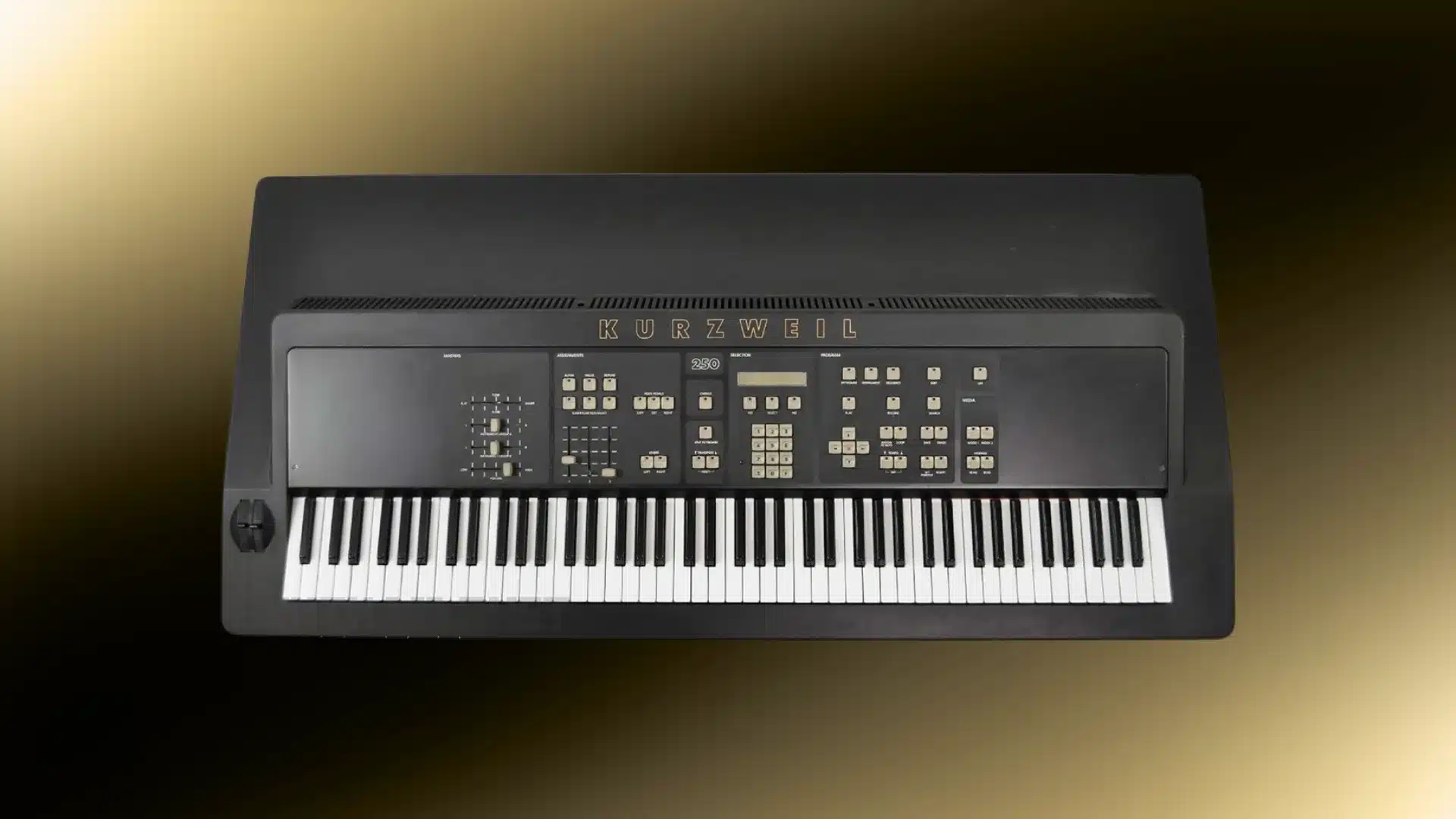
The Kurzweil K250, originally sold as the Kurzweil 250, is a 12-voice digital keyboard instrument that began shipping in 1984 after a prototype appeared at the June 1983 NAMM show. It combined an 88-note weighted wooden keyboard, ROM-based acoustic instrument sounds, a built-in multitrack sequencer and, through a later option, user sampling. Its importance rests on one achievement above all: it was the first electronic instrument widely accepted as capturing the sound and feel of a grand piano with real credibility, and it did so at a moment when most digital pianos and samplers still struggled to sound like anything more than an approximation.
Table of Contents
Sound and character
The Kurzweil K250’s identity begins with its piano. Ray Kurzweil later explained that the difficulty with sampled pianos lay in their inharmonic overtones. Samplers of the period typically looped the final waveform during the decay, and in doing so turned a piano note into something closer to an organ tone. Kurzweil’s team developed a way to keep that inharmonicity alive through the evolution of each note, and that is audible in the Kurzweil K250’s long, shifting decays. Contemporary reviewers described the approach as a “sound model” derived from pattern-recognition work, with piano notes analysed across several touch intensities rather than captured as a single recording stretched across the keyboard.
The result was not a perfect grand. One Two Testing’s 1984 review judged that it would lose a blindfold test against a real grand in the same room but could beat a recorded piano, which captures its character well: it sounds like a well-recorded acoustic instrument rather than a synthesizer imitating one. Sound On Sound’s later retrospective compared its grand favourably with the DX7 in the bass register and suggested that some later sampled Steinway libraries did not sound as good.
Beyond the piano, reviewers singled out brass as a strength, and the factory library covered strings, choir, acoustic bass, organ, drums and percussion. The overall tone leans polished, warm and orchestral rather than synthetic or aggressive. Its user-sampling side is a different matter: Sound On Sound’s retrospective described sampled audio as sounding closer to 12-bit, with quantisation “fizz” at the tail of decays, which reinforces that the Kurzweil K250’s real voice is its factory ROM rather than its sampler.
Features and architecture
- Manufacturer: Kurzweil Music Systems (founded by Ray Kurzweil in 1982)
- Year introduced: prototype shown at NAMM in June 1983; shipping began in 1984
- Production years: Kurzweil’s own product history gives 1984 to 1989, while Vintage Synth Explorer lists 1984 to 1990
- Synthesis type: ROM-based sample playback using Kurzweil’s analysed “sound model” approach, with optional user sampling
- Category: 88-key digital keyboard instrument and early music workstation
- Polyphony: 12 voices, with a voice-stealing scheme that removes the least noticeable notes first
- Original price: about $10,750 for the stock model in U.S. coverage of 1984, with the sampling option quoted at a further $2,000 to $2,500 plus a Macintosh; Mix later put the cost at almost $16,000; in the UK the basic unit sold for £11,995, and a complete system could reach £17,000
- Current market signal: rare and largely seller-driven; see Market value
- Sounds: 30 resident voices in the standard instrument, organised into 40 keyboard setups; Sound Block A added 72 voicings and 80 setups, with further Sound Blocks B (Contemporary), C (Orchestral) and D (Brass) later available, for up to 96 ROM instruments
- Sampling: optional Sound Modelling Program, up to 50 kHz; standard memory gave about 10 seconds of mono sampling time at 50 kHz, expandable to 20 and 40 seconds with SUPERAM boards
- Internal resolution: described by Sound On Sound as 18-bit floating point
- Layering and splits: up to six layers and 31 samples per keyboard setup, with extensive keyboard splitting
- Filter: early reviews noted no filters; Sound On Sound’s later account lists assignable filters
- LFOs: listed as 24 in Sound On Sound’s later account, which matches Vintage Synth Explorer’s two per voice
- Envelopes: 12 seven-segment envelope generators noted in 1984
- Modulation system: four master sliders for tuning, panning and volume, three assignable sliders and two piano-style pedals, with assignable controls covering functions such as sustain, modulation and filter sweeps
- Sequencer / arpeggiator: built-in 12-track sequencer; capacity is quoted differently across sources, from about 4,000 notes in early reviews to 7,500, 7,900 and up to 12,000 notes in later configurations; no arpeggiator
- Effects: software chorusing in 1984 coverage; chorus, flanging and delay listed in later accounts
- Memory: offline storage of samples, setups and sequences relied on an Apple Macintosh running MacAttach, and extra sound libraries loaded from floppies through the Mac
- Keyboard: 88 notes, velocity-sensitive, weighted wooden keys
- Inputs / outputs: a single stereo output as standard, on jacks and balanced XLRs; twelve individual outputs were an optional modification rather than fitted to every unit
- MIDI / USB: MIDI; no USB
- Display: two-line LCD alongside a central 12-digit keypad
- Dimensions / weight: about 95 lb for the keyboard, plus about 22 lb for the separate power supply
- Power: external power supply housed in the “Pedal Pod,” which also carries the two sustain pedals and connects through a thick multicore cable
- Related model: a keyboardless Expander (also called 250XP) introduced in 1985, later repackaged as the 250RMX rack unit in 1986
Strengths
- Its grand piano was a genuine breakthrough. By preserving the inharmonic behaviour of piano partials instead of looping them into static tones, it delivered a realism that defined expectations for the electronic piano.
- The keyboard matched the sound. An 88-note weighted wooden action gave pianists a playing experience that most synthesizers and samplers of the period simply did not offer, and 1984 reviewers called it one of the most responsive keyboards on the market.
- It worked immediately for non-programmers. The Kurzweil K250 powered up on its grand piano preset, 1984 reviewers called it unusually simple to use, and a 1986 review judged it a better fit than its sampling competitors for players who did not want to juggle floppy disks and sample editing.
- It was an early workstation. A 12-track sequencer, layering, splits and a growing ROM library meant one instrument could sketch full orchestral or band arrangements, which suited composers and studios.
- The factory library reached beyond piano. Brass, strings, choir and percussion, later extended by the Sound Blocks, suited orchestral sketching.
Limitations
- Twelve voices is tight for an 88-key piano instrument, particularly with sustain pedal and layered setups, even with its intelligent voice stealing.
- It is enormous. At around 95 lb before its separate power supply, the Kurzweil K250 was a studio instrument first and a touring instrument only with real logistical commitment.
- User sampling was an extra, not a foundation. It arrived as an option, required a Macintosh for storage, processed slowly (Sound On Sound cited around five minutes for a four-second sample) and sounded less refined than the factory ROM.
- Storage depended on an external computer. Without a Mac and MacAttach, there was no way to save user work offline.
- The price placed it far beyond most musicians. With a stock model above $10,000 and Mix citing a cost of almost $16,000, it was limited to studios, wealthy professionals and institutions.
Historical context
The Kurzweil K250 emerged from an unusual meeting of assistive technology and music. Stevie Wonder had become the first customer for Ray Kurzweil’s reading machine for the blind after seeing it on television in 1976. In 1982, touring Wonder’s new studio, the two discussed what Wonder saw as two separate worlds of instruments: acoustic instruments with rich, complex sound and computer-based instruments with flexible control but thin, artificial tone. Wonder challenged Kurzweil to bring them together. Kurzweil Music Systems was founded that same year, with Wonder as musical advisor.
The company’s first product made its case publicly in 1983, with a prototype at the June NAMM show and a crowded demonstration at the New York AES convention that autumn. Shipping began in 1984, when reviewers were still measuring high-end sampling against systems such as the Fairlight, the Synclavier and the PPG. The Kurzweil K250 occupied a different position from those systems. It was less a general-purpose sound computer than a performer’s instrument built around the most demanding acoustic sound of all.
The company also drew on synthesizer pioneers: One Two Testing reported in 1984 that Alan R. Pearlman and Bob Moog had come on board, though sources do not detail their roles on the 250. Later, production of the K1000 series began in the fall of 1987, offering acoustic sample playback at a fraction of the Kurzweil K250’s cost; Kurzweil Music Systems filed for bankruptcy in 1990 and sold its assets to Young Chang, which introduced the K2000 in 1991.