

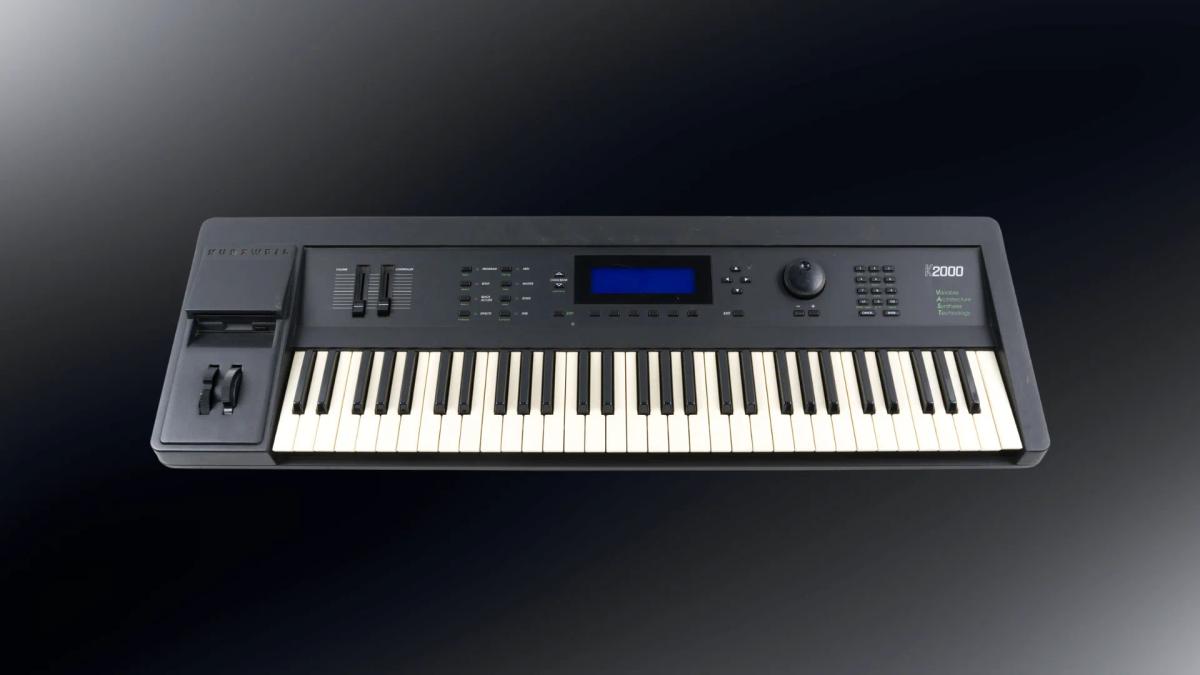
The Kurzweil K2000 is a 61-key, 24-voice digital synthesizer workstation released in 1991 by Young Chang, the Korean piano maker that had acquired Kurzweil Music Systems the year before. It paired 8 MB of 16-bit ROM samples with Variable Architecture Synthesis Technology, or VAST, an engine that let each layer of a sound run through one of 31 configurable algorithms built from chains of filters, oscillators, waveshapers and other DSP functions. Joined by sampling and rackmount versions, and later updated as the K2vx and K2000VP, it became the foundation of a synthesis platform that Kurzweil was still building on three decades later.
Table of Contents
Sound and character
The Kurzweil K2000’s sound starts from samples, but it does not stop there. Craig Anderton, reviewing it for Sound On Sound in 1992, described the factory sounds as “accurate rather than punchy” and noted that the instrument could seem “a bit conservative alongside the super-bright digital sounds of other synths.” The factory pianos, strings, choirs and orchestral sounds lean toward realism and balance rather than the glassy, hyped brightness that defined much early 1990s digital hardware.
The deeper character emerges once VAST is involved. Instead of a fixed sample-plus-filter path, each layer can be routed through an algorithm that might combine resonant filters, parametric EQ, waveshaping, distortion, pulse-width modulation, ring modulation or hard sync. Anderton listed 17 filter types and non-linear functions he traced back to the Electronotes tradition of analog design, while warning that those functions “can sound pretty nasty on their own.” That warning is also the point: the Kurzweil K2000 can move from a polished stereo piano to grinding, folded, metallic tones within the same architecture.
Movement is the other defining trait. Anderton singled out how the modulation system kept sampled sounds alive: “It’s no longer a given that your sound has to become static as soon as it hits the loop point.” Nick Batzdorf, reviewing it for Music Technology in 1992, went further, calling it “simply one of the best-sounding instruments I’ve heard in a very long time.” A recent side-by-side comparison by Don Solaris found the Kurzweil K2000 still had “a unique sonic fingerprint” next to its own successor, the K2600, noting fuller low end on some patches and a less polished reverb.
Features and architecture
- Manufacturer: Kurzweil Music Systems, owned by the Korean piano maker Young Chang since 1990
- Year introduced: 1991 in the US; UK reviews and availability followed in 1992
- Production years: 1991 through the late 1990s across its variants; the K2000VP was still reviewed as a current product in 1998
- Variants: K2000 (keyboard), K2000R (rack), K2000S and K2000RS (keyboard and rack with the sampling option, which arrived in 1993), K2vx and K2vxS (keyboards with expanded ROM), K2000VP and K2000VPR (late versions loaded with the K2500 sound set)
- Synthesis type: sample-based synthesis with VAST DSP processing per layer; optional sampling
- Category: 61-key synthesizer workstation
- Polyphony: 24 voices, 16-part multitimbral
- Original price: $2,995 list in the US; £2,699.99 in the UK in 1992, with the SMP-R sampling option adding £893.99 in 1993
- Sound memory: 8 MB of 16-bit ROM samples, expandable to 24 MB with optional ROM blocks (Orchestral and Contemporary); four SIMM sockets for up to 64 MB of volatile sample RAM
- Oscillators: ROM or RAM samples per layer, plus algorithm-based sine, sawtooth and square oscillators, noise, ring modulation and hard sync
- Program structure: up to 3 layers per Program, each with its own keymap; drum Programs with up to 32 layers
- Filter: 17 filter types, including low-pass, high-pass, band-pass, all-pass and notch, alongside EQ and non-linear waveshaping functions
- Algorithms: 31 algorithms, some chaining as many as five processing stages, shown as block diagrams on the display
- LFOs: per-layer LFOs with 14 waveshapes, plus phase-following control sources
- Envelopes: envelope generators available as modulation sources, including attack/sustain/release types
- Modulation system: extensive routing from MIDI controllers, velocity, release velocity, pressure, random and clock-following sources, plus “FUNs” that combine two control signals
- Sequencer / arpeggiator: a simple RAM “scratchpad” Song mode at launch; a full 32-track sequencer arrived with version 3 software in February 1995; no arpeggiator is described in contemporary reviews
- Effects: one global multi-effects processor running up to four effects at once, with reverb, delay, modulation and EQ types; 26 effects algorithms at launch
- Memory: around 200 ROM Programs, user Programs and Setups in battery-backed program RAM, organized in 10 banks; storage to floppy disk or SCSI drive
- Keyboard: 61 keys with velocity, release velocity and aftertouch
- Inputs / outputs: stereo main outputs plus two auxiliary stereo pairs (usable as four mono outputs or as inserts), headphone output, dual footswitch inputs and a pedal input; analog and S/PDIF or AES/EBU digital inputs with the sampling option
- MIDI / storage: MIDI In and Out; SCSI for hard disks, CD-ROM and SMDI; 3.5-inch MS-DOS floppy drive; reads Akai disks, with Ensoniq and Roland support from version 2 and WAV and AIFF translation on later units
- Display: 240 × 64 pixel backlit graphic LCD
- Dimensions / weight / power: not documented in the reviews consulted
Strengths
- VAST gave sample playback a real synthesis engine. Configurable DSP chains per layer let samples be filtered, distorted, waveshaped and modulated well beyond most early 1990s ROM synths.
- Sampling and sample loading made the instrument open-ended. With SIMM-based RAM, SCSI and the ability to read Akai disks, the Kurzweil K2000 could function as a playback engine for existing sample libraries, which is how several professional users relied on it.
- The operating system and documentation were praised from day one. Sound On Sound wrote that “the K2000’s operating system sets a new standard for synthesizers” and called the manual conversational, well organized and thorough.
- The platform was unusually long-lived. Software updates, ROM expansions and the sampling option kept early units current for years, and K2000 files remain loadable, with caveats, on modern Kurzweil hardware.
- The effects were strong for their era. Anderton judged their quality “excellent, rivalling that of quality outboard devices.”
Limitations
- Twenty-four voices disappear quickly. Because each sounding layer uses a voice, a three-layer Program effectively plays eight notes, and by 1998 Sound On Sound called the polyphony “very restrictive” for multitimbral work.
- The effects section is a single global processor. Multitimbral arrangements share one effects chain.
- Sample RAM is volatile. Every user sample has to be reloaded from floppy or SCSI after power-up, and early units did not support loading while playing.
- Depth comes with a learning curve. VAST rewards patient programmers, but the 240 × 64 display and menu-driven editing make deep work slow.
- The fully equipped instrument was expensive. Anderton called it “not cheap,” and sample RAM, the sampling option, ROM blocks and hard disk storage were all sold separately.
Historical context
Kurzweil’s first instrument, the K250, had built the brand’s reputation on realistic sampled acoustic sounds, particularly piano. By 1990 the company had been acquired by Young Chang, and the Kurzweil K2000 was the first major statement of that new era. It arrived into a crowded market. As Gordon Reid pointed out in his review of the K2700, the Roland JD-800 and Korg 01/WFD were launched in the same year. Most sample-based workstations of the period followed a similar template: ROM waveforms, a filter, envelopes, effects and a sequencer.
The Kurzweil K2000 responded to that template by refusing to fix the signal path. Its advertising framed VAST as “the entire history of synthesis under one control panel.” Behind the marketing was a serious idea: instead of competing only on the quality of its samples, the Kurzweil K2000 competed on what could be done to them. It also blurred the line between synthesizer and sampler. The sampling option was announced at launch but only arrived in 1993, and it turned the instrument into a self-contained sound design system, while compatibility with Akai sample disks made it practical in studios already built around samplers.
The Kurzweil K2000 was also designed as a platform rather than a single product. Over the following years Kurzweil added an Orchestral ROM board, a major version 3 upgrade in 1995, the K2vx with expanded ROM, and finally the K2000VP, which loaded the sound set of the newer K2500.