

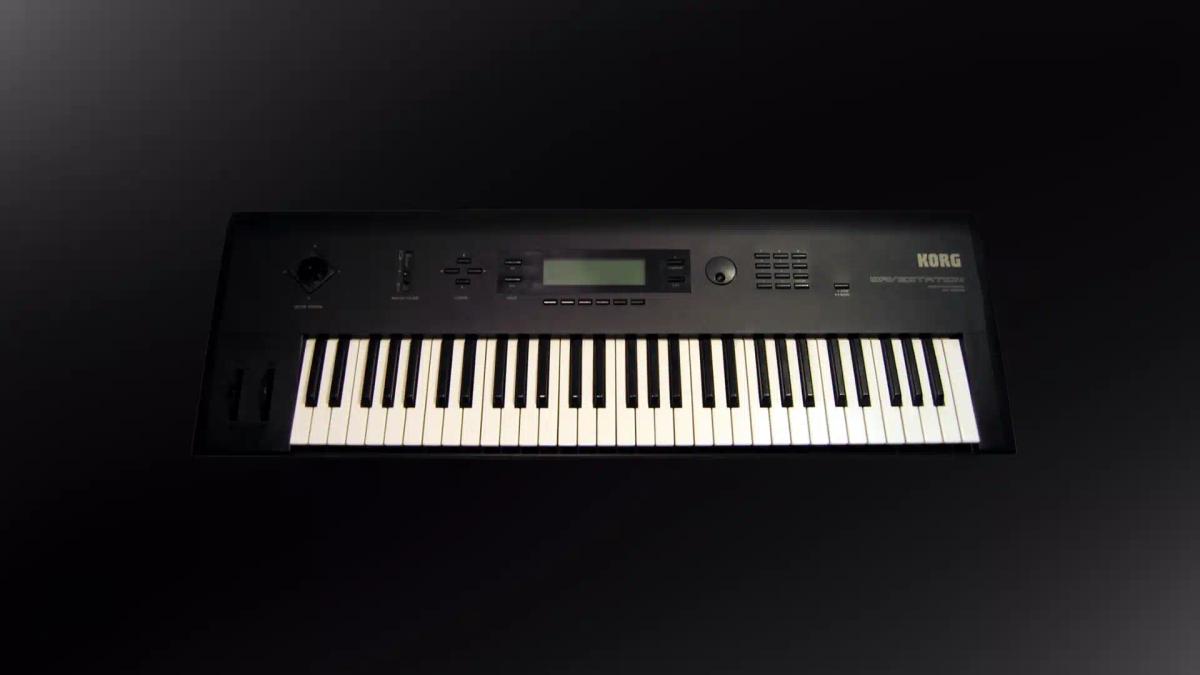
The Korg Wavestation is a 61-key digital synthesizer introduced in 1990, built around 32 voices of sample-based oscillators, a joystick for vector mixing, and wave sequencing, a system that strings short waveforms into timed, crossfaded chains. It was designed in California by former Sequential Circuits engineers led by Dave Smith and John Bowen, and it took the vector idea of the Prophet VS much further. It was never a mainstream hit, but its evolving pads and rhythmic, self-animating textures gave it a voice no other synth of the early 1990s could reproduce, and Korg returned to its ideas three decades later.
Table of Contents
Sound and character
The Korg Wavestation sounds like motion. Where most digital synths of its era played a sample and shaped it with an envelope, the Korg Wavestation was built to change timbre continuously. Within a single Patch, up to four oscillators can each play a wave sequence, a list of waveforms that step or crossfade into one another over time, while the joystick or a looping mix envelope blends those four sources against each other. The result shifts and shimmers even on a single held note.
Its natural territory is the evolving pad: glassy, breathing, often slightly metallic textures that seem to drift rather than sustain. Music Technology’s 1990 review pointed to slowly evolving sustained sounds, strings, breathy vocal textures, metallic tinkling, arpeggios and rhythms, and suggested film background work as a natural use. Sound On Sound later wrote that its evolving pads were unequalled by any synth before or since. Because wave sequence steps can sync to MIDI clock, many factory sounds behave like small rhythmic machines, producing pulsing patterns from a single held key.
The character also comes from what the Korg Wavestation lacks. Its low-pass filter has no resonance, and Korg offered an “exciter” parameter instead, so the Korg Wavestation does not do squelchy analog sweeps. Its 2MB of sample memory was small, and Hollow Sun notes that many waveforms were under-sampled, which adds aliasing grit to the top end. The two onboard effects processors then do a great deal of work, wrapping sounds in reverbs, delays and choruses; Sound On Sound called the effects fundamental to the quality and nature of its sounds. The voice leans digital, airy and cinematic, polished on the surface and grainy underneath.
Features and architecture
- Manufacturer: Korg
- Year introduced: 1990
- Production years: commonly listed as 1990 to 1994 for the line; the original keyboard was followed by the Wavestation EX in 1991
- Synthesis type: digital sample-based synthesis with vector synthesis and wave sequencing
- Category: polyphonic keyboard synthesizer
- Polyphony: 32 voices; each oscillator uses one voice, so four-oscillator Patches give eight-note polyphony
- Original price: £1,575 including VAT in the UK at launch
- Current market signal: discontinued and available only on the used market
- Oscillators: up to four per Patch, drawing on 365 internal waveforms and samples (253 waveforms and 112 mostly percussive samples) in 2MB of ROM, expandable by PCM cards
- Wave sequencing: each oscillator can play a wave sequence of up to 255 steps by Sound On Sound’s count (Korg’s advertising said 256), with per-step wave, tuning, level, duration and crossfade; sequences can loop and sync to MIDI clock
- Vector synthesis: front-panel joystick mixes the four oscillators along X and Y axes; a five-point mix envelope can automate and loop the movement
- Filter: one 24dB per octave low-pass filter per voice, with no resonance, plus keyboard tracking and an exciter amount
- LFOs: two in the voice structure, with triangle, square, sawtooth and ramp shapes, delay, fade-in and modulatable depth and rate
- Envelopes: a dedicated four-stage amplifier envelope and one assignable four-stage envelope, plus the vector mix envelope
- Modulation system: matrix of 13 sources, including two user-definable MIDI controllers, routable to amplifier level, filter cutoff, mixer X, mixer Y and pitch
- Sequencer / arpeggiator: no conventional note sequencer or arpeggiator; rhythmic movement comes from wave sequences
- Effects: two independent effects processors in parallel or serial configurations; Korg advertised 46 effects and Sound On Sound counted 47 programs, including reverbs, delays, choruses, flangers, distortion and pitch shifting
- Memory: 35 ROM and 70 RAM Patches, 50 ROM and 100 RAM Performances, 32 ROM and 64 RAM wave sequences, 16 Multisets; ROM/RAM program cards add further banks
- Performance structure: up to eight Patches layered or split per Performance, each Part with its own key and velocity zones and MIDI channel
- Keyboard: 61 keys with velocity and aftertouch, plus the vector joystick
- Inputs / outputs: stereo left and right outputs plus two individual outputs; no audio inputs on the keyboard model
- MIDI / USB: MIDI with multitimbral Multi mode across 16 channels, joystick sent as controllers 16 and 17, and extensive SysEx; no USB
- Display: large backlit 64 x 240 graphic LCD
Strengths
- Wave sequencing gives it a sonic signature no contemporary rival matched. Timbre that changes step by step, crossfaded and synced to tempo, produces pads and textures that feel alive without constant player input.
- Vector control is genuinely playable. The joystick lets the player rebalance four sources in real time, and the mix envelope can loop that movement automatically, turning a static layer into something that evolves.
- The Performance structure is deep. Up to eight Patches can be layered or split, each with zones, tuning tables and effects routing, so a single Performance can behave like a small arrangement.
- The effects section is integral rather than decorative. Two processors with serial or parallel routing and modulatable parameters let sounds be finished inside the instrument.
- It works as a controller as well as a sound source. Velocity and key zones transmitting on several MIDI channels made it a capable master keyboard, as Music Technology’s reviewer noted.
Limitations
- Programming is hard. Music Technology warned of “head-scratching,” and Sound On Sound later called the editing system “nothing if not confusing,” with sounds hidden behind many nested screens. Many owners never went far beyond the factory library.
- The filter has no resonance, which rules out classic analog-style sweeps and was one of the most common complaints.
- The original 2MB of samples offered no multisampled acoustic piano and few realistic instruments, a gap Korg filled with the EX in 1991.
- Polyphony shrinks quickly in layered Performances. Thirty-two voices divided by four-oscillator Patches leaves eight notes, and fewer when several Patches are stacked.
- Wave sequence timing needs planning. The internal clock runs at a fixed rate equivalent to about 105 bpm, so sequences intended for MIDI sync must be programmed with that in mind.
- Multitimbral use is compromised because the two effects processors are shared, and sounds often depend heavily on those effects.
- Operating system bugs were never fully fixed, and some delay settings do not behave as displayed.
Historical context
The Korg Wavestation’s story begins with Sequential Circuits. Dave Smith’s team had introduced vector synthesis with the Prophet VS, but Sequential was never financially stable, and Yamaha bought the company in 1988. Yamaha set up the team as DSD, whose vector work surfaced in the Yamaha SY22 and related models, then closed it within a year. Korg’s head, Tsutomu Katoh, persuaded Smith and his colleagues to move, and in May 1989 Korg established a Silicon Valley research company with Smith as vice president. Sound On Sound credits Bowen’s ideas about wave sequences as the starting point for the Korg Wavestation that followed.
The timing mattered for Korg. The M1 had become a major success at the end of the 1980s, and much of the market was moving toward sample-based workstations with realistic instruments and onboard sequencers. The Korg Wavestation deliberately went the other way. It dropped the sequencer and drum kits of the M1 and T-Series, and Music Technology noted that it avoided a sample-centred approach in favour of waveform-based synthesis.
Korg extended the line quickly. The EX of 1991 added piano and drum samples and eight new effects algorithms, and original owners could buy an upgrade board for a little over £400. The Wavestation A/D, also from 1991, put the EX engine in a 2U rack with analog inputs, turning it into a vocoder and signal processor. The 1U Wavestation SR of 1992 was a preset-heavy module with a two-line screen and the last hardware model. By the mid-1990s the hardware was discontinued, and Korg did not build the 76-note or higher-polyphony version that many users wanted.