

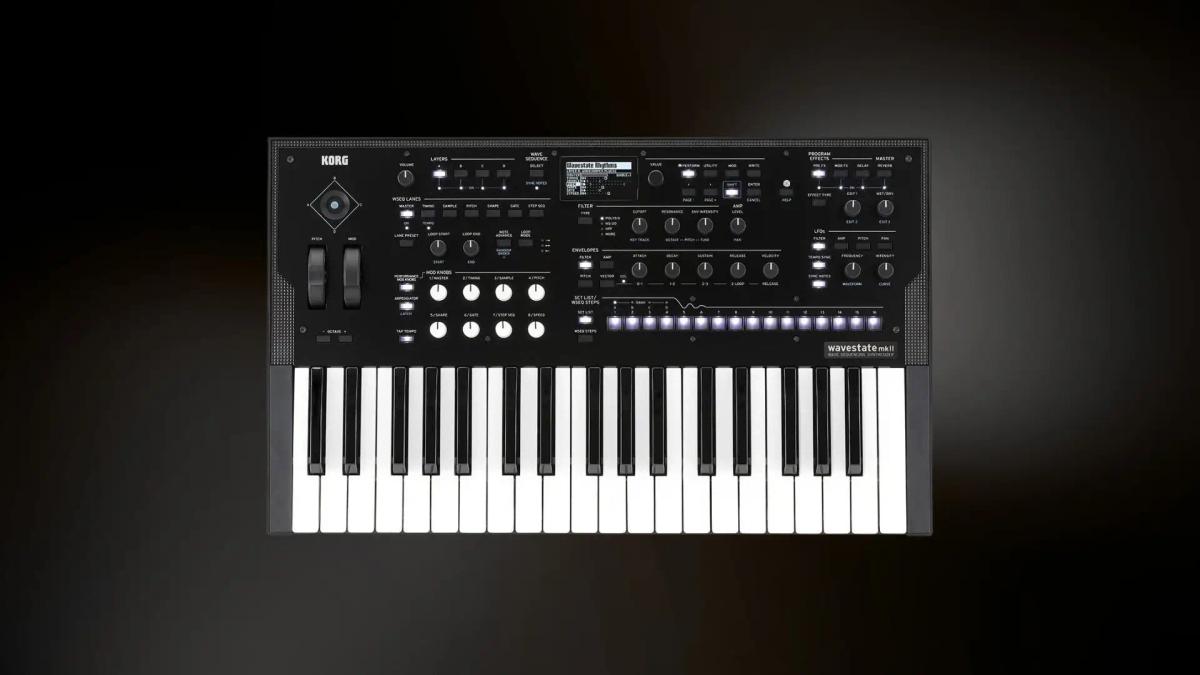
Introduced in 2020, the Korg Wavestate is a 37-key digital synthesizer built around Wave Sequencing 2.0, a substantially redesigned version of the technology associated with the original 1990 Wavestation. The first-generation instrument combines 64 stereo voices, four independently programmable Layers, vector control, modeled filters, extensive modulation and a large sample library in a compact performance keyboard. It is neither a conventional sample workstation nor a replica of the Wavestation. Instead, it turns the older instrument’s linear sample sequences into a flexible system of independently moving lanes, probabilities and modulation relationships.
Table of Contents
Korg Wavestate Sound and Character
The Korg Wavestate’s defining quality is movement. Many synthesizers begin with a comparatively stable oscillator and create animation by applying envelopes, LFOs or effects. The Korg Wavestate can change the source material itself as a note develops, moving through sequences of samples while independently altering their timing, pitch, gate length, contour and modulation values. Because these elements can run at different lengths and loop points, a sound may continue recombining itself without settling into an immediately obvious repetition.
This architecture naturally favors evolving pads, cinematic beds, rhythmic pulses, animated textures, fragmented acoustic hybrids and sounds that occupy the boundary between a synthesizer patch and a miniature arrangement. Composer Yuzo Koshiro has described using it for background material and soundscapes, sometimes adding the Korg Wavestate when he wants something more chaotic than an ordinary pad. Independent reviewers similarly identified ethereal movement and rhythmic complexity as particular strengths.
The Korg Wavestate can also produce conventional strings, bells, keyboards, basses and synthetic leads, but its identity is clearest when samples are treated as events rather than static oscillator cycles. The factory material includes the original Wavestation waves and sequences alongside samples contributed by Korg, Plugin Guru and libraries associated with instruments such as the Kronos and Krome. Modeled MS-20 and Polysix filters, conventional multimode filters and a broad effects section can give those digital sources a harder, warmer or more processed edge.
Its overall tone is polished, spacious and unmistakably digital. It can suggest vintage Korg textures, but it does not imitate the instability or physical density of an analog polysynth. Nor is it primarily designed to reproduce acoustic instruments with workstation-style realism. Its real territory is constructed motion: sounds whose internal behavior is as important as their basic timbre. That makes it especially effective for ambient music, electronic scoring, experimental pop, game music, progressive electronic styles and rhythmically detailed sound design.
Features and Architecture
- Manufacturer: Korg.
- Year introduced: Announced in January 2020 and released during the first part of that year. Contemporary launch coverage listed a US price of $799.99, while later hands-on coverage reported April 2020 availability.
- Production years: The original first-generation keyboard belongs to the 2020–2023 period of the product line. Korg announced the 37-key Korg Wavestate mk II successor on June 20, 2023.
- Synthesis type: Digital, sample-based Wave Sequencing 2.0 with vector synthesis, subtractive filtering, modulation and effects processing.
- Category: Polyphonic wave-sequencing synthesizer and performance-oriented digital sound-design instrument.
- Polyphony: Maximum of 64 stereo voices on the original Korg Wavestate. The later mk II increased this to 96 stereo voices.
- Original price: Approximately $799.99 in the United States and £699 in the United Kingdom at launch.
- Current market price: In August 2026, the current Korg Wavestate mk II is advertised at approximately $599.99 by major US retailers and around $539 through Thomann’s international store. Reverb’s guide for the discontinued original model indicates a typical used range of approximately $281 to $405, although individual asking prices may be higher.
- Sound sources: Each Program uses either a Wave Sequence or a single multisample source. Up to four Programs can be combined as Layers inside one Performance. The engine does not contain a separate virtual-analog oscillator section, although its sample library includes many synthetic and single-cycle sources.
- Wave Sequencing architecture: Independent Timing, Sample, Pitch, Shape, Gate and Step Sequence lanes can use different lengths, start points, end points and loop structures. Individual steps can also use probability and randomized playback order.
- Filters: Two-pole and four-pole low-pass, high-pass, band-pass and band-reject filters; Multi Filter; modeled MS-20 low-pass and high-pass filters; and a modeled Polysix low-pass filter.
- LFOs: Three LFOs are included among the Program-level modulation sources.
- Envelopes: Three conventional envelopes plus a Vector Envelope. The Vector Envelope can control Layer balance and can also be routed to other parameters.
- Modulation system: Pitch and modulation wheels, an X/Y Vector Joystick, eight programmable Mod Knobs, two Mod Processors, key tracking, velocity, release velocity, MIDI continuous controllers, external aftertouch and numerous internal performance states can be used as sources. Korg states that, depending on sequence length, a single Program may expose more than 1,000 potential modulation destinations.
- Sequencing and arpeggiation: Four arpeggiators are available, one for each Layer. Wave Sequencing controls sample and parameter events, but the Korg Wavestate is not equipped with a conventional workstation-style multitrack song sequencer.
- Effects: Each of the four Layers has a Pre FX, Mod FX and Delay slot. A Performance adds master reverb and four-band parametric EQ, allowing 14 processors to operate simultaneously. Algorithms include compression, EQ, waveshaping, ring modulation, chorus, ensemble, phasing, flanging, wah, reverse delay, tape echo, early reflections and the Overb reverb algorithm.
- Memory: The original model shipped with more than 240 Performances, 740 Programs and 1,000 Wave Sequences, with storage for tens of thousands of user Performances. System version 2.0 added support for importing up to 4GB of user multisamples.
- Keyboard: 37 full-size keys sensitive to velocity and release velocity. The original keyboard does not generate aftertouch, although the engine can respond to channel or polyphonic aftertouch received through external MIDI.
- Inputs and outputs: Impedance-balanced left/mono and right 6.3mm TRS outputs, 6.3mm stereo headphone output, damper-pedal input, MIDI In and Out and USB-B. No audio input is included in the published specification.
- MIDI and USB: Five-pin MIDI In and Out plus class-compliant USB-MIDI connectivity for macOS and Windows. The USB specification is for MIDI communication rather than integrated multichannel audio interfacing.
- Display: Compact monochrome OLED display. It provides access to detailed parameter pages, but its physical size limits how much of the deep architecture can be visualized simultaneously.
- Dimensions: 565 × 338 × 92mm, or approximately 22.24 × 13.31 × 3.62 inches.
- Weight: 2.9kg, or approximately 6.93 pounds.
- Power: External 12V DC, 2.5A adapter. Rated power consumption is 5W.
Strengths
- Wave Sequencing 2.0 is genuinely structural rather than cosmetic. Separating sample order, pitch, timing, gate, shape and modulation into independent lanes changes how sequences behave. It permits controlled variation and non-repeating relationships that would require several synchronized modulation and sequencing devices in a more conventional setup.
- Four Layers create complete but still playable Performances. Each Layer can have its own Program, keyboard and velocity zones, effects and arpeggiator. The vector system can then transform the balance between them during performance instead of treating the Layers as a fixed stack.
- It is unusually capable at producing motion without DAW automation. Probability, different lane lengths, independent loop points, random order and per-step modulation allow a held chord to evolve internally. This gives the Korg Wavestate particular value for ambient composition, scoring and electronic arrangements that need continuous variation.
- The front panel exposes the most musically important controls. Filter, envelopes, LFOs, Wave Sequence lanes, vector movement and eight Performance-specific Mod Knobs can all be manipulated without beginning every task in a menu. The Randomize function can also be restricted to selected sections rather than replacing the entire sound indiscriminately.
- Its effects are integrated into the sound architecture rather than added as an afterthought. Three effects per Layer allow individual components of a Performance to occupy different spectral and spatial roles before reaching the common reverb and EQ.
- Korg substantially expanded the Korg Wavestate after launch. Free system updates added 4GB user-sample import, an Editor/Librarian, Performance Hold, pitch-lane scale constraints, improved category navigation and vector crossfade options. These additions made the Korg Wavestate more open and easier to integrate into larger production systems.
Limitations
- The programming depth can exceed what the hardware screen communicates comfortably. The OLED is clear, but the combination of four Layers, multiple Wave Sequence lanes, per-step settings and extensive modulation creates unavoidable menu navigation. The software Editor/Librarian is often a more practical environment for detailed construction.
- The 37-key keyboard does not generate aftertouch. That omission is particularly noticeable because the synthesis engine can use both channel and polyphonic aftertouch as modulation sources. External controllers can unlock this capability, while the larger Wavestate SE incorporates aftertouch directly.
- Its lightweight construction does not feel like a flagship instrument. The original model weighs only 2.9kg, and contemporary reviews described a largely plastic enclosure with a partial metal panel. This improves portability but can make the hardware feel less substantial than the synthesis engine suggests.
- It is easier to obtain spectacular complexity than disciplined simplicity. Randomization, factory Performances and layered Wave Sequences can generate immediate results, but understanding why a complex patch behaves as it does requires careful inspection of several interdependent systems.
- It is not the strongest choice for traditional analog immediacy. Although the filter models are useful and the sample library contains synthetic waveforms, the Korg Wavestate’s fundamental character remains sample-based and digital. Reviewers found it more persuasive for animated textures and rhythmic complexity than for weighty monophonic sounds.
- Its four-Layer structure is not a replacement for workstation multitimbrality. The Korg Wavestate can build elaborate splits, layers and internally animated Performances, but it does not provide the broad 16-part arrangement structure, audio recording or song sequencing associated with a full production workstation.
Historical Context
The Korg Wavestate cannot be understood without the Wavestation, introduced in 1990. The earlier instrument combined vector synthesis with Wave Sequencing, allowing PCM waves to be arranged into evolving chains instead of functioning only as static oscillator sources. That design was connected to ideas developed in the Sequential Circuits Prophet VS and to engineers and sound designers who moved from the Sequential environment into Korg’s California research operation.
The Wavestation became historically important because it treated change over time as part of the oscillator architecture. It could produce complex rhythmic figures and soundtrack-like textures from a single held note, but programming it through a compact 1990-era interface could be demanding. Korg subsequently carried aspects of Wave Sequencing into the OASYS and Kronos workstations, while software versions kept the Wavestation library available after the original hardware family disappeared.
The Korg Wavestate appeared three decades later, when sequencing, modular modulation, probability and algorithmic processes had become central to contemporary electronic production. Rather than reproducing the Wavestation’s architecture exactly, Korg separated its sequencing dimensions into independent lanes. That decision reflects the influence of modular sequencers, grooveboxes and generative composition more clearly than the architecture of a traditional early-1990s keyboard.
Its launch therefore represented both a return and a correction. Korg recovered a synthesis concept strongly associated with its own history, but removed the rigid relationship between sample, pitch and duration that had constrained the original sequencing method. The result was less a revival of a vintage instrument than the modernization of an unfinished idea.