

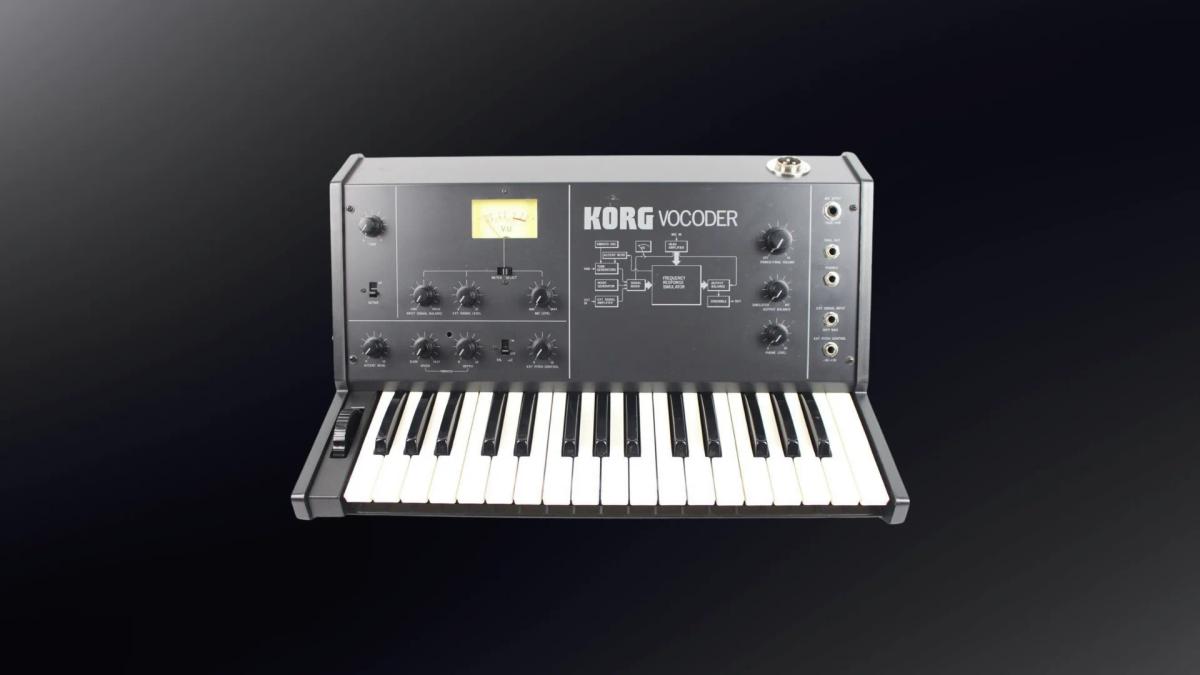
The Korg VC-10 is a 20-band analog vocoder that Korg introduced in 1978 as part of its MS series, alongside the MS-20 and MS-10 synthesizers and the SQ-10 sequencer. It was Korg’s first vocoder, and it was built to work on its own: inside the MS-10’s chassis sit a fully polyphonic 32-key divide-down tone generator to act as the carrier, a gooseneck microphone input for the voice, an ensemble effect and a glowing VU meter. Earlier vocoders were mostly studio processors that needed a separate keyboard instrument. By combining the parts in one portable box, the Korg VC-10 made the robot voice something a keyboardist could set up and play in minutes, which is why Korg now describes it as the first vocoder with a built-in keyboard.
Table of Contents
Korg VC-10 sound and character
A vocoder splits a modulator signal, usually a voice, into frequency bands, follows the level in each band and applies those levels to the same bands of a carrier signal. On the Korg VC-10 the analyzer and the matching filter bank each have 20 bands, and the carrier normally comes from its own tone generator: a sawtooth per key, with optional white noise mixed in. The result is a classic late-1970s analog vocoder sound, buzzy and synthetic, with intelligible speech when the voice is clear and the carrier is bright.
Its character is shaped by a few design choices. According to a technical description published with Full Bucket Music’s FBVC emulation, the VC-10 has no voiced/unvoiced detector, and its top four filter bands receive only the noise signal rather than the sawtooth. That helps sibilants and consonants come through, but it can also make the top end hissy and less precise than on larger studio vocoders. Synthtopia’s demo noted that the noise generator is itself fairly noisy and that some carrier bleed can be heard even when nobody is speaking into the microphone.
The extras soften the electronic edge. Accent bend adds a small pitch inflection to make the result more voice-like, vibrato has its own speed and depth controls, and the ensemble effect, derived from Korg’s PS series, spreads the sound into a wider, chorus-like texture that suits choir pads. A mix control sets the balance between the dry voice and the vocoded signal.
Because the carrier and modulator inputs can be replaced with external sources, the Korg VC-10 is not limited to speech. A guitar, synth or drum loop can be used as either signal, which turns it into a talk-box style effect or a rhythmic filter bank. It sits firmly on the vintage, lo-fi side of the vocoder family: less refined than a Sennheiser or EMS studio vocoder, but quick, direct and characterful.
Features and architecture
- Manufacturer: Korg (Keio Electronic Laboratories), Tokyo
- Year introduced: 1978, launched with the MS series
- Production years: 1978 to 1982 according to Vintage Synth Explorer and the Swiss Museum for Electronic Music Instruments
- Synthesis type: analog channel vocoder with an internal divide-down tone generator
- Category: self-contained keyboard vocoder
- Polyphony: fully polyphonic; 32 notes, one oscillator per key
- Original price: Wikipedia gives US$1,299 excluding the microphone; other launch prices are not well documented
- Current market price: Reverb’s price recommendation sits around $1,450, while serviced units from dealers are often listed far higher
- Vocoder: 20-band analyzer and 20-band synthesis filter bank; the top four bands are fed only by noise; no voiced/unvoiced detection
- Carrier: internal sawtooth tone generator with optional white noise; external carrier input for guitar, synth or other sources
- Filter: fixed vocoder filter banks; no conventional VCF
- LFOs: vibrato with speed and depth controls
- Envelopes: none in the synthesizer sense; band levels follow the modulator signal
- Modulation system: accent bend for voice-like pitch inflection, vibrato, octave and tune controls, and an external pitch control (CV) input
- Sequencer / arpeggiator: none
- Effects: ensemble effect derived from Korg’s PS series
- Memory: no patch memory
- Keyboard: 32 full-size keys, no velocity or aftertouch
- Inputs / outputs: proprietary three-pin socket for the MC-01 gooseneck microphone plus a standard 1/4-inch microphone input, external signal input, external pitch control input, audio output
- MIDI / USB: none; the instrument predates MIDI
- Display: analog VU meter for input level
- Dimensions / weight: shares the basic chassis of the MS-10; published weight figures are not consistently documented
- Power: internal power supply, built in voltage-specific versions for different markets
Strengths
- It is genuinely self-contained. The tone generator, keyboard, microphone and effects are all in one box, so a vocoder part can be played without any other instrument.
- Full polyphony means chords are vocoded as easily as single notes, which makes it well suited to choir pads and harmonized vocal lines.
- The ensemble effect and accent bend give it a warmer, more animated result than a dry vocoder, especially on sustained chords.
- External carrier and pitch inputs make it flexible. Guitars, synths and drum loops can be run through its filter banks, and the tone generator can be controlled from other CV gear.
- It is quick to use. A handful of controls and a level meter get usable results fast, which suited live performance as much as the studio.
- It has a distinct, period-correct analog sound that plugins and modern vocoders still emulate.
Limitations
- The 20 bands and the noise-only upper bands limit intelligibility compared with larger studio vocoders, and the top end can sound hissy.
- There is no voiced/unvoiced detection, so consonants depend on how the noise is set rather than being switched in automatically.
- The internal carrier is a fixed sawtooth-and-noise source with no filter or envelope, so tonal variety needs an external synth.
- The original MC-01 microphone used a proprietary connector, and many units now turn up without it.
- Carrier bleed and background noise are common on vintage units, so careful gain staging or servicing may be needed.
- The 32-key keyboard is short, has no velocity and offers no MIDI, so integrating it into a modern rig requires CV conversion or external carriers.
- Serviced examples are increasingly expensive relative to what the hardware offers.
Historical context
The Korg VC-10 came out of the same push that produced Korg’s MS series. Sound On Sound’s 2024 retrospective describes how senior engineer Fumio Mieda led a plan, from late 1977, to build a family of affordable instruments, completed by spring 1978. Korg launched them as a coordinated system: the MS-20 and MS-10 synthesizers, the SQ-10 sequencer and the Korg VC-10 vocoder, all sharing the same industrial style and control conventions.
Vocoders were already known through studio units from EMS, Sennheiser and others, and Kraftwerk had made the sound familiar to pop audiences, a story covered in the site’s article on how Kraftwerk turned the Minimoog and vocoders into the blueprint for electronic pop. What those systems lacked was convenience. Korg’s answer was to share the MS-10’s chassis, add a divide-down tone generator borrowed from organ and string-machine practice, and ship a gooseneck microphone, so that the vocoder became a keyboard instrument in its own right. Roland followed with the VP-330 Vocoder Plus in 1979, covered separately on this site.