

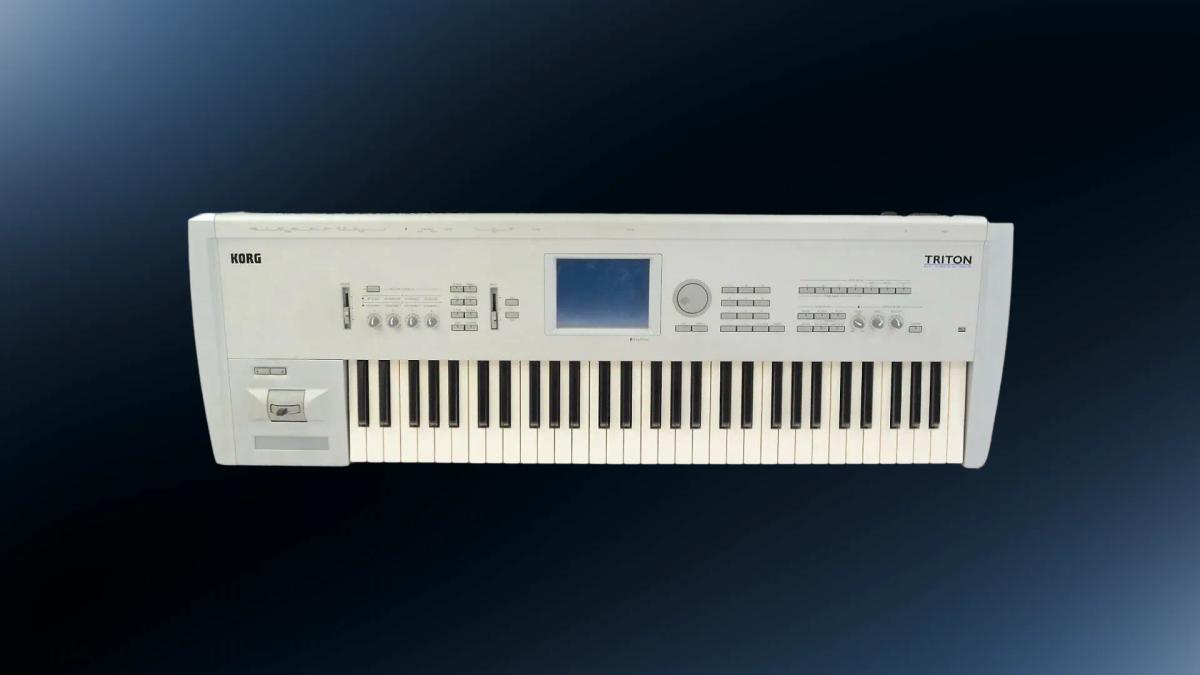
The Korg Triton is a sample-based music workstation introduced in 1999 as the successor to the Trinity, offered as the 61-key Korg Triton, the 76-key Triton Pro and the weighted 88-key Triton ProX. It combined Korg’s HI (Hyper Integrated) synthesis, 62-voice polyphony, a built-in sampler, dual arpeggiators, a 16-track sequencer and a TouchView screen, at a lower price than the Trinity. Its factory programs and drum kits went on to shape 2000s hip-hop, R&B, pop and UK grime, and the original model, now usually called the Korg Triton “Classic,” founded one of Korg’s most successful product lines.
Table of Contents
Sound and character
The Triton sounds clean, bright and polished, with real weight in the low mids. Korg‘s own history credits part of that full low-mid character to its D/A converter, and recalls a quality-assurance manager singling out “the texture of the lows” when approving the demo songs. Sound On Sound’s 1999 review found the samples clear and sparkling, with loop points almost impossible to detect, smoothed with Jupiter Systems’ Infinity software.
Its strongest territory is pads, imitative instruments and ready-made production sounds. Sound On Sound called the pads “largely wonderful,” while the factory set leaned further toward dance music than the Trinity’s, with club-oriented drum kits, DJ-style scratches, yells and hits. That choice proved decisive: the presets that made the Korg Triton a useful stage keyboard also made it an instant source of beats, stabs and hooks for producers who did not want to program from scratch.
The character comes from the architecture rather than from analog color. Up to two sample-playback oscillators per Program, a resonant filter that reviewers found “meatier and more resonant” than the Trinity’s, and an effects section strong enough to make sounds feel finished straight from the box add up to a modern, produced sound rather than a gritty or experimental one. The optional Z1-based MOSS board added a more synthetic side.
Features and architecture
- Manufacturer: Korg
- Year introduced: 1999
- Production years: 1999 into the early 2000s; the Triton Studio superseded it as flagship in 2002, and an exact end date for the original model is not well documented
- Synthesis type: HI (Hyper Integrated) sample-based synthesis with built-in sampling; optional MOSS physical-modelling synthesis via the EXB-MOSS board
- Category: keyboard music workstation (synthesizer, sampler, sequencer and effects)
- Polyphony: 62 voices in single-oscillator mode, 31 in double mode; 68 voices with the EXB-MOSS board installed
- Multitimbrality: 8 parts in Combination mode, 16 parts in Sequencer mode
- Original price: £1,799 including VAT in the UK for the 61-key model, around £600 less than the Trinity at launch
- Current market signal: modest on the used market; Attack Magazine’s buying guide placed the original Korg Triton and Triton Le at around £250 to £450
- Oscillators: up to 2 oscillators per Program, drawing on 32 MB of PCM ROM with 425 multisamples and 413 drum samples; velocity switching between oscillators and between two waveforms within each oscillator, oscillator delay, random tuning and reverse playback
- Filter: resonant digital filters with two types, a 24 dB/octave low-pass or a combined 12 dB/octave low-pass and high-pass
- LFOs: 2 LFOs
- Envelopes: dedicated envelope generators within each Program, with a broader modulation set than the Trinity’s
- Modulation system: joystick, ribbon, two assignable switches and four real-time knobs in two banks (one preset to cutoff, resonance, EG intensity and release), plus pedal inputs
- Sequencer / arpeggiator: 16-track sequencer (192 ppqn, around 100,000 events, 200 songs, Standard MIDI File support); RPPR (Realtime Pattern Play/Recording) for triggering patterns from single keys; dual polyphonic arpeggiators
- Sampler: 16-bit, 48 kHz mono or stereo; 16 MB RAM, expandable to 64 MB via two SIMM slots; imports Akai S1000/3000, AIFF, WAV and Trinity formats; Time Slice and Time Stretch came with the version 2.0 operating system
- Effects: 5 stereo insert effects, 2 master effects and a 3-band master EQ; 89 master and around 100 insert effect types (Sound On Sound counted 101, Korg lists 102), including a vocoder
- Memory: 640 Program and 512 Combination locations, including banks for expansion boards and sampled sounds; 64 user drum kits; a General MIDI bank of 256 Programs and 9 drum kits; 3.5-inch floppy drive
- Keyboard: 61 keys (Triton), 76 keys (Triton Pro) or 88 weighted keys (Triton ProX), all with velocity and aftertouch
- Inputs / outputs: stereo main outputs, four individual outputs, headphones, two mic/line audio inputs, damper and assignable pedal/switch jacks
- MIDI / USB: MIDI In, Out and Thru; serial TO HOST port for direct Mac/PC connection; no USB and no digital audio I/O
- Expansion: two EXB-PCM sound-board slots, EXB-MOSS synthesis board, EXB-SCSI interface
- Display: backlit 320 × 240 dot TouchView touchscreen
- Dimensions / weight: Triton 1,074.4 × 348.5 × 122 mm, about 14.3 kg; Triton Pro 1,281.4 × 348.5 × 122 mm, about 16.7 kg; Triton ProX 1,472 × 436.5 × 137 mm, about 28.5 kg
- Power: internal AC mains supply, 26 W consumption
Strengths
- It nearly doubled the Trinity’s polyphony, from 32 to 62 voices, at a lower price, which made layered Combinations and dense multitimbral sequences practical on one keyboard.
- The sampler was standard rather than optional. With 16 MB of RAM, Akai import and sampling through the insert effects, it could build kits and loops without a separate hardware sampler.
- The factory sounds were unusually production-ready. Drum kits, pads, basses, keys and hits could be dropped into a track almost unchanged, which is exactly how many producers used them.
- Dual polyphonic arpeggiators and RPPR made it a composition tool as well as a keyboard, running bass lines, drum patterns and phrases from single keys.
- Five inserts usable in both Combinations and songs, two master effects and a sweepable master EQ let sounds leave the instrument close to finished.
- The touchscreen, real-time knobs, joystick and ribbon made a deep instrument easier to navigate than many menu-driven workstations of the period, and expansion boards and RAM were user-installable.
Limitations
- There was no digital audio I/O and no hard disk recording option, both of which the Trinity had offered. Sound On Sound called the lack of digital connectivity “almost perverse.”
- Sample RAM is volatile: samples are lost at power-off unless saved, and backing up 16 MB took around a dozen floppy disks.
- At launch it could not export samples and lacked time-stretching and crossfade looping; some of this arrived only with the version 2.0 operating system.
- MOSS voices shared a single effects chain, and Trinity sounds and expansion boards were not compatible.
- The preset drum patterns lacked variety, and the sequencer had no time display for checking song length.
- Deep sound design is harder than on an analog or virtual-analog synth; the instrument rewards preset selection and light editing more than programming from scratch.
- The ProX weighs roughly 28.5 kg, and all models now depend on aging floppy drives and touchscreens.
Historical context
The Korg Triton descends from the Korg M1 of 1988, which popularized the integrated workstation, and more directly from the Trinity of 1995. The Trinity was admired for its sound and touchscreen, but its 32-voice polyphony drew criticism and its price was high. Korg’s own history says the Triton was developed as a cheaper successor, and Sound On Sound’s review confirmed both halves of that answer: nearly twice the polyphony and a launch price around £600 below the Trinity.
The engineering behind the shift was a new tone generator. The Korg Triton ran on two 32-note TG96 chips that combined sample playback, filtering and effects on one device after roughly three years of development, whereas the Trinity used discrete chips on a processor board. That integration made more voices, outputs and effects possible at lower cost.
The timing mattered too. By 1999 sampling and beat-making were central to commercial music, and the Korg Triton placed a sampler, arpeggiators, pattern triggering and a club-ready sound set inside a flagship keyboard priced closer to working musicians. Korg then built a family around it: the Triton Rack in 2000, the cheaper Triton Le in 2001, the 120-voice Triton Studio in 2002 with a built-in piano and hard disk, and the Triton Extreme in 2004 with a vacuum-tube “Valve Force” stage and almost all EXB-PCM sounds preloaded.