

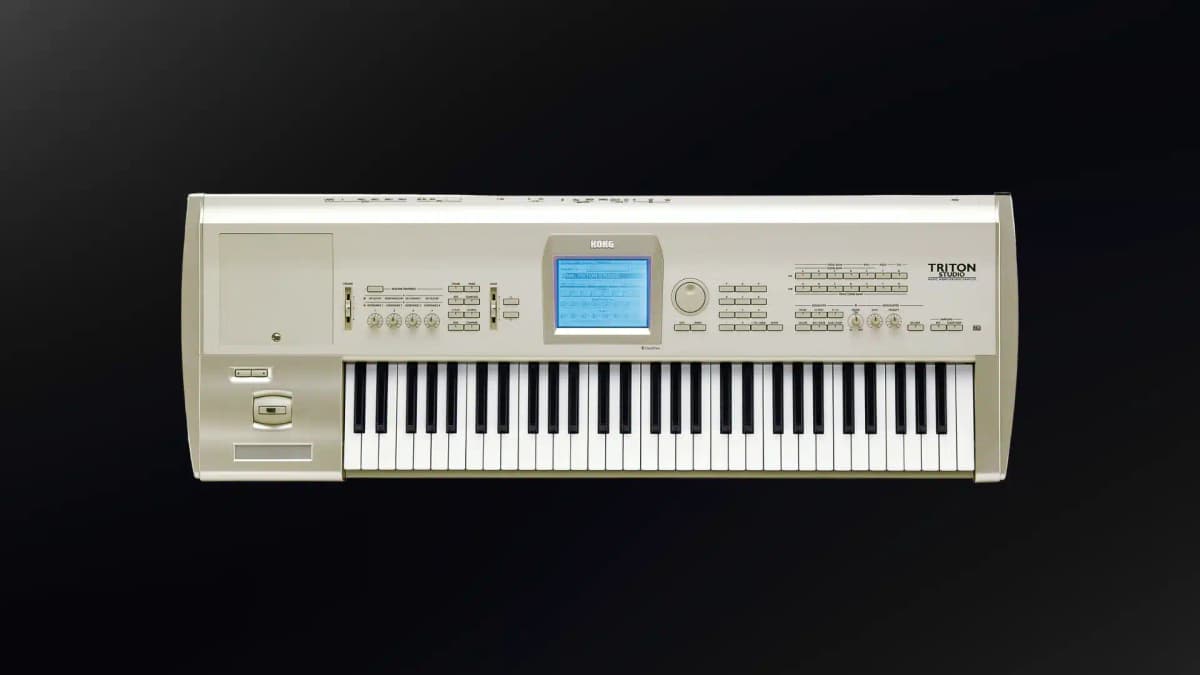
The Korg Triton Studio is a sample-based music workstation that Korg launched in 2002 as the new flagship of the Triton line, offered in 61-, 76- and weighted 88-key versions. It kept the Triton’s HI synthesis, sampler, dual arpeggiators and TouchView screen, then expanded nearly everything around them: 120 voices split across two pools, a built-in 16 MB stereo piano, seven expansion slots, up to 96 MB of sample RAM, an internal hard disk, SCSI and optical S/PDIF as standard, and an optional internal CD-RW drive. What makes it matter is ambition: it was Korg’s attempt to make a keyboard that could take a track from first idea to finished audio CD without a computer.
Table of Contents
Korg Triton Studio sound and character
The Korg Triton Studio sounds like a Triton with more room to breathe. The core 32 MB PCM set, the filters and the 102-type effects library are shared with the original, so its basic character is the same clean, bright, mid-heavy sound that defined the series, covered in the site’s article on the original Korg Triton. What changes is how much of that sound can play at once and how much material is available beyond the factory ROM.
The most audible addition is the piano. The Korg Triton Studio preloads the 16 MB stereo acoustic piano that Korg also sold as the EXB-PCM08 board, and Sound On Sound’s Paul Nagle rated it highly in his July 2002 review. A French owner on Audiofanzine was more measured, finding the pianos good but not on the level of Yamaha’s samples, and some owners criticize the drums, guitars and electric pianos. Seven EXB-PCM slots let owners add libraries such as orchestral, vintage keys and dance sets, so two Studios can sound quite different depending on which boards are installed.
Polyphony shapes the sound in practice. The 120 voices are divided into two pools of 60: one for the internal ROM and user samples, the other for the piano and expansion boards. A dense Combination built only from ROM sounds therefore behaves like a 60-voice instrument, while one mixing ROM with piano and board sounds can use the full count. The result is an instrument best at big layered stage patches and full arrangements, still polished and produced rather than raw, but with more weight available than any earlier Triton.
Features and architecture
- Manufacturer: Korg
- Year introduced: 2002
- Production years: 2002 to around 2005; the version 2.0 operating system followed in 2003, and the Triton Extreme took over as flagship in 2004; an exact end date is not well documented, and Korg had discontinued the Triton family by 2008
- Synthesis type: HI (Hyper Integrated) sample-based synthesis with built-in sampling; optional MOSS physical-modelling synthesis via the EXB-MOSS board
- Category: flagship keyboard music workstation with integrated hard disk and CD production tools
- Polyphony: 120 voices in single mode, split into two pools of 60 (ROM and RAM samples in one, piano and EXB-PCM samples in the other); double-oscillator Programs halve the count
- Multitimbrality: 8 parts in Combination mode, 16 tracks in Sequencer mode
- Original price: £2,349 for the 61-key model, £2,549 for the 76-key and £2,999 for the 88-key, including VAT in the UK; one zZounds reviewer cites around $3,500 retail for the 88-key in the US
- Current market price: Equipboard’s tracking of Reverb showed scattered used listings from about $300 to about $940 in late 2026, and a Reverb listing for an 88-key unit showed a price recommendation midpoint of $962
- Oscillators: up to 2 oscillators per Program; 48 MB PCM ROM including the 16 MB stereo piano, with 429 multisamples and 417 drum samples
- Filter: resonant digital filters per oscillator, 24 dB/octave low-pass or combined 12 dB/octave low-pass and high-pass
- LFOs: 2 per Program
- Envelopes: pitch, filter and amplitude envelopes per Program
- Modulation system: joystick, ribbon controller, two assignable switches, four real-time knobs and pedal inputs
- Sequencer / arpeggiator: 16-track sequencer with In-Track Sampling to RAM (just under three minutes of mono audio per sample); RPPR pattern play and record; dual polyphonic arpeggiators; version 2.0 added two hard-disk audio tracks and a bounce function
- Sampling: 16-bit, 48 kHz mono or stereo, to RAM or directly to the internal hard disk as WAV files (up to 80 minutes); 16 MB RAM supplied, expandable to 96 MB via three SIMM slots; Akai import, Time Slice and Time Stretch
- Effects: 5 insert effects, 2 master effects and a 3-band master EQ, from 102 effect types
- Storage: internal 2.5-inch IDE hard disk (around 5 GB, with about 4.6 GB usable in the unit Sound On Sound tested; later bundles advertised larger drives); SCSI standard; optional internal CDRW-1 drive for writing and ripping audio CDs
- Expansion: seven EXB-PCM slots installable from the front panel, EXB-MOSS, EXB-DI (ADAT output and word clock) and EXB-mLAN
- Keyboard: 61 or 76 keys, or 88 weighted keys; velocity and aftertouch
- Inputs / outputs: stereo main outputs plus four individual outputs, two analog inputs, optical S/PDIF in and out at 48 or 96 kHz, headphones and pedal inputs
- MIDI / USB: MIDI In, Out and Thru; no USB
- Display: 320 × 240 TouchView touchscreen
- Dimensions / weight: Sound On Sound gives 17.2 kg for the 61-key model; the larger versions are heavier, and owners consistently describe the 88-key as bulky
- Power: internal AC mains supply
Strengths
- It solved the original Triton’s polyphony problem. With two pools of 60 voices, piano and expansion sounds no longer had to compete with the main ROM for notes in big Combinations.
- The built-in stereo piano and seven expansion slots made it the most expandable Triton. Owners could combine the factory ROM, the piano and several EXB-PCM libraries in one instrument.
- Standard SCSI, optical S/PDIF and an internal hard disk fixed the connectivity gaps of the 1999 Triton, which had shipped with no digital audio I/O at all.
- Sampling straight to disk removed the RAM ceiling for long recordings, and In-Track Sampling let vocals or guitar phrases sit inside a sequence without leaving the keyboard.
- With the optional CD-RW drive, a song could be mixed, bounced and burned to an audio CD inside the instrument, which Sound On Sound described as a studio-in-a-workstation package.
- The free version 2.0 update added two hard-disk audio tracks and bouncing, extending the instrument’s recording role after purchase.
Limitations
- The polyphony figure needs a footnote. Sounds drawn only from the internal ROM and sample RAM are limited to 60 voices, and Sound On Sound called the implementation somewhat confusing.
- Samples do not load automatically at power-up and there is no Flash RAM option, so sample-based setups must be reloaded from disk each time.
- Audio recording is limited by later standards. In-Track samples are capped at just under three minutes of mono audio, and even after version 2.0 the hard-disk recorder offers only two tracks.
- Some disk and file operations are clumsy, as Sound On Sound noted, and loading large sample sets is slow compared with modern instruments.
- Sample RAM tops out at 96 MB, which some owners found too limited even at the time.
- It is heavy, and the internal IDE hard drive and optional CD-RW drive are now aging mechanical parts.
- Expansion boards and RAM have become secondhand-only items, so the specification of a used unit depends heavily on what a previous owner fitted.
Historical context
By 2002 the Triton had become Korg’s most successful workstation, but its 1999 design showed gaps: 62 voices, volatile RAM saved to floppy, no hard disk option and no digital audio I/O. At the same time computer-based recording was spreading quickly, and workstation makers were deciding whether their keyboards should compete with the computer or complement it. Korg’s answer with the Korg Triton Studio was to keep the sound engine and pull more of the studio into the keyboard.
Sound On Sound reviewed the Korg Triton Studio in July 2002 and listed what was new: a built-in hard drive, SCSI and optical S/PDIF as standard, the built-in piano, seven expansion slots, dedicated sampling buttons, a battery-backed calendar and a faster processor, plus the ability to write and rip CDs. Korg’s own history adds that the design team was allowed to work more freely, replacing the silver of the original with champagne gold. In 2003 Korg released version 2.0, a free update that added two audio tracks on the internal disk, track bouncing and automatic sampling setup, and promoted the instrument with rebates and a free CD-RW drive for buyers that spring.
The Studio’s run as flagship was short. In 2004 Korg introduced the Triton Extreme, which preloaded most EXB-PCM libraries in 160 MB of ROM and replaced the hard disk and SCSI with USB and CompactFlash. AudioTechnology’s review of the Extreme described it as offering nearly everything the Korg Triton Studio did for hundreds of dollars less. Retail listings date the Korg Triton Studio’s production to about 2005, and the M3, announced in 2007, succeeded the Triton line as a whole.