

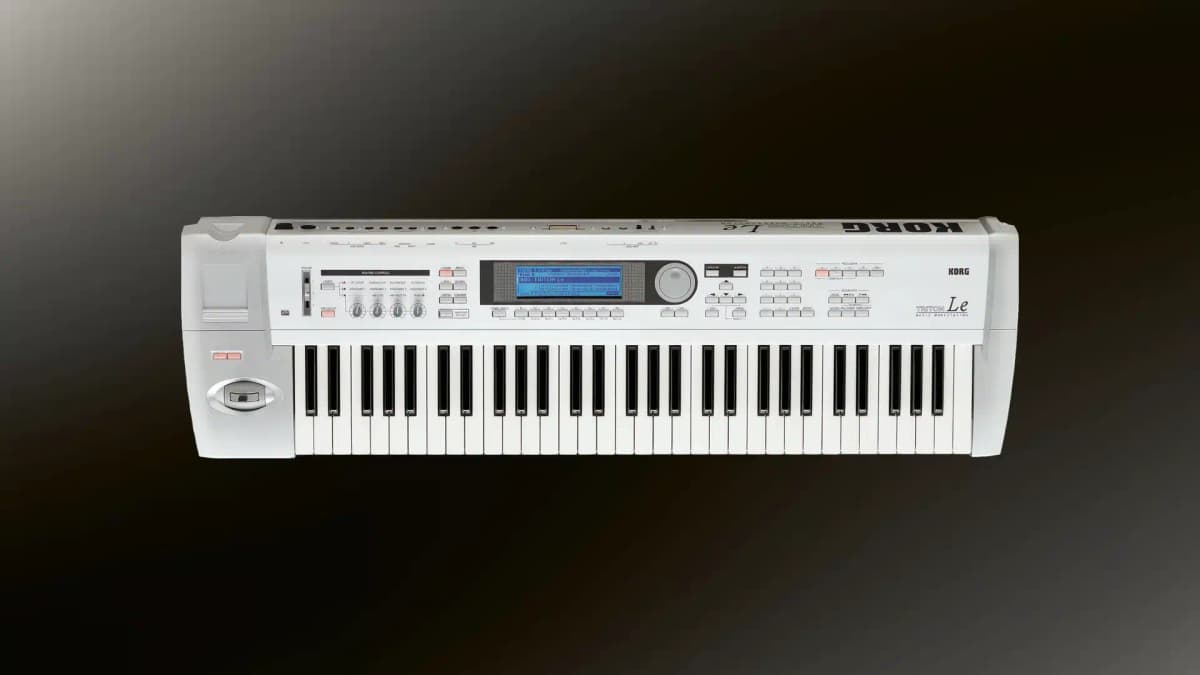
The Korg Triton Le is a sample-based music workstation that Korg introduced in 2001 as a cheaper, simplified version of its Triton flagship, offered with 61 and 76 keys and, from 2002, as the weighted Le 88. It kept the Triton’s 32 MB PCM ROM, 62-voice HI tone generator, 16-track sequencer, RPPR pattern system and dual polyphonic arpeggiators, but replaced the touchscreen with a small LCD, dropped the ribbon, floppy drive and expansion slots, cut the insert effects from five to one and made sampling an option. What makes it matter is reach: it carried the Triton sound to musicians who could not justify the flagship’s price, and it became one of the most common workstations of the decade.
Table of Contents
Korg Triton Le sound and character
The Korg Triton Le sounds like a Triton because, in the parts that make the sound, it is one. Korg’s own history of the series describes the tone generator as nearly unchanged from the original, with the same PCM data and effect algorithms, and Sound On Sound’s Paul Nagle, reviewing it in January 2002, wrote that everything that remained still managed to sound and perform like a Triton. The same clean, bright, mid-heavy multisamples, the same resonant filters and the same master effects are all there.
What changes is how finished a sound can be made inside one patch. The full Triton offers five insert effects; the Le offers one, alongside two master effects and a master EQ. A single Program can still be polished, but in a Combination or a song only one part gets its own insert, so dense arrangements lean harder on the shared reverb and delay. In practice the Le rewards players who build tracks from a few strong parts rather than many separately processed ones.
Korg also refreshed the factory set. Its history page says the Le updated the presets for dance-music users, and Nagle noted a dance-focused selection among the Programs. Sonic State’s user review found the acoustic piano patches improved over earlier Korgs, though the same owner said pianos felt odd on the light 61-key action and suggested a weighted controller. Its character sits firmly in the polished, produced end of the 2000s: excellent at pads, keys, drum kits, stabs and arpeggiated parts, much less suited to raw or unstable textures.
Features and architecture
- Manufacturer: Korg
- Year introduced: 2001 according to Korg; Vintage Synth Explorer and some retail listings give 2000, and Sound On Sound’s review appeared in January 2002; the Le 88 was shown at the summer NAMM show in July 2002
- Production years: 2001 to the mid-2000s; a black Triton Le BK edition of 200 units followed in 2005, and the TR, which Korg dates to 2005, took over the role; an exact end date for the Le is not well documented
- Synthesis type: HI (Hyper Integrated) sample-based synthesis, with optional sampling
- Category: entry-level keyboard music workstation
- Polyphony: 62 voices
- Multitimbrality: up to 8 Programs per Combination; 16 tracks in Sequencer mode
- Original price: £1,099 including VAT in the UK for the 61-key model, about £700 less than the original Triton according to Sound On Sound; US buyers recall paying around $999
- Current market price: Equipboard’s Reverb tracking showed used 61-key units at around $429 in October 2026; Attack Magazine’s buying guide placed the Triton and Korg Triton Le at about £250 to £450
- Oscillators: up to 2 oscillators per Program drawing on 32 MB of PCM ROM with 425 multisamples and 413 drum samples; the Le 88 adds a 16 MB piano ROM
- Filter: resonant digital filter per oscillator, with a 24 dB/octave low-pass type or a combined 12 dB/octave low-pass and high-pass type
- LFOs: 2 per Program, as on the Triton
- Envelopes: dedicated pitch, filter and amplitude envelopes per Program, inherited from the Triton engine
- Modulation system: joystick and assignable real-time knobs; no ribbon controller
- Sequencer / arpeggiator: 16-track sequencer with 200,000-note capacity (double the original Triton’s), 200 songs and 192 ppqn resolution; RPPR with 150 factory and 100 user patterns; two polyphonic arpeggiators with 216 user patterns and five presets
- Sampling: optional EXB-SMPL board, 16-bit 48 kHz stereo, shipped with a 16 MB SIMM and expandable to 64 MB with two 32 MB SIMMs; adds two mic/line inputs, SCSI, Akai S1000/S3000, AIFF and WAV import, and Triton version 2.0 editing such as Time Slice and Time Stretch
- Effects: one stereo insert effect, two stereo master effects and a master EQ, drawing on 89 effect types
- Memory: four user Program banks (A to D) plus a General MIDI bank, and three Combination banks (A to C)
- Storage: SmartMedia card slot supporting cards up to 128 MB; no floppy drive
- Expansion: no EXB-PCM or EXB-MOSS slots; the EXB-SMPL sampling board is the only internal option
- Keyboard: 61 or 76 keys with velocity and aftertouch, lighter than the Triton’s; Le 88 with an RH2 weighted hammer action
- Inputs / outputs: stereo main outputs, two individual outputs, headphones and pedal inputs; audio inputs only with EXB-SMPL fitted
- MIDI / USB: MIDI In, Out and Thru; no USB and no TO HOST computer port
- Display: 240 × 64 dot LCD with no touchscreen, supported by dedicated function keys plus Category and Audition buttons
- Dimensions / weight: brushed aluminum body with plastic end pieces; Sonic State lists the 61-key model at about 16 pounds
- Power: external power supply
Strengths
- It delivers the core Triton sound for far less money. The PCM ROM, filters, master effects and arpeggiators are carried over, so the presets that defined the Triton family are available on the cheapest model.
- The sequencer is better than the flagship’s in one respect. Its 200,000-note capacity doubled the original Triton’s, and owner reviews on zZounds repeatedly single out the 16-track sequencer as the most valuable feature.
- RPPR and the dual arpeggiators survived the cost cutting intact, which keeps the Le a composition tool rather than just a preset player.
- SmartMedia storage was a real improvement over the original’s floppy drive, holding far more data on a card and making sample and song backups far less tedious.
- The optional sampling board added more than sampling: it brought SCSI, audio inputs and the version 2.0 editing tools, so a fully equipped Le could slice and stretch loops like the larger models.
- It is light and simple to carry. At around 16 pounds for the 61-key model, it suited gigging players who wanted Triton sounds without a flagship’s weight.
Limitations
- One insert effect is the biggest sonic compromise. In Combinations and songs only one part can have its own insert, so layered patches and full arrangements never sound quite as finished as on a full Triton.
- There is no expansion path for sounds. The Le cannot take EXB-PCM libraries or the MOSS board, so its palette is fixed at the factory ROM plus whatever is loaded into optional sample RAM.
- The small 240 × 64 display replaces the TouchView screen. Sound On Sound found it slightly slow to update, and deep editing involves more paging than on the touchscreen models.
- The keyboard feels light. Sound On Sound and many owners describe the 61- and 76-key action as less substantial than the Triton’s, with thin plastic trim at the ends.
- It uses an external power supply, which Sound On Sound listed among its drawbacks; a missing or substitute adapter is a common issue on used units.
- It has no ribbon controller and no direct computer connection, and sampling requires a board that is now found only secondhand.
- SmartMedia is an obsolete format, and older cards and readers are increasingly hard to source.
Historical context
By 2001 Korg had a successful but expensive flagship. The Triton, launched in 1999 and covered separately on this site, sat well above the price many home producers, students and cover-band keyboardists could pay, while Yamaha and Roland were competing for the same buyers with their own cheaper workstations. Korg’s answer was not a new engine but a reduction: keep the tone generator, PCM and sequencer, and remove the parts that cost the most, from the touchscreen and expansion slots to most of the insert effects.
Korg’s own account dates the Le to 2001 and describes it as a lower-cost model with updated presets for dance-music fans. It borrowed function keys from the Triton Rack to speed up work on the compact display, and replaced the floppy drive with a SmartMedia slot. Sound On Sound reviewed the 61-key model in January 2002 at £1,099, with the 76-key version expected to cost under £1,350 and the EXB-SMPL sampling upgrade at £229. Nagle concluded that the Le looked like the one to beat at its level. The weighted Le 88, with an added 16 MB piano ROM, followed in mid-2002.
The Le had an unusually long life for a cut-down model. Korg released a black Le BK in 2005, limited to 200 61-key units, and then folded the concept into the TR, which doubled the PCM memory to 64 MB, added a Bösendorfer piano, USB MIDI and an SD card slot. Sound On Sound’s 2006 TR88 review summed it up as basically an LE with a fresh coat of paint and extra samples. The M3 replaced the Triton line as Korg’s workstation in 2007, and the remaining models were discontinued by 2008.