

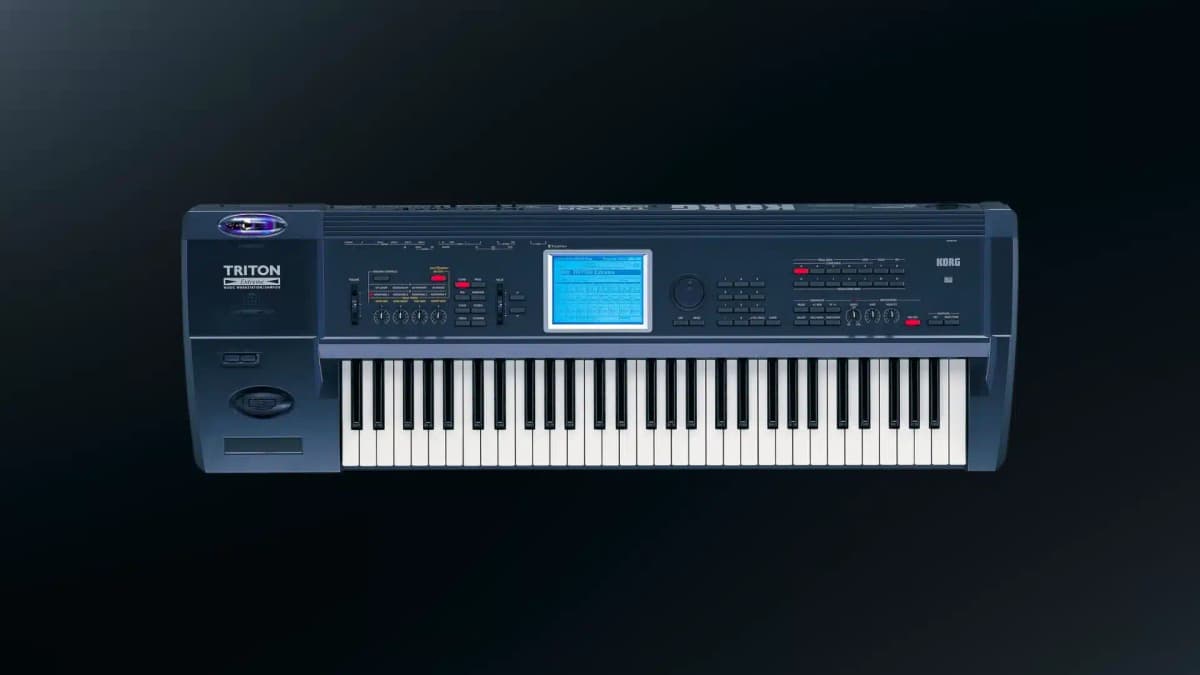
The Korg Triton Extreme is a sample-based music workstation that Korg announced at the NAMM show in January 2004 as the final flagship of the Korg Triton Extreme series, offered in 61-, 76- and weighted 88-key versions. It took the Triton Studio’s 120-voice engine, sampler, sequencer and TouchView screen and changed the priorities around them: wave ROM grew to 160 MB, preloading the Studio’s sounds plus most of Korg’s EXB-PCM expansion libraries; the hard disk, SCSI and expansion slots gave way to USB and a CompactFlash slot; and a 12AU7 vacuum-tube circuit called Valve Force was added to the output. What makes it matter is that it turned the expandable Korg Triton Extreme into a fully loaded one.
Table of Contents
Korg Triton Extreme sound and character
The Korg Triton Extreme has the largest sound set of any Korg Triton Extreme. Its 160 MB ROM holds 962 multisamples and 1,175 drum samples, and Sound On Sound’s Derek Johnson, reviewing it in May 2004, listed the contents: the piano, Orchestral Collection, Trance Attack and Vintage Archives cards in full, plus best-of selections from Dance Extreme, Studio Essentials and Pianos/Classic Keyboards. Sonic State’s NAMM report added new acoustic and electric guitars, woodwinds, brass, organs, choirs and a new concert grand, and Johnson noted that much of the new material came from Korg’s Pa1X Pro arranger. The engine and effects are the familiar Korg Triton Extreme ones, so the base character remains bright, clean and polished, covered in the site’s article on the original Korg Triton.
Valve Force is the part that changes the color. A single 12AU7 dual-triode tube, inherited in concept from Korg’s Electribe MX and SX, which used two, sits behind a small window on the front panel and can be used as an insert effect on a sound or across the main outputs, with an Ultra Boost option for added low end. Wikipedia’s account describes it as warmer, amp-like drive suited to organs, pads and pianos. Johnson observed that the tube barely glows and that the circuit cannot be applied to the digital output, so its effect only reaches the analog outputs.
In practice, Valve Force is subtle at low settings and obvious when pushed. It adds weight and some saturation to sounds that can otherwise feel thin, but it does not make the Extreme an analog instrument. The Extreme’s real strength is breadth: orchestral, vintage keys, trance and dance sounds are all onboard without hunting for expansion boards.
Features and architecture
- Manufacturer: Korg
- Year introduced: 2004, announced at the NAMM show in January 2004; Vintage Synth Explorer gives 2005 and some retail listings 2005 to 2009
- Production years: 2004 to the late 2000s; black limited editions followed in 2005, the M3 succeeded the Korg Triton Extreme line from 2007, and Korg had discontinued the series by 2008; an exact end date is not well documented
- Synthesis type: HI (Hyper Integrated) sample-based synthesis with built-in sampling; optional MOSS physical-modelling synthesis via the EXB-MOSS board
- Category: flagship keyboard music workstation
- Polyphony: 120 voices with single-oscillator Programs, from two 60-voice tone generators; two-oscillator Programs halve the count
- Multitimbrality: 8 parts in Combination mode, 16 tracks in Sequencer mode
- Original price: £1,749 for the 61-key, £1,899 for the 76-key and £2,499 for the 88-key, including VAT in the UK, below the Triton Studio’s launch prices
- Current market price: Equipboard’s tracking of Reverb listings in October 2026 ranged from about $484 for an 88-key unit to about $1,870 for a 61-key unit, a spread that reflects condition, options and edition
- Oscillators: up to 2 oscillators per Program, drawing on 160 MB of 16-bit, 48 kHz PCM ROM with 962 multisamples and 1,175 drum samples
- Filter: resonant multimode digital filter per oscillator, 24 dB/octave low-pass or combined 12 dB/octave low-pass and high-pass
- LFOs: 2 per Program with 21 waveforms each, syncable to the arpeggiator, sequencer or external MIDI clock
- Envelopes: pitch, filter and amplitude envelopes per Program
- Modulation system: Alternate Modulation Source system with 42 sources and 51 destinations; joystick, ribbon controller, four real-time knobs, two assignable switches and three pedal inputs
- Sequencer / arpeggiator: 16-track sequencer with 200,000-note capacity, 200 songs, 192 ppqn resolution, In-Track Sampling, song templates and Cue List; RPPR; dual polyphonic arpeggiators with five preset and 507 user patterns, 489 of them preloaded
- Sampling: Open Sampling System, 16-bit 48 kHz mono or stereo from any mode, to RAM or CompactFlash; 16 MB RAM standard, expandable to 96 MB with SIMMs; Time Slice, Time Stretch, WAV, AIFF and Akai S1000/S3000 import
- Effects: 5 insert effects from 102 types, 2 master effects, a master EQ and the Valve Force tube circuit, which can be bypassed
- Memory: 1,536 Program and 1,536 Combination locations, with about 1,344 Programs and 1,280 Combinations preloaded (Sonic State gives 1,334 Programs); 144 drum kits; a GM2 bank of 256 Programs and 9 kits
- Storage: CompactFlash and Microdrive slot (AudioTechnology cites cards up to 1 GB, Wikipedia up to 8 GB); USB type A port for external drives and CD writers; no internal hard disk, SCSI or floppy drive
- Expansion: no EXB-PCM, EXB-DI or EXB-mLAN slots; options limited to EXB-MOSS and sample RAM
- Keyboard: 61 or 76 synth-action keys, or 88 keys with Korg’s RH2 weighted hammer action; velocity and aftertouch
- Inputs / outputs: stereo main outputs plus four individual outputs, two analog inputs with gain and mic/line switching, optical S/PDIF in and out (input fixed at 48 kHz)
- MIDI / USB: MIDI In, Out and Thru; USB type B for computer connection, USB MIDI and access to the CompactFlash card
- Display: 320 × 240 TouchView touchscreen
- Dimensions / weight: published weight figures for the three sizes are not consistently documented
- Power: internal AC mains supply
Strengths
- It is the most complete Korg Triton Extreme out of the box. With the Studio ROM and most EXB-PCM libraries preloaded, an Extreme sounds fully expanded without anyone having to find, buy and install boards.
- It cost less than the Studio at launch. Sound On Sound and AudioTechnology both concluded that it offered more sound for less money, which is why it largely displaced the Studio as the buyer’s choice.
- USB and CompactFlash modernized storage. Fast cards, external USB drives and computer access replaced SCSI and internal hard disks, making backups and sample loading far simpler than on earlier Tritons.
- Valve Force gives it a sound no other Korg Triton Extreme has. Used as an insert or across the outputs, the tube can add weight to pads, organs and pianos and be bypassed when a clean signal is needed.
- It keeps the full Korg Triton Extreme control set. Joystick, ribbon, four knobs, two switches and the touchscreen make the large sound library usable on stage.
- The program count is huge. More than 1,300 preloaded Programs and 1,280 Combinations made it a ready-made stage instrument for covers, orchestral parts and production work.
Limitations
- Expansion is effectively closed. Without EXB-PCM slots, the sound set is fixed apart from user samples, and there is no ADAT or mLAN option.
- Sample RAM tops out at 96 MB, which Sound On Sound listed as a weakness even in 2004.
- Valve Force works only on the analog outputs, and its contribution is modest at sensible settings; it adds color rather than turning digital sounds into analog ones.
- The full 120-voice figure applies only to single-oscillator Programs, and Sound On Sound noted it is available only under certain conditions.
- Computer integration was limited at launch. Sound On Sound found USB MIDI worked on Mac OS X and Windows XP but apparently not on older systems, and CD burning requires an external USB burner.
- The large preset library can make navigation slow, and editing deep Combinations still involves extensive touchscreen paging.
- Sound On Sound’s tongue-in-cheek complaint that it was no longer silver hints at a real point: the navy finish divides opinion, and touchscreens and tubes are now aging parts.
Historical context
By 2003 the Triton Studio had defined Korg’s flagship as an expandable production system, with seven PCM slots, a hard disk and CD burning. In practice, many buyers wanted the sounds from those boards more than the disk-based studio features, and computers were taking over recording and CD mastering. The Extreme answered by moving the expansion libraries into ROM and replacing the internal disk and SCSI with cheaper, faster USB and CompactFlash storage.
Korg unveiled the Extreme at NAMM in January 2004, and Sonic State’s report described 160 MB of wave ROM, the complete Studio ROM and Korg’s description of Valve Force as a first for a keyboard instrument. Korg’s own history calls it the strongest model in the series and records that the engineers found one tube could deliver stereo where the Electribe MX and SX had used two. Sound On Sound reviewed it in May 2004, and AudioTechnology in September 2004, both judging it better value than the Studio. In 2005 Korg released an Extreme BK, a black 61-key edition limited to 200 units with an orange-glowing tube; Wikipedia describes a black edition for the Japanese market.
The Extreme was the last of the large Triton flagships. Korg’s OASYS arrived in 2005 at a much higher price, and the M3, announced at NAMM 2007, succeeded the Korg Triton Extreme family. The cheaper TR models continued the name briefly, but by 2008 Korg had discontinued all of the original Korg Triton Extreme hardware.