

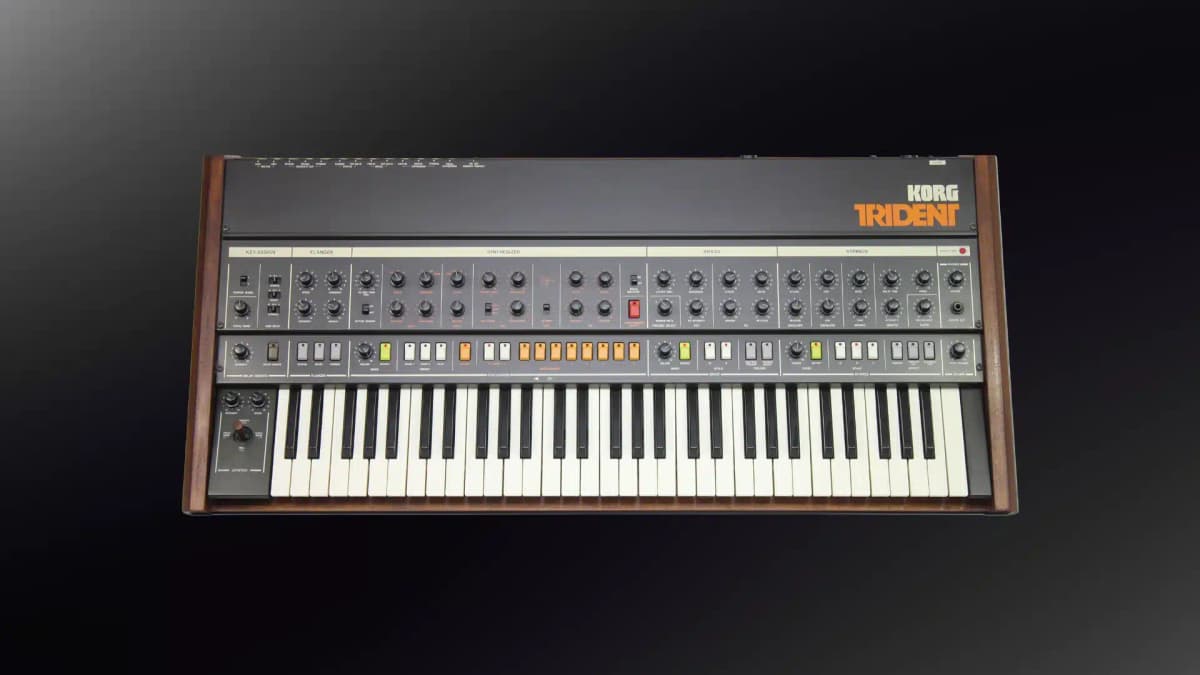
The Korg Trident is an eight-voice analog polyphonic synthesizer that Korg introduced in 1980, with an improved Trident MkII following in 1982. As its name suggests, it is three instruments in one cabinet: a programmable two-oscillator polysynth, a brass section with its own filter and envelope, and a string ensemble with chorus and a “bowing” attack, all sharing a 61-key keyboard that can be split or layered. A flanger, separate outputs per section and a dense panel of CV and expression inputs complete the design. The Korg Trident matters because it was Korg’s large, programmable answer to the American polysynths of its day, and because it captured the moment when the string machine and the polyphonic synthesizer were briefly fused into a single flagship.
Table of Contents
Korg Trident sound and character
The Korg Trident’s character comes from its layering rather than from any single section. On its own, the synth section is a fairly conventional eight-voice design, two oscillators per voice into a resonant low-pass filter built around SSM2044 chips, the same filter family Korg used in the Polysix. Greatsynthesizers describes its sound potential as standard polysynth territory but calls the filter remarkably powerful at high resonance. Sound On Sound’s Alex Clarke found it strongest at heavy pads, phased strings and combined string-and-synth textures, and weakest at electric piano and bell tones.
The string section is where many owners fall for it. Running at 16′, 8′ and 4′ with an ensemble effect, two-band EQ and vibrato, it produces the warm, swirling string sound of the late string machines, with a bass register Greatsynthesizers calls absolutely impressive. The bowing control adds a lift to the attack, though Clarke judged it subtle. The brass section is a simpler voice with a single shared filter and envelope, which makes it paraphonic when played in chords but lets it cut as a monophonic lead.
The built-in flanger, with its own sweep and feedback, gives the instrument much of its late-1970s color, and several reviewers call it the highlight. It can only be applied to one section at a time, however, and its wide dynamic range can push recordings into clipping.
The Korg Trident sits firmly on the vintage, warm side of the spectrum, but it is not a fat American-style synth. Greatsynthesizers describes the Korg sound of the period as stable, slightly nasal and conservative, and a familiar complaint, recorded even by Bonedo’s enthusiastic owner, is that the synth section alone can sound thin. Its best results come from stacking sections and from patient programming.
Features and architecture
- Manufacturer: Korg (Keio Electronic Laboratories), Japan
- Year introduced: 1980; some sources, including Sound On Sound and Cherry Audio, date it to 1981, and the MkII followed in 1982
- Production years: about 1980 to 1982 for the original, with the MkII from 1982; Korg has not published exact end dates or production numbers
- Synthesis type: analog subtractive
- Category: programmable polyphonic synthesizer with built-in string and brass sections
- Polyphony: 8 voices in the synth section, with separate brass and string sections that can be layered or split
- Original price: listed at $4,595 in the United States; Bonedo puts the German price at about 8,000 DM
- Current market price: Greatsynthesizers puts a MkI at roughly 3,000 to 5,000 euros or dollars and a MkII at 5,000 to 7,000 or more; recent Reverb listings fall between about $3,300 and $6,300
- Oscillators: synth section with 2 VCOs per voice at 16′, 8′ and 4′; VCO1 offers sawtooth and pulse with pulse width and PWM, and VCO2 can be detuned by up to a semitone; strings at 16′, 8′ and 4′ and brass at 16′ and 8′
- Filter: 24dB/octave resonant low-pass VCF per voice in the synth section (SSM2044), with off, half and full keyboard tracking; the brass section has its own resonant low-pass filter shared across notes; the strings use a two-band EQ instead
- LFOs: global vibrato with speed, delay and depth; the flanger has its own sweep
- Envelopes: MkI synth section with one ADSR shared by filter and amplifier; MkII with separate ADSRs for VCF and VCA; brass with its own ADSR; strings with attack and release
- Modulation system: joystick for pitch bend (left and right) and vibrato or trills up to a minor third (up and down); delayed vibrato; external filter CV
- Sequencer / arpeggiator: none
- Effects: flanger with speed, feedback, intensity and manual controls, assignable to one section at a time; ensemble and bowing in the string section
- Memory: MkI with 16 user programs plus three presets (Piano 1, Piano 2, Clavi); MkII with 32 programs in four banks of eight, the presets removed, editable from a blank patch and a cassette interface
- Keyboard: 61 keys with no velocity or aftertouch; octave split with sections assignable to the upper, lower or whole range
- Inputs / outputs: separate outputs for synth, brass and strings, high- and low-level mix outputs, headphones, three section expression inputs plus a total expression input, filter CV inputs and a brass trigger input
- MIDI / USB: none; aftermarket MIDI retrofit kits exist
- Display: none; programs are selected from panel buttons
- Dimensions / weight: about 101 x 54 x 17 cm according to Bonedo; published weights run from 21 kg to nearly 24 kg
- Power: internal power supply; the MkII added heavier heat-sinking and a sturdier supply
Strengths
- Three instruments share one keyboard. Synth, brass and strings can be split or layered, so a single player can cover pads, leads and string parts at once.
- The string section is a serious string machine in its own right. Its ensemble, EQ and bowing control produce warm, full strings with a particularly strong low end.
- The flanger gives the instrument a distinctive period color. With its own sweep and feedback controls it can move from gentle movement to self-oscillation.
- Its connectivity is generous for a pre-MIDI keyboard. Separate section outputs, expression inputs and filter CV inputs make it easy to process each part independently or to drive it from modular gear.
- The panel is large and uncluttered, with dedicated controls for almost every parameter, which makes it a sit-down-and-play instrument rather than a menu exercise.
- Programmability and memory made it practical on stage at a time when string machines had none, especially in the 32-slot MkII.
Limitations
- The synth section is basic. There is no cross modulation, ring modulation or fast LFO, and owners often describe the sound on its own as thin.
- The brass section uses a single filter and envelope for all notes, so chords are paraphonic rather than truly polyphonic.
- The flanger can serve only one section at a time, and tuning is global, with no per-section tuning.
- It has no MIDI and no arpeggiator. Integrating it into a modern setup requires a retrofit kit or the CV and gate inputs.
- The MkI cannot properly edit a stored sound from scratch: new patches must be built by modifying existing ones, which limits how varied its 16 memories become.
- Reliability is a concern. Sound On Sound warned that some units drift when hot, Joe Zawinul said his broke down, and the memory backup battery can leak onto nearby boards.
- At more than 20 kg in a wooden case, it is heavy, and Sound On Sound advised choosing stands carefully.
Historical context
By the late 1970s Korg had built a reputation on monophonic synthesizers such as the MS-20 and on the fully polyphonic PS-3100 and PS-3300, while its Lambda and Delta keyboards combined ensemble strings with simple synth voices. American companies, led by Sequential Circuits with the Prophet-5, had meanwhile shown that a programmable polysynth with patch memory was what professionals wanted. Greatsynthesizers reports that the Korg Trident took more than a year of secret development, and that Korg set aside a four-voice polyphonic sampler project in its favor.
The Korg Trident arrived in late 1980, more than two years after the Prophet-5 and around the time of Roland’s Jupiter-8. Its concept was a hybrid: Korg attached a programmable eight-voice synth to the string and brass sections that its customers already knew, in a heavy wooden cabinet priced at the top of the market. The MkII of 1982 addressed the most obvious weaknesses: it doubled memory to 32 programs, separated the filter and amplifier envelopes, allowed patches to be built from a blank page, added a cassette interface, and improved heat-sinking and the power supply. It also adopted chunkier Polysix-style knobs and gray switches.