

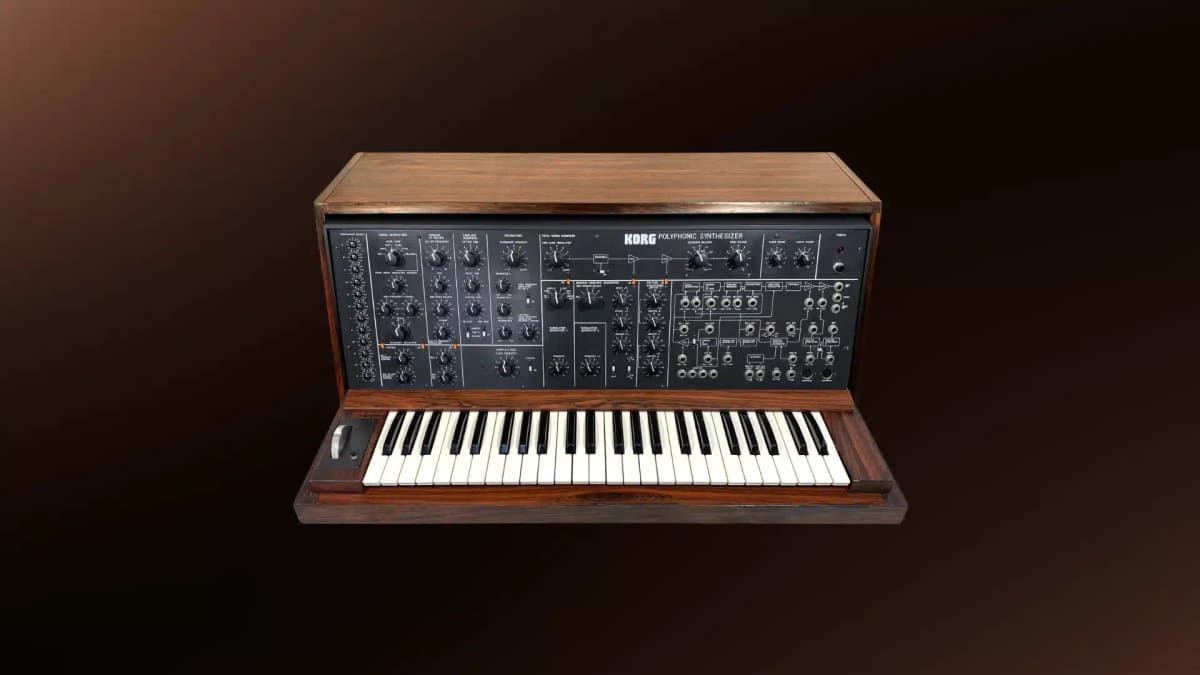
The Korg PS-3100 is a fully polyphonic, semi-modular analog synthesizer that Korg introduced in 1977 as the most compact member of its PS series, alongside the giant PS-3300 and the later, programmable PS-3200. Designed under Fumio Mieda, it derives every pitch on its 48-note keyboard from 12 divide-down oscillators, then gives each key its own filter, envelope and amplifier, so all 48 notes can sound at once with independent articulation. A three-band resonator, an ensemble circuit, two modulation generators, sample and hold, adjustable temperament and a large patch panel complete the design. It matters as one of the most ambitious polyphonic synths of the pre-Prophet-5 era, and as a rare, sought-after source of warm, organic pads.
Table of Contents
Korg PS-3100 sound and character
The Korg PS-3100 sounds warm, rich and organic rather than aggressive. Because every key has its own two-pole low-pass filter and envelope, chords articulate naturally: each note opens and closes on its own, so held clusters, overlapping releases and played-in pads breathe in a way that paraphonic string machines and divide-down organs cannot match. Sound On Sound’s Simon Lowther singled out animated pads, washes and “woofy” basses as its strengths in his 2001 Retrozone feature.
The resonators are the signature. Three bandpass filters, each tunable from roughly 100Hz to 10kHz and swept by the second modulation generator, impose shifting formant peaks on the whole instrument, producing phaser-like, vocal and orchestral textures that many owners consider the heart of the PS sound. The ensemble circuit thickens the single-oscillator-per-note voice, which has no sub-oscillator, and the general envelope generator can sweep all 48 filters together for paraphonic effects on top of the polyphonic voicing.
It has clear limits. The filter resonance is weak and does not self-oscillate, Lowther found the cutoff less dramatic than its specification suggests, and he noted that soaring Prophet- or Moog-style leads do not come easily. Its strengths lie in slow-building pads (the attack can run to around two minutes), lush ensembles, plucked polyphonic patterns and modulated textures, firmly on the vintage, organic end of analog polyphony.
Features and architecture
- Manufacturer: Korg (Keio Electronic Laboratories), Tokyo, Japan
- Year introduced: 1977
- Production years: 1977 to about 1980 according to GreatSynthesizers, or 1981 according to the SMEM collection; about 600 units are commonly cited
- Synthesis type: analog subtractive with divide-down oscillators
- Category: fully polyphonic, semi-modular keyboard synthesizer
- Polyphony: 48 voices, one per key
- Original price: £2,124 in the UK at its 1979 list price, according to Sound On Sound; Audiofanzine lists ¥490,000 in Japan
- Current market price: Reverb listings tracked by Equipboard average around US$13,800 in October 2026; a serviced unit with a Kenton MIDI retrofit sold through Soundgas for £8,750 before VAT, and project units appear near £10,000
- Oscillators: 12 master oscillators divided down across 48 keys, each with independent tuning for alternative temperaments; triangle, sawtooth, square, fixed pulse and PWM waveforms; FM from MG1, an external source or the general envelope
- Filter: 48 two-pole (12dB/octave) low-pass filters, one per key, with cutoff, peak (resonance), envelope amount (Expand) and bidirectional keyboard tracking; resonance does not self-oscillate
- Resonators: three voltage-controllable bandpass filters, about 100Hz to 10kHz, with shared resonance and MG2 modulation
- LFOs: MG1 with sine, sawtooth (both directions), pulse, white and pink noise, reaching audio rate; MG2 triangle, hardwired to the resonators and PWM
- Envelopes: 48 envelopes with attack, decay and sustain knobs and a three-position release switch (damped, half, full); a General Envelope Generator with delay, attack and release
- Modulation system: semi-modular patch panel overriding the normalled routings, sample and hold with its own clock, voltage processors, amplitude modulator
- Sequencer / arpeggiator: none
- Effects: Ensemble chorus circuit
- Memory: no patch memory
- Keyboard: 48 keys (some listings say 49), no velocity or aftertouch; metal pitch-bend wheel without spring return
- Inputs / outputs: Main and Direct audio outputs (the resonators, chorus and amplitude modulation appear only on Main) plus the patch-panel jacks; no standard keyboard CV/gate interface
- MIDI / USB: none originally; Kenton offers a MIDI retrofit, which is common on surviving units
- Display: none
- Dimensions / weight: about 82 x 52.8 x 36 cm and about 30 kg, according to GreatSynthesizers
- Power: internal power supply; units were made for specific mains voltages
Strengths
- Every key is a complete voice. With its own filter, envelope and amplifier per note, the Korg PS-3100 articulates chords in a way most 1970s polyphonics could not.
- The resonators give it a sound of its own. Sweeping three formant peaks across a full polyphonic texture produces phasing, vocal and orchestral colors that are hard to reproduce with ordinary filters.
- It is genuinely patchable. The semi-modular panel lets players override normalled routings, which made it unique among polyphonic synthesizers of its time.
- Temperament control is built in. Independent tuning of the 12 oscillators allows historical and alternative scales without external equipment.
- Its modulation section is generous for 1977, with an audio-rate MG1, a dedicated resonator modulator, sample and hold and a general envelope.
- It is the most practical member of the PS family: one cabinet with a built-in keyboard, smaller and cheaper than the PS-3300 and easier to patch.
Limitations
- There is no patch memory, so every sound must be set up by hand; memories arrived only with the PS-3200.
- The filter is relatively weak, with gentle resonance that does not self-oscillate, which limits dramatic sweeps and aggressive leads.
- With one divide-down oscillator per note and no sub-oscillator, sounds can be thin without the ensemble, and tuning all 12 oscillators is fiddly.
- It is heavy and bulky at around 30 kg, and its wooden cabinet is often worn or damaged on surviving units.
- Maintenance is serious work. GreatSynthesizers reports failing edge connectors, leaking capacitors and the need for spare octave-divider chips.
- There is no MIDI or standard CV/gate input without a retrofit, and the resonators cannot process external audio.
- Prices have risen so far that an original is now a significant investment for a player.
Historical context
The PS series grew out of the same organ research that produced Korg’s first synthesizers. Fumio Mieda’s early-1970s prototype introduced the Traveler filter and led to the miniKORG 700 of 1973, while Korg’s PE-1000 and PE-2000 polyphonic ensembles of 1976 experimented with one oscillator per note. Perfect Circuit describes neither as especially successful, but they paved the way for a more ambitious approach.
In 1977 Korg launched the Korg PS-3100 and PS-3300, the latter essentially three Korg PS-3100 voice systems in a modular cabinet with a separate PS-3010 keyboard. The Korg PS-3100 put a single voice system and a 48-note keyboard into one console-style wooden cabinet, with a left-to-right panel layout that foreshadowed the MS-20 a year later. Perfect Circuit notes that the series arrived about a year before Sequential Circuits announced the Prophet-5, at a time when polyphony usually meant either divide-down instruments with shared filters, such as the Polymoog, or large voice-assigned designs.
The PS-3200 followed in 1978, effectively a two-oscillator Korg PS-3100 with a 16-memory programmer and a graphic equalizer in place of the resonators. The series was expensive to build and sell, and voice-assigned, programmable synths with far fewer circuits soon defined the market. Production of the Korg PS-3100 ended around 1980 or 1981, after roughly 600 units according to commonly cited figures.