

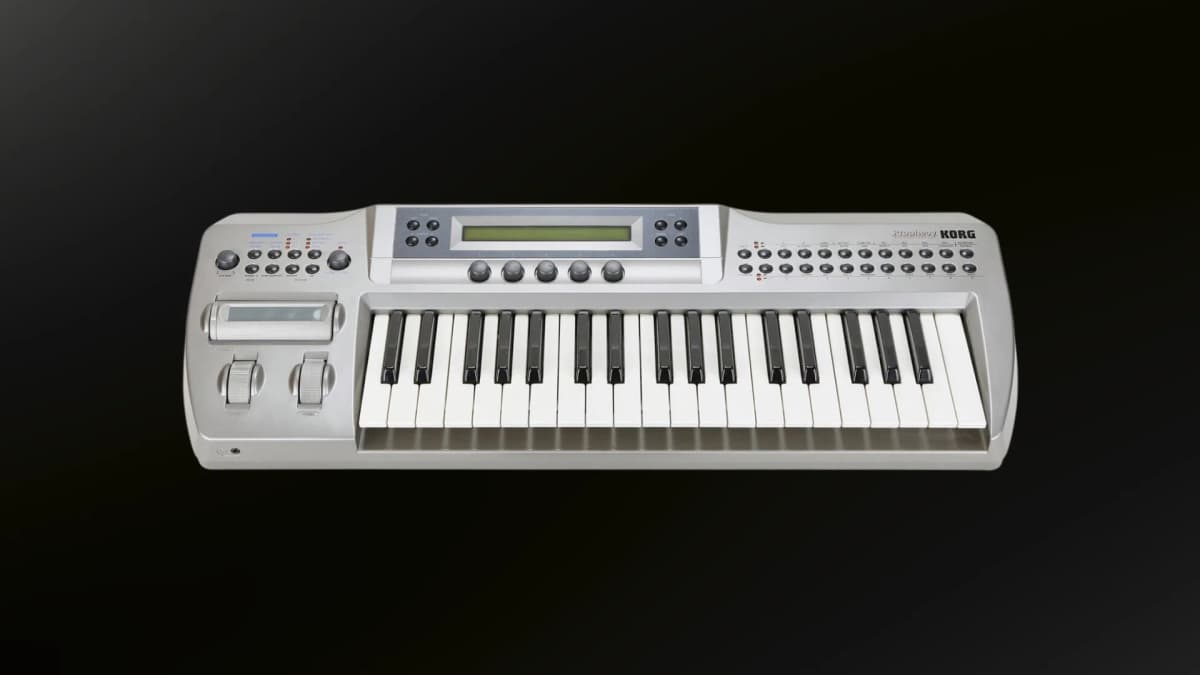
The Korg Prophecy is a monophonic digital synthesizer that Korg announced at the Frankfurt Musikmesse in 1995 and shipped later that year. Its engine, later known as MOSS (Multi Oscillator Synthesis System), ran entirely in DSP software derived from Korg’s unreleased OASYS project and combined analog-style oscillators, VPM (Korg’s take on phase modulation) and physical models of brass, reed and plucked strings. The 37-key, silver-cased instrument added two resonant multimode filters, a deep effects chain, an arpeggiator and the so-called log, a wheel with a pressure-sensitive ribbon on top. It matters as one of the earliest commercial instruments to combine analog modeling and physical modeling in one playable box, at a price aimed at working musicians.
Table of Contents
Korg Prophecy sound and character
The Korg Prophecy’s analog models are what made its reputation. Sound On Sound’s preview team wrote that, had they not been told it was digital, they would have accepted the analog sounds without question, and Gordon Reid’s full review in October 1995 described the results as very smooth, very powerful and very convincing. Basses are firm and round, leads are bright and aggressive, and oscillator sync, ring modulation and cross modulation give it the full range of classic monosynth tricks.
What separates it from a straightforward virtual analog is everything after the oscillators. Each oscillator feeds its own waveshaper, which can add distortion or a resonant edge, and the two resonant filters can run in series, in parallel or split. The effects chain adds distortion, wah, EQ, chorus or flanging, delay and reverb, and those stages give the Korg Prophecy its signature: screaming, feedback-heavy leads and gritty resonant sweeps. Liam Howlett told Sound On Sound in 1996 that it was one of the few ready-to-run synths that produced really big distortion.
The physical models are more demanding. Brass, reed and plucked-string algorithms respond to velocity, aftertouch, the log and the performance knobs, and Reid stressed that convincing wind sounds depend on the player rather than the patch; there is no breath controller input on the panel beyond the general controller sockets. VPM covers the metallic, DX7-style territory. The overall character is clean and digital but forceful, closer to a modern virtual analog than to the grainy sample-based synths of its day, and its expressive control makes it at its best as a solo voice rather than in a mix.
Features and architecture
- Manufacturer: Korg Inc., Japan
- Year introduced: 1995, announced at the Frankfurt Musikmesse and shipping from the summer
- Production years: 1995 to about 1997, according to most references
- Synthesis type: DSP modeling (MOSS): analog modeling, VPM phase modulation, physical modeling, noise with comb filter, and sync, ring and cross-modulation types
- Category: monophonic solo synthesizer
- Polyphony: monophonic and monotimbral
- Original price: about $1,595 in the United States; just under £1,000 in the UK at launch, after a projected price of around £1,200 at the preview stage
- Current market price: Polynominal gives a European trend figure of around €250; Reverb showed no active listings when checked, and recent sold prices are not consistently documented
- Oscillators: two MOSS oscillators selected through 12 preset combinations, plus a sub-oscillator and noise generator; Sound On Sound counts nine oscillator types, while other sources count up to 13 depending on how variants are grouped; only one physical model can run at a time
- Waveshaping: one waveshaper per oscillator, used for distortion or resonant coloring
- Filter: two resonant multimode filters with low-pass, high-pass, band-pass and band-reject modes, configurable in series, parallel or split
- LFOs: four, each with about 30 waveform options, syncable to MIDI clock
- Envelopes: six multi-stage envelopes, two dedicated to amplitude and pitch and the rest freely assignable
- Modulation system: extensive source and destination routing, with five Performance Editor knobs that can each control several parameters at once
- Sequencer / arpeggiator: arpeggiator with one to four octave range, five preset and five user patterns, latch and key sync; no sequencer
- Effects: stereo chain including overdrive or distortion, wah, two-band parametric EQ, chorus or flanger, panning, delay and reverb
- Memory: 128 user programs, with additional storage on an optional SRC-512 RAM card
- Keyboard: 37 keys with velocity and aftertouch
- Controllers: pitch wheel, modulation wheel and Wheel 3, the log, which combines a modulation wheel with a pressure- and position-sensitive ribbon; five Performance Editor knobs
- Inputs / outputs: stereo audio outputs, sustain footswitch, expression pedal and EC5 multi-controller sockets, RAM card slot
- MIDI / USB: MIDI In, Out and Thru; arpeggiator syncs to MIDI clock; no USB
- Display: 2 x 40-character backlit LCD
- Processing: three Texas Instruments TMS57002 DSPs with NEC and Toshiba control processors, according to Sound On Sound
- Dimensions / weight: about 740 x 280 x 100mm and 5.7kg, according to Polynominal
- Power: internal power supply
Strengths
- Its analog models were convincing well ahead of most competitors. In 1995 reviewers struggled to tell its basses and leads from real analog, at a time when few virtual analogs existed.
- It combines several synthesis types in one voice. Analog, VPM, physical modeling and cross-modulation sit within the same oscillator section, giving it a broader palette than any analog monosynth.
- The log controller is genuinely expressive. A ribbon you press and slide, mounted on a wheel, gives continuous control over pitch, filter or model parameters in a way few synths have copied.
- The effects and waveshapers give it character. Distortion, wah and resonant waveshaping make it excellent for aggressive leads and textures without external processing.
- It is compact and road-friendly. At under 6kg with 37 keys, it was designed as a performance instrument to sit on top of a larger keyboard.
- Its arpeggiator and MIDI clock sync made it useful in dance and techno productions, its largest market according to Gordon Reid’s Korg history.
Limitations
- It is strictly monophonic, so chords and pads are impossible; even Liam Howlett, one of its best-known users, said it was a shame it could not play polyphonically.
- Three octaves is limiting, a point Sound On Sound raised in its review.
- Programming is hard. A two-line display, deep menus and unfamiliar modeling parameters made it daunting, and there was no widely available computer editor at launch.
- The physical models need skill and controllers to sound real. There is no breath controller, and Polynominal judges its wind emulations weaker than Yamaha’s VL series.
- The log’s return springs were criticized as too stiff, and the mechanism is a part to check on used units.
- The silver plastic housing divides opinion; MusicRadar compared it to a Cyberman from Doctor Who.
Historical context
Korg had been working on OASYS, a modular DSP synthesis platform, since the early 1990s, and showed it publicly in 1995. With a projected price around £10,000 for a 16-voice instrument, it was too expensive to launch and was dropped in 1996, but its ideas fed directly into smaller products. The Korg Prophecy was the first: a single-voice instrument that used DSP chips previously reserved for effects processing to run synthesis algorithms. Korg’s own history of the Korg Prophecy notes that it arrived when PCM workstations dominated the market and analog monosynths had largely disappeared from new product lines.
Announced in spring 1995 alongside the Trinity workstation and shipped that summer, the Korg Prophecy was aimed at players who wanted a dedicated solo voice. Korg UK’s Rob Castle later told Sound On Sound that customers seemed to understand it, and it sold well in the US and UK, where dance and techno producers were its main buyers, though it did not take off in other markets. Its engine was also offered as an optional board for the Trinity, turning the Korg Prophecy’s sound into a solo voice inside the workstation.
The Korg Prophecy’s run was short. In 1997 Korg released the Z1, a 61-key, 12-voice, six-part multitimbral instrument built on the same MOSS technology with more oscillator models and an XY pad, and it effectively replaced the Korg Prophecy. MOSS continued as an expansion board for the Trinity V3 and later for the Triton family and the Karma, and Korg eventually stepped back from physical modeling of acoustic instruments while keeping analog modeling.