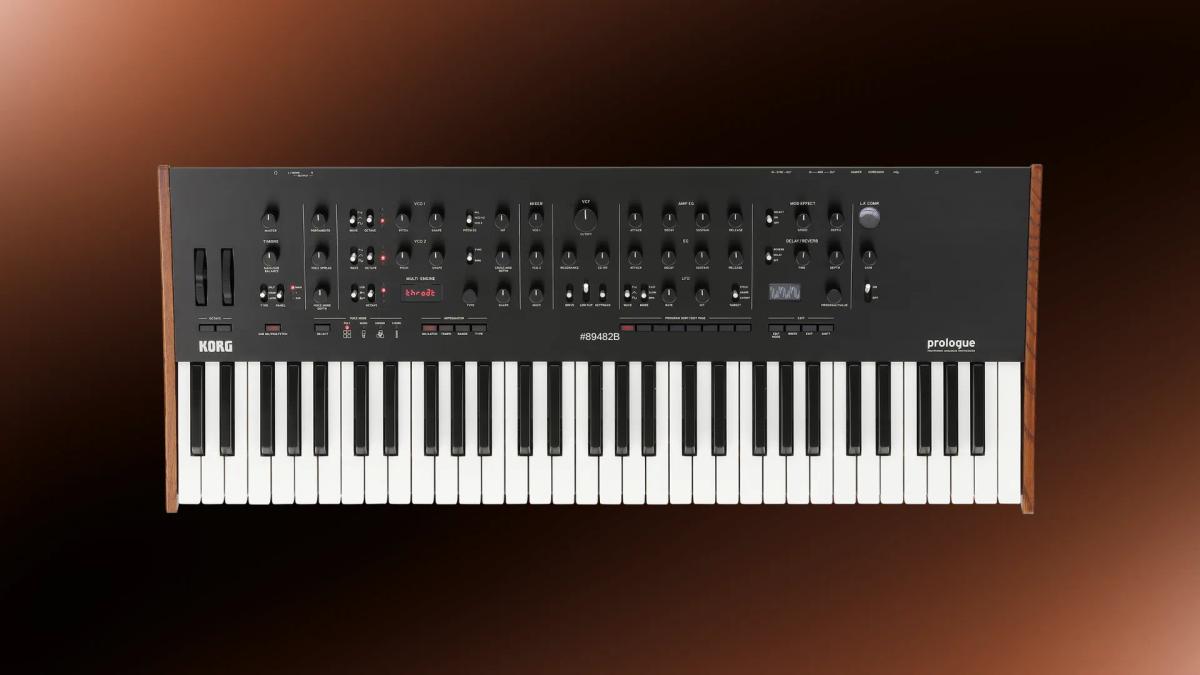
Its most forward-looking element came after launch. At Superbooth in May 2018, Korg announced the SDK for the Prologue, published its code, tools and documentation on GitHub, and scheduled user oscillators and modulation effects to be enabled by a firmware update and a Librarian application in June 2018. In September 2019, firmware 2.0 added microtuning, delay and reverb wet/dry control, MIDI aftertouch reception and arpeggiator gate and speed settings. By then, the minilogue xd had appeared with a closely related Multi Engine, and Korg’s documentation confirms that the two instruments share the same development API.
Legacy and significance
The Korg Prologue matters less as a sales phenomenon than as a statement about what an analog polysynth could be at the end of the 2010s. The Korg Prologue proposed something its rivals did not: an analog instrument whose digital oscillator and effects were treated as open platforms. Designer Etienne Noreau-Hebert told Attack Magazine that the SDK was built with minimal dependencies so it could stay usable beyond a typical product lifecycle, an unusual ambition for a hardware synth.
That idea outlived the instrument. The same development API carried into the minilogue xd at a much lower price, so the Prologue was a prologue in more than name: it introduced a hybrid architecture that Korg would reuse in cheaper instruments.
The instrument’s reputation has also shifted with time. Synthtopia observed in 2026 that the Korg Prologue was under-appreciated at launch, when discussion focused on what it lacked, and that interest has grown since its discontinuation as musicians have rediscovered its analog sound, build quality and ease of use. Its omissions were real, but its sound and feel were the qualities that lasted.
Artists, users, and curiosities
The Korg Prologue is better documented through reviewers and demonstrators than through high-profile records. Gordon Reid’s Sound On Sound review captures how it was received by experienced players: he reported that some patches “transported me back to the 1970s,” while insisting the instrument was “more than just a Minilogue Pro.” In 2026, Synthtopia highlighted a series of “shut up and play” demos by synthesist Panu M Savolainen that used only factory presets and internal effects, a sign that the instrument’s native sound was still drawing attention years after launch.
One of the more telling curiosities concerns its keyboard. Reid noted that the keybed, reportedly shared with the Kronos 61, can generate aftertouch messages, yet the Prologue itself ignored them, a decision he called “unfathomable.”
Another concerns its filter. Reid reported that Korg’s explanation for the absence of a four-pole mode was that one could not be implemented, a claim he disputed by pointing out that two 12dB stages can be placed in series. The decision gave the Korg Prologue its open, bright identity, but it remained one of the most debated aspects of the design.
A final footnote: Korg opened the SDK to independent developers first, and its designers acknowledged that new sounds for everyday owners would arrive gradually. The Prologue was sold with a promise as much as a feature list.
Korg Prologue market value
- Current market position: a discontinued analog/digital hybrid flagship that sits between modern-classic status and an overlooked used-market bargain
- New price signal: no longer offered new by major U.S. retailers; Sweetwater’s archived prologue-16 listing showed a final price of $1,699.99, below the $1,999.99 launch price
- Used market signal: aggregator snapshots in October 2026 showed used prologue-16 listings around $1,200, with prices varying by condition, model and completeness
- Availability: findable on the used market without being common; the larger, heavier prologue-16 can be costly to ship
- Buyer notes: check that all voices tune and calibrate correctly after warm-up, test every key and the wheels, confirm the firmware version (Korg lists v2.10 as the latest system updater), check the compressor and VU meter on the prologue-16, and inspect the exposed keyboard ends and wooden side panels for transport damage
- Support ecosystem: Korg still hosts the manuals, Librarian and firmware, the logue SDK remains on GitHub, and user oscillators are often shared with minilogue xd owners
- Market character: underrated relative to its build and voice count, with interest reported to be growing since discontinuation
- Long-term position: still forming; it is likely to be remembered as Korg’s analog flagship of the late 2010s and as the first instrument of its user-oscillator platform, which may support values over time without making it a speculative collectible
Conclusion
The Korg Prologue was a conventional instrument in some ways and an unusually open one in others. Its analog core offered a bright, breathing polysynth sound, a solid keyboard and up to sixteen voices, while its Multi Engine and SDK suggested that an analog flagship could keep growing after it left the factory. Its constrained modulation and missing aftertouch shaped its reception in 2018, but they do not define its place now. The Korg Prologue matters because it showed Korg treating analog and digital not as rival philosophies but as two halves of one playable, programmable instrument.
Sources
- Korg Prologue review, Sound On Sound
- Korg Prologue Review: A New Spin on Analogue, MusicTech
- Korg Prologue 8 review, MusicRadar
- Review: Korg Prologue 16, AudioTechnology
- Analogue plus digital: Designing Korg Prologue, Attack Magazine
- Meet Korg Prologue, new analogue synth flagship, Attack Magazine
- NAMM 2018: Korg Announce The Prologue Polyphonic Analog Synthesiser, MusicTech
- prologue specifications, Korg
- prologue SDK, Korg
- Korg Prologue SDK Now Available, Synthtopia
- KORG Prologue Synthesizer Firmware 2.0 Adds Microtuning, MIDI Aftertouch & More, Synth Anatomy
- Shut Up & Play: Sounds Of The Korg Prologue, Synthtopia
- Korg Minilogue XD review, Sound On Sound
- Korg Prologue 61-key 16-voice Analog Synthesizer, Sweetwater
- Korg Prologue 16 pricing and availability, Equipboard