

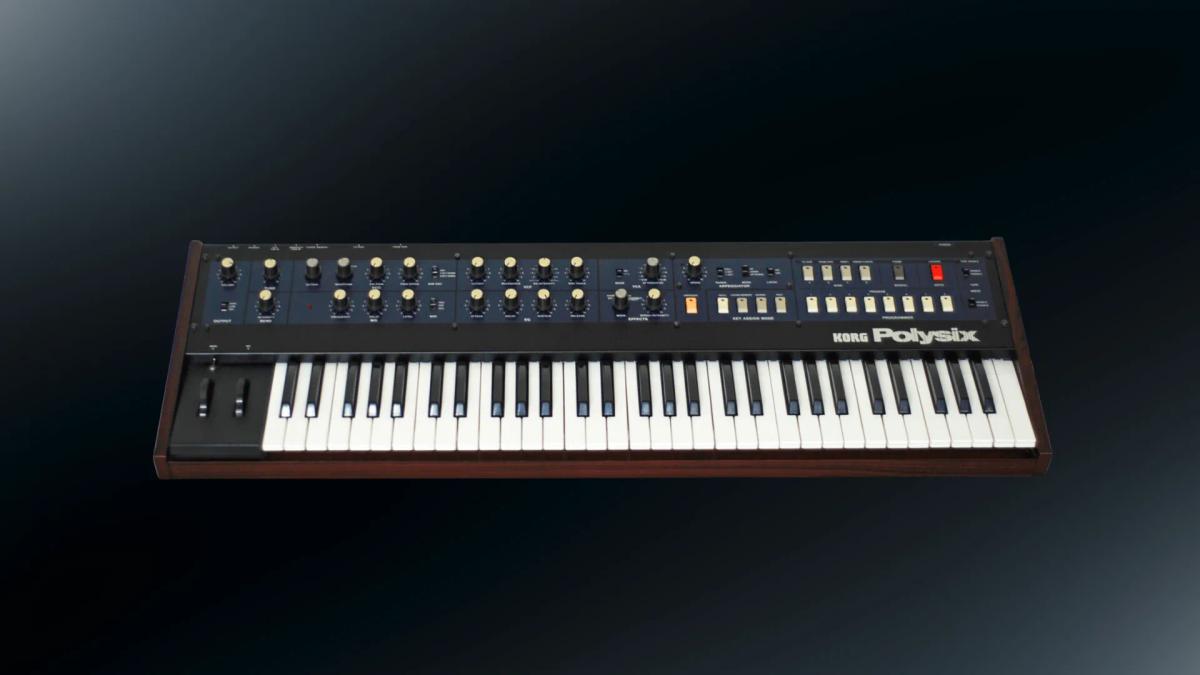
The Korg Polysix is a six-voice analog polyphonic synthesizer introduced in 1981. Each voice uses a single VCO with a sub-oscillator, a 24dB/octave resonant low-pass filter, and one ADSR envelope, and the instrument adds 32 patch memories, an arpeggiator, chord memory, unison, and a built-in chorus, phaser, and ensemble section. Its importance lies less in any single feature than in the combination: it was one of the first programmable polysynths that working musicians could realistically afford, arriving months before Roland’s Juno-6 and at a fraction of the cost of the Prophet-5 and Oberheim polysynths it was so often compared with.
Table of Contents
Sound and character
The Korg Polysix sounds warmer, rounder, and heavier in the low end than its reputation as a budget instrument might suggest. Writing in Sound On Sound in 1994, Nick Magnus described its character as “thoroughly squodgy” and “plummy,” and set it against the brighter, thinner tone he associated with the Juno. He traced much of that difference to the filter: a narrower response than the Roland’s, but with a much richer concentration of low mids and bass. Vintage Synth Explorer makes a similar point, describing the oscillators as softer and brassier than the Juno’s.
The filter is the center of the voice. It is a four-pole low-pass design built around SSM filter chips of the kind used in early Sequential Circuits instruments, and it self-oscillates at high resonance. Gordon Reid, comparing the two Japanese rivals in Sound On Sound, singled out the “powerful 24dB/octave response of the PolySix’s filters” as something the Juno lacked. That steep slope is why basses and brass patches hold together with weight rather than fizz.
The other half of the Korg Polysix identity is the effects section. With only one oscillator per voice, a dry patch can sound plain, and Korg’s answer was a bucket-brigade chorus, phaser, and ensemble placed after the voices.
The Electronics & Music Maker reviewer in 1982 wrote that the chorus “transforms the Korg Polysix into a very powerful beast,” and the ensemble setting in particular became the instrument’s signature: Vintage Synth Explorer credits it with “instant Mellotron-like strings,” and Korg itself says the original was especially praised for strings and pads. Unison mode pushes in the other direction, stacking all six VCOs on one note for leads and basses that can be almost too large to sit in a mix.
Its strength is not complex motion but a dense, slightly soft-edged polyphonic voice that rewards simple programming and the ensemble switch.
Features and architecture
- Manufacturer: Korg
- Year introduced: 1981
- Production years: early 1980s; Korg launched the Poly-61 as its successor in 1982, and a precise end date for Polysix production is not well documented
- Synthesis type: analog subtractive
- Category: programmable polyphonic keyboard synthesizer
- Polyphony: 6 voices, monotimbral
- Original price: UK reviews in 1982 quoted around £1,200; later retrospectives describe it as breaking the £1,000 barrier, and US launch figures differ between sources
- Current market signal: a sought-after vintage polysynth whose value depends heavily on the condition of its memory board and service history
- Oscillators: 1 VCO per voice with 16′, 8′, and 4′ footages, sawtooth and variable pulse waves, pulse-width modulation with its own speed and intensity controls, and a square-wave sub-oscillator one or two octaves below
- Filter: 24dB/octave resonant low-pass based on SSM chips, with cutoff, resonance, bipolar envelope amount, and keyboard tracking variable from 0 to 150 percent
- LFOs: one triangle modulation generator with frequency, delay, and level, switchable to VCO, VCF, or VCA; separate PWM modulation
- Envelopes: 1 ADSR shared by the filter and amplifier; the VCA can instead follow a simple gate for organ-style shapes
- Modulation system: modulation wheel wired to vibrato, pitch-bend wheel with adjustable range, external CV input for filter cutoff
- Sequencer / arpeggiator: arpeggiator with up, down, and up/down modes over 1 octave, 2 octaves, or the full keyboard, with latch, a 0.2 to 20 Hz clock, and an external trigger input; no sequencer
- Key assign modes: Poly, Unison, Chord Memory, and Hold
- Effects: chorus, phaser, and ensemble with variable speed and intensity, based on bucket-brigade analog delay lines
- Memory: 32 programs in four banks of eight, with a write-protect switch and cassette tape backup
- Keyboard: 61 keys, no velocity or aftertouch
- Inputs / outputs: mono audio output, headphone output, VCF cutoff CV input, arpeggiator trigger input, cassette interface
- MIDI / USB: none originally; MIDI retrofits have been offered by Kenton, Tubbutec (Modysix), and Kiwi Technics (KiwiSix)
- Display: none; program and bank status shown on LED switches
- Dimensions / weight: weight listed at about 11.5 kg in Synthmania’s specification summary
- Power: internal mains supply
Strengths
- The voice has genuine weight. A four-pole SSM-based filter on a VCO voice gives the Korg Polysix a fuller low-mid profile than its single-oscillator design suggests, which is why period and retrospective reviewers kept comparing it upward to the Prophet rather than downward to cheaper instruments.
- The ensemble effect is part of the instrument, not an afterthought. It turns simple sawtooth patches into wide string and pad textures, and it is the single feature most associated with the Korg Polysix sound.
- Programmability arrived at an accessible price. Thirty-two memories with cassette backup meant players could prepare a live set or recall studio sounds on an instrument that cost far less than the American polysynths that pioneered patch storage.
- Performance modes add real range. Unison turns it into a heavy six-oscillator monosynth, Chord Memory allows one-finger stabs, and Hold plus the latching arpeggiator make sustained patterns easy to play live.
- The panel is direct and readable. Every parameter has its own knob or switch, so the instrument is quick to learn and encourages programming by ear.
Limitations
- One oscillator per voice limits complexity. There is no oscillator sync, cross-modulation, or poly-mod, which reviewers in 1982 noted when comparing it with Oberheim and Sequential instruments.
- A single ADSR has to serve both filter and amplifier, which restricts how independently brightness and loudness can be shaped.
- There is no display or value readout. Editing a stored program means moving a knob until it becomes “live,” so exact settings cannot be read back and programming is done by ear.
- The original has no MIDI, so integration with modern setups depends on a retrofit.
- The KLM-367 programmer board relies on a backup battery that is notorious for leaking. The alkaline fluid can corrode traces and components, and repairers have reported units damaged badly enough to be uneconomical to fix.
- It is a full-size, heavy vintage instrument with aging pots, switches, and calibration. Sound On Sound’s 1994 buyer advice already warned about tuning drift, oxidized switches, and hard-to-replace pots.
Historical context
By 1981 the programmable analog polysynth was established, but it belonged to an expensive tier. The Prophet-5 and Oberheim’s OB-series used two oscillators per voice and priced most musicians out. Korg had not previously offered a modern polysynth with dynamic voice allocation, and the Korg Polysix was its answer to that gap. According to its Wikipedia summary, which draws on period reviews, Korg reduced cost by giving each voice a single oscillator and compensated with the onboard effects section.
The timing was tight. The Korg Polysix appeared months before Roland’s non-programmable Juno-6 and about a year before the programmable Juno-60, so it briefly occupied the affordable programmable polysynth space largely on its own. Gordon Reid later called it “the first ‘Everyman’s’ polysynth” and noted that it quickly earned the nickname “poor man’s Prophet,” prompted by its Prophet-like size, shape, and panel layout, and reinforced by the SSM chips in its voice. Its styling also shared its blue-and-black livery with its sibling, the Mono/Poly.