

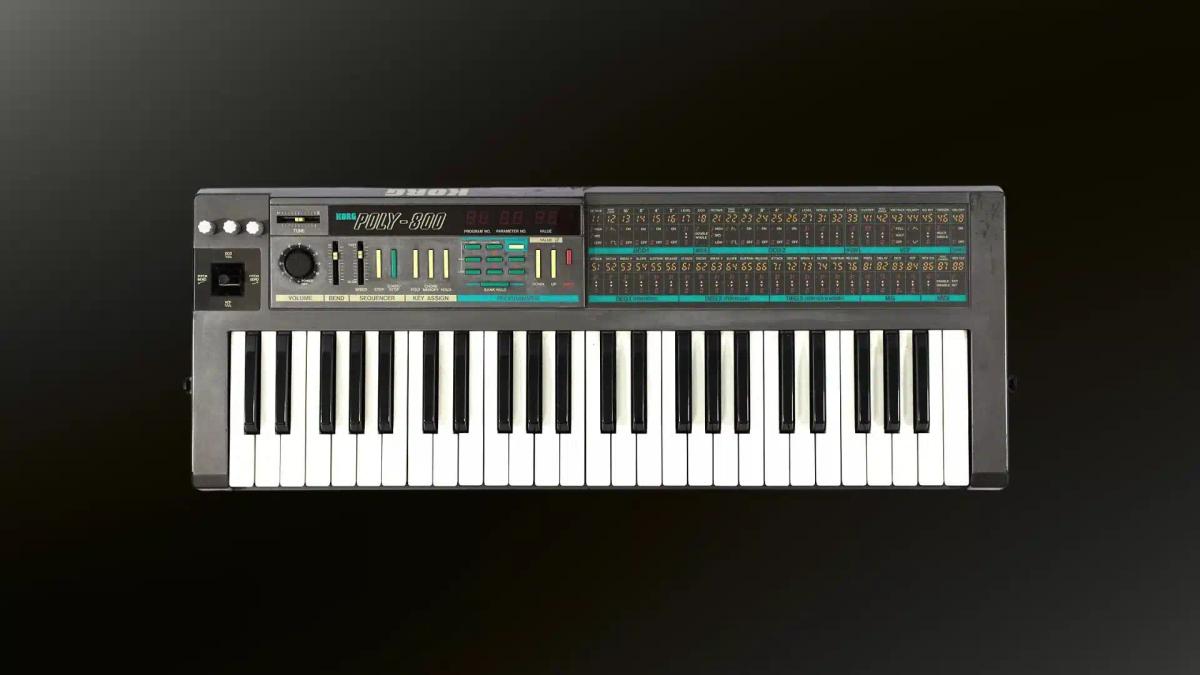
The Korg Poly-800 is an eight-voice programmable synthesizer that Korg announced at the end of 1983 for $795, widely cited as the first fully programmable polyphonic synthesizer sold for under $1,000. It pairs eight digitally controlled oscillators with a single analog low-pass filter shared by all voices, six-stage digital envelopes, a 64-program memory, a 256-step polyphonic sequencer, chorus and MIDI, all in a light plastic 49-key case that can run on batteries and hang from a guitar strap. The EX-800 module and the Poly-800 II followed. It matters because it brought programmable polyphony and MIDI to musicians who could never have afforded a polysynth, and because its compromises, especially the shared filter, are inseparable from its sound.
Table of Contents
Korg Poly-800 sound and character
The Korg Poly-800 has a bright, slightly hollow and distinctly square-wave character. Each DCO produces square and sawtooth waves (the sawtooth is derived from the square) at 16′, 8′, 4′ and 2′, mixed additively like organ drawbars, so many sounds have an organ-like, stacked quality. Gearnews’ Adam Douglas, who learned synthesis on one, admits that some people feel it always sounds square-ish while praising its basses and organs and calling it “quirky as hell”.
The single filter defines how it behaves. Because one 24dB/octave low-pass filter processes all eight voices, its envelope is shared, and in multiple-trigger mode every new key retriggers the filter on held notes. Electronics & Music Maker found this fatiguing and eventually annoying, and Geoff Downes, reviewing it for One Two Testing, noted the same effect. The filter is resonant but does not self-oscillate, and Downes found it lacked sizzle and penetration, making some sounds dull.
What works well are evolving pads, strings, brass and organ tones, especially with the stereo chorus, which Downes said opens up nearly every program. The six-stage envelopes, with break point and slope stages, allow double-decay shapes unusual at this price, though their digital steps can be heard on slow attacks. The Korg Poly-800 is vintage in sound but not warm in the American sense: lighter, more synthetic and more limited than the Juno-60 or Polysix, and its fans value it for exactly that character.
Features and architecture
- Manufacturer: Korg (Keio Electronic Laboratories), Japan
- Year introduced: 1983, announced at the end of the year; the first UK reviews appeared in February 1984
- Production years: 1983 to 1987 according to Wikipedia; the EX-800 module arrived in 1984 and the Poly-800 II in 1985 (some sources give 1986)
- Synthesis type: analog subtractive with digitally controlled oscillators and digital envelopes
- Category: budget programmable polyphonic synthesizer, paraphonic because of its single filter
- Polyphony: 8 voices with one DCO each in whole mode, or 4 voices with two DCOs each in double mode
- Original price: $795 in the United States; £635 including VAT in the UK; about £350 for the EX-800; £599 for the Poly-800 II
- Current market price: recent listings put working units at roughly $350 to $700, with non-working units around $200
- Oscillators: 8 DCOs generated by Oki MSM5232 tone chips, each with square and sawtooth and additive levels at 16′, 8′, 4′ and 2′; white noise generator
- Filter: one 24dB/octave resonant low-pass filter for all voices (Polynominal identifies Korg’s NJM2069), not self-oscillating, with envelope polarity reversal and single or multiple triggering
- LFOs: Wikipedia describes one triangle LFO with delay; Polynominal lists separate modulation generators for pitch and filter
- Envelopes: three six-stage digital envelope generators (attack, decay, break point, slope, sustain, release), one for each DCO bank and one for the filter and noise
- Modulation system: joystick with pitch bend left and right, pitch vibrato up and filter modulation down
- Sequencer / arpeggiator: 256-step polyphonic step-time sequencer that can be clocked from MIDI; 1,000 notes on the Poly-800 II; chord memory; no arpeggiator
- Effects: stereo chorus on the original; the Poly-800 II replaced it with a digital delay of up to 1,024 ms with modulation, plus a programmable two-band EQ
- Memory: 64 programs with about 50 editable parameters; cassette storage for programs and sequences; early units lose memory when the batteries are removed, while the Poly-800 II has battery-backed memory
- Keyboard: 49 full-size keys, no velocity or aftertouch; strap pegs for playing it slung like a guitar
- Inputs / outputs: stereo outputs, headphones, tape interface, program-up footswitch input and memory-protect switch
- MIDI / USB: MIDI in and out (sources disagree on whether the original has a Thru); no SysEx on the original, which arrived with the EX-800 and the Poly-800 II
- Display: small LED display for program and parameter numbers and values
- Dimensions / weight: 780 x 286 x 89 mm, about 4.3 kg
- Power: 9V DC adapter or six C-size batteries; reviewers measured about four to six hours of battery life
Strengths
- It made programmable polyphony cheap. At $795 it offered eight voices, 64 memories and MIDI for less than many monosynths had cost a few years earlier.
- It is genuinely portable. Battery power, strap pegs and a weight of around 4 kg made it a practical instrument for small stages and, as Downes put it, for setting up in a hotel room.
- The DCOs are stable, so it stays in tune without the warm-up and calibration that VCO-based polysynths demand.
- The six-stage envelopes and additive footage mixing give more sound-shaping depth than the panel suggests, and Electronic Soundmaker’s comparison found it had more sound parameters than the Poly-61.
- A polyphonic sequencer, chord memory and MIDI clock made it an early, cheap sketchpad for MIDI-based composition.
- Its quirks are a distinctive voice in their own right, and the Korg Poly-800 responds well to well-documented modifications.
Limitations
- One filter serves all voices, so filter envelopes retrigger across held notes and true polyphonic filter articulation is impossible.
- Parameter editing is button-based and coarse, with some values offering only a handful of steps and no knobs for real-time cutoff or resonance on an unmodified unit.
- The filter lacks brightness and does not self-oscillate, and many reviewers judged the factory sounds disappointing.
- Early units store programs only while batteries are fitted, so a battery change or a dead set can wipe both patches and sequences.
- The plastic case felt flimsy to reviewers in 1984, and many surviving units show road wear or battery-compartment corrosion.
- There is no unison mode, no velocity, no arpeggiator and, on the original, no SysEx.
Historical context
The Korg Poly-800 completed a run of affordable polysynths that Korg began with the Polysix in 1981 and continued with the Poly-61. Each step lowered the price of polyphony, and Roland’s Juno series was the main competition. Korg’s engineers, with Fumio Mieda credited by Gearnews, built the new instrument around the Oki MSM5232, a tone-generator chip also used in arcade games, using it for the oscillators and much of the voice circuitry, while one analog filter handled the tone shaping. The design reduced cost so far that Korg could undercut every other programmable polysynth.
Announced at the end of 1983 for $795 and reviewed in the UK at £635 in early 1984, it arrived just as MIDI was becoming standard. Reviews were enthusiastic about the value and reserved about the sound: Electronics & Music Maker called it extremely impressive and expected it to change the professional keyboard market, while Electronic Soundmaker found it ingenious but flimsy. Korg sold large numbers, and Gearnews notes that surviving units often show heavy touring wear. A limited version with reverse-colored keys, resembling a Vox Continental organ, became a visual signature.
Korg extended the platform in 1984 with the EX-800, a rack-mountable module that added patch dumps over MIDI and could be layered with a Korg Poly-800 for more voices. The Poly-800 II of 1985, in the blue and black of the DW-8000, replaced the chorus with a programmable digital delay and EQ, expanded the sequencer to 1,000 notes, made the envelopes exponential, added SysEx and moved memory backup to an internal battery. By then the DW series and, from 1988, the M1 pointed Korg toward digital synthesis, and the Korg Poly-800 line ended in the later 1980s.