

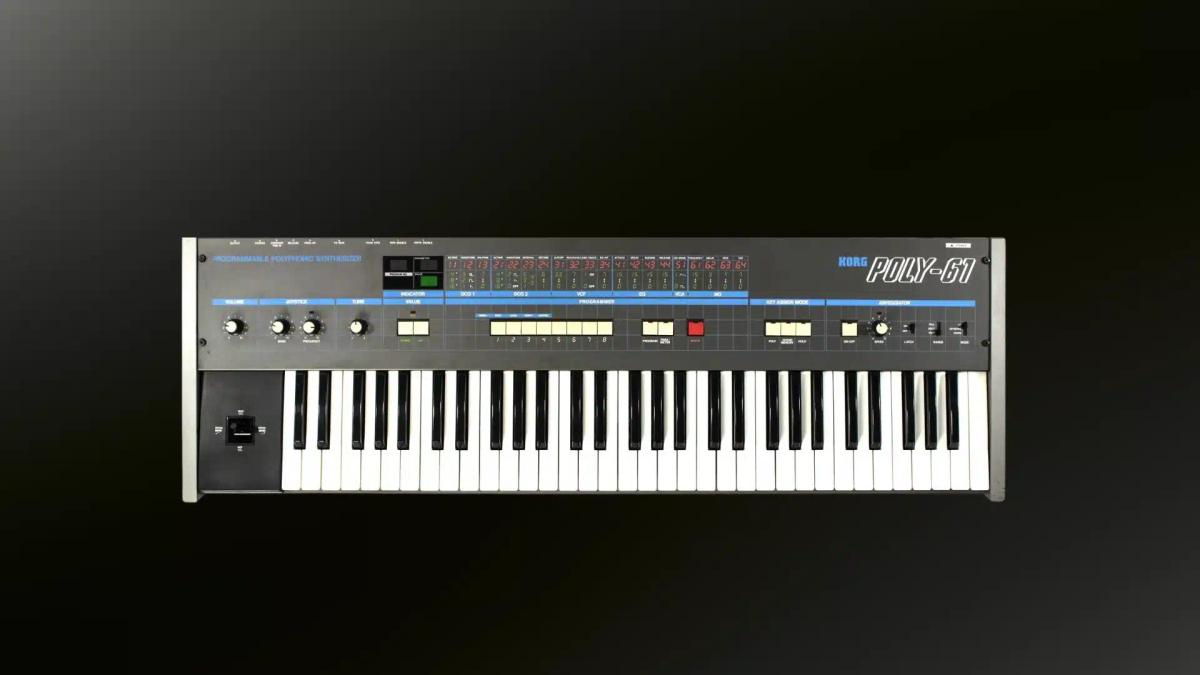
The Korg Poly-61 is a six-voice analog polyphonic synthesizer that Korg introduced in 1982 as the successor to the Polysix, and it was the company’s first synthesizer with digitally controlled oscillators. Each voice has two DCOs feeding a 24dB/octave low-pass filter, there are 64 memories, an arpeggiator, chord memory and a joystick, and everything is programmed through numbered buttons and up and down keys rather than a knob per function. A MIDI version, the Poly-61M, followed in 1984. The Korg Poly-61 matters because it showed where affordable polysynths were heading: stable digitally controlled oscillators, more voices for less money, and a panel that traded hands-on control for a cheaper, parameter-access interface.
Table of Contents
Korg Poly-61 sound and character
The Korg Poly-61 sounds warm and fairly smooth, with the steady, slightly polite tone typical of DCO-based polysynths. Because its oscillators are digitally controlled, they hold pitch and keep a constant detune between them, which Electronics & Music Maker’s Mike Beecher singled out as a key advantage. Detuning DCO2 against DCO1 gives chorus-like and honky-tonk thickness, while DCO2’s fixed intervals (minor third, third, fourth and fifth) produce parallel-chord and organ-like effects without any extra hardware.
Contemporary reviewers liked what it could do with ordinary material. One Two Testing found its strings, organs and brass excellent, with a powerful bottom end, and judged it richer and warmer than the single-oscillator Polysix, though a little fizzy on some brass. Vintage Synth Explorer adds that it is good at gritty basses and trippy analog effects, and that its filter sounds less fat than the Polysix’s.
Its weak points are mostly about resolution and range. Resonance and envelope amount each have only eight steps, there is no noise generator, and a single envelope serves both filter and amplifier, so percussive filter sweeps over sustained tones are not possible. Reviewers disagreed on the filter’s top end: Electronics & Music Maker reported that it does not self-oscillate, while Electronic Soundmaker found it would oscillate but glitched and tracked the keyboard poorly. The Korg Poly-61 is a vintage-sounding but tidy instrument, better at pads, chords and basses than at aggressive sound design.
Features and architecture
- Manufacturer: Korg (Keio Electronic Laboratories), Japan
- Year introduced: 1982; the MIDI-equipped Poly-61M followed in 1984
- Production years: generally given as 1982 to 1986, although Wikipedia notes that the DW-8000 replaced it in 1985
- Synthesis type: analog subtractive with digitally controlled oscillators
- Category: programmable polyphonic synthesizer
- Polyphony: 6 voices; a unison mode stacks all 12 oscillators on one note
- Original price: £995 including VAT in the UK according to Electronics & Music Maker (One Two Testing printed £999), more than £200 below the Polysix; Sound Programming lists a US price of $995
- Current market price: Reverb listings and Equipboard’s tracking point to roughly $450 to $750 for working units
- Oscillators: 2 DCOs per voice (12 in total); DCO1 offers sawtooth, square and pulse with PWM, DCO2 offers sawtooth and square, with fine detune or fixed intervals of a minor third, third, fourth or fifth; three footages
- Filter: 24dB/octave low-pass VCF per voice with 64-step cutoff, 8-step resonance and envelope amount, and on/off keyboard tracking
- LFOs: one triangle-wave modulation generator with delay, from about one cycle every three seconds up to about 20Hz, routable to pitch, DCO1 pulse width and filter cutoff; the joystick adds vibrato
- Envelopes: one ADSR per voice shared by filter and amplifier (attack up to 10 seconds, decay up to 23, release up to 20)
- Modulation system: joystick with pitch bend left and right and vibrato or filter modulation forward and back
- Sequencer / arpeggiator: arpeggiator with up, down and up/down patterns across one octave, two octaves or the full keyboard, with an external trigger input; chord memory for up to six notes; hold
- Effects: none dedicated; Vintage Synth Explorer mentions a chorus, but contemporary reviews describe chorus-like tones produced by DCO detune
- Memory: 64 programs numbered 11 to 88, with battery backup and a cassette interface (a full dump takes about eight seconds)
- Keyboard: 61 keys, C to C, no velocity or aftertouch
- Inputs / outputs: mono output with high/low switch, stereo headphones, arpeggio trigger input, release (sustain) footswitch input, program-up footswitch input, tape to and from sockets
- MIDI / USB: none on the original Korg Poly-61; the Poly-61M added a basic MIDI implementation
- Display: red and green LED numeric readouts for programs and parameters
- Dimensions / weight: 985 x 350 x 110 mm, about 12 kg
- Power: internal power supply; control by twin 8049 microprocessors
Strengths
- The oscillators are stable. Digital control keeps tuning and detune steady, which was a real advantage over the drifting VCOs of its predecessors.
- Two oscillators per voice at this price was new. One Two Testing called it the first of the lower-priced breed of polysynths to offer two oscillators per note.
- It is light and compact for a five-octave analog polysynth. At about 12 kg it weighs roughly half as much as Korg’s Trident.
- Performance features are generous: arpeggiator with external sync, chord memory, hold, a unison mode and a joystick that reviewers enjoyed.
- Sixty-four memories with cassette backup made it practical for gigging players at a time when the rival Juno-6 had no memory at all.
- Prices remain modest, which makes it one of the most accessible ways to own a programmable Japanese analog polysynth from the early 1980s.
Limitations
- The editing system is slow. Every parameter is reached through numbered buttons and two value keys, and Beecher noted that sweeping the cutoff from 0 to 63 took about five seconds.
- Parameter resolution is coarse. Most values have 15 steps or fewer, and resonance and envelope amount only eight, which shows up on release times and filter settings.
- There is no noise generator, an omission Electronics & Music Maker called important for a first polysynth.
- A single envelope serves both filter and amplifier, which limits articulation compared with two-envelope designs.
- The original model has no MIDI, and the Poly-61M’s implementation is very basic, reportedly receiving in omni mode.
- The memory backup battery can leak and damage the CPU board; Sound Programming warns that if ignored it will eventually destroy the board.
Historical context
The Korg Poly-61 followed the Polysix of 1981, the programmable six-voice synth that had given Korg a strong position in the affordable polysynth market. By 1982 the race was to deliver more for less: Roland’s Juno-6 offered DCOs at a low price but no memory, and Roland’s JX-3P and Juno-60 were close behind. Korg’s answer kept six voices but doubled the oscillators to two per voice, moved them to digital control, added 64 memories and an arpeggiator, and cut the price below the Polysix.
Korg paid for those gains with the panel. Instead of a control per function, the Korg Poly-61 used parameter access: select a parameter with a numbered button and adjust it with up and down keys, read on LED displays. Reviewers were divided. One Two Testing called it a formidable instrument and said it made the rest of Korg’s range look 19th century, while Electronic Soundmaker’s 1983 polysynth survey preferred the JX-3P and judged the Korg’s interface slow and error-prone. Within months Yamaha’s DX7 would show how far this style of interface could go, and with its arrival the market appeal of analog polysynths began to erode.
Korg updated the instrument in 1984 as the Poly-61M, essentially the same synth with MIDI added in place of the original’s analog trigger connections. By then the eight-voice Poly-800 had taken over the budget end of Korg’s range, and the DW-6000 and DW-8000 moved the company toward digital waveforms. Wikipedia reports that the DW-8000 replaced the Korg Poly-61 in 1985, though production references often extend to 1986.