

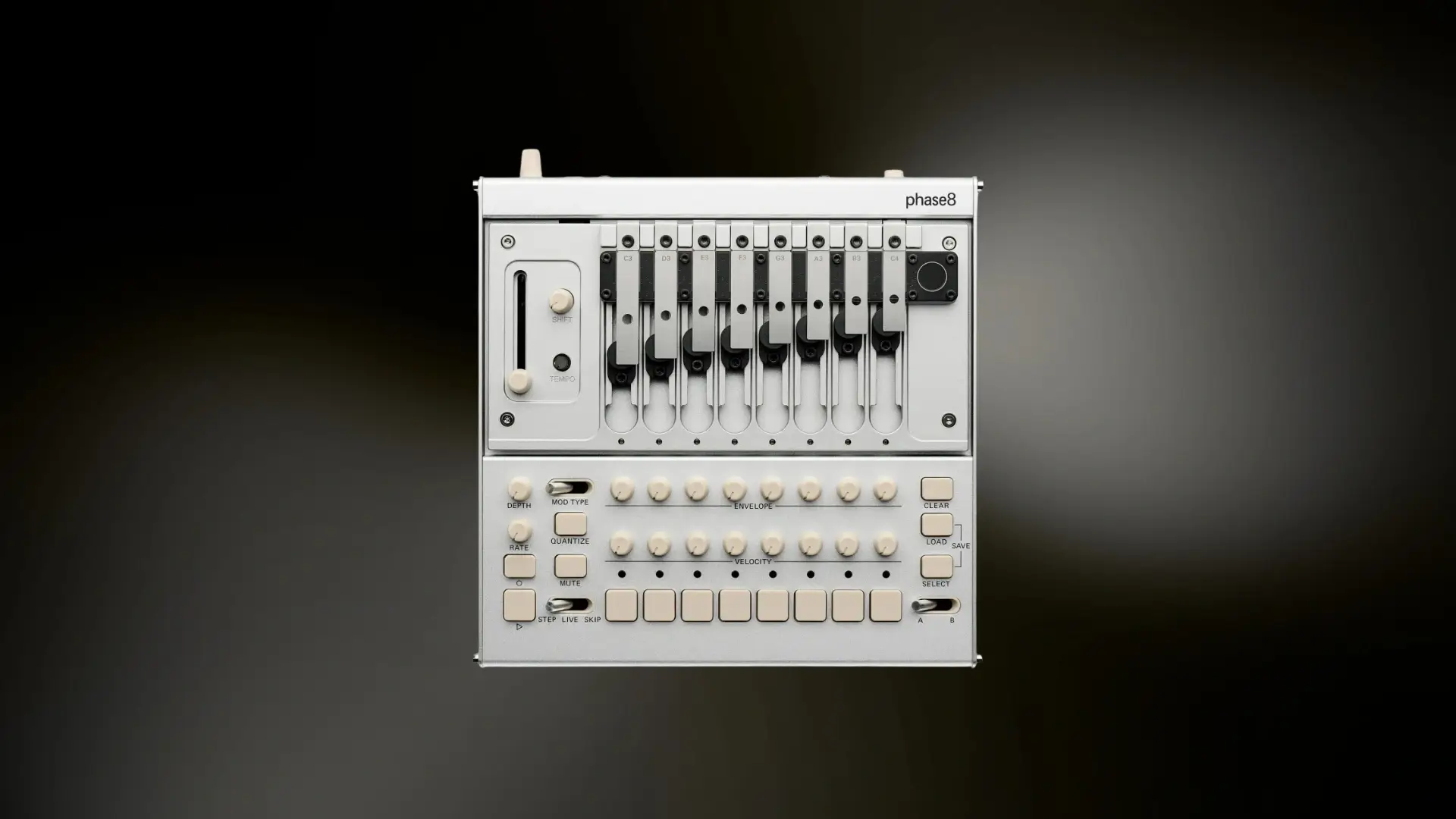
The Korg Phase8 is an eight-voice desktop acoustic synthesizer introduced as a finished commercial instrument at NAMM in January 2026. Developed by Korg Berlin, it replaces the conventional oscillator at the beginning of a synthesizer voice with physically vibrating steel resonators driven by electromagnetic impulses. Electronic envelopes, analogue wavefolding, amplitude modulation, parameter automation and a polymetric sequencer then shape that material vibration. It is the first commercial expression of Korg’s Acoustic Synthesis technology and the first completed instrument to emerge from the Berlin research division’s long-running exploration of mechanically generated sound.
Table of Contents
Korg Phase8 sound and character
The Korg Phase8 does not sound like a conventional analogue polysynth with an unusual preset bank. Its tonal centre comes from the irregular behaviour of real steel resonators. Each voice begins with a piece of metal twisting, bending and vibrating at several related frequencies, so the sound contains small variations and interacting overtones that are consequences of physical movement rather than digital randomisation or oscillator drift. The resulting identity sits somewhere between an electric kalimba, prepared percussion, a tine-based keyboard instrument and an experimental electronic sound generator.
At restrained settings, the Korg Phase8 produces rounded plucks, metallic knocks, bell-like figures and dry rhythmic pulses. Longer envelope settings bring out sustained drones and slowly developing resonances, while the per-voice wavefolder adds increasingly dense harmonics as the Velocity control is raised. That wavefolding stage is important because it prevents the Korg Phase8 from being limited to polite, mallet-like tones. It can push the resonators into sharper buzzing, clanging and almost electrically distorted territories without disguising their physical origin.
The three modulation modes extend the palette further. Tremolo creates conventional pulsing and shimmering motion, while the two pitch-dependent audio-rate amplitude-modulation modes introduce more synthetic, sideband-heavy colours. One mode uses a sine wave that descends toward the frequency of the triggered resonator; another applies polyphonic modulation related to the pitch of each voice. These processes can turn a recognisable metallic strike into something more unstable, industrial or ring-modulator-like, while still preserving the transient and resonance of the physical source.
Its most distinctive sounds appear when the player stops treating it as a sealed electronic box. The resonators can be plucked, tapped, strummed, damped or touched while a sequence is running. Wood, felt, stones, bolts and other objects can be placed against them to alter their contact points and vibration. The AIR slider mixes more of the raw pickup response into the controlled signal, making those interactions louder and potentially encouraging acoustic feedback in high-volume environments. The Korg Phase8 therefore behaves less like a device that reproduces stored patches and more like an amplified object whose tone depends on the room, the performer and whatever is touching it.
The Korg Phase8 is particularly effective for polymetric percussion, evolving ostinatos, prepared-instrument textures, ambient drones, abstract sound design and sample creation. It is less naturally suited to conventional subtractive-synthesis duties such as wide brass chords, smooth string pads or oscillator-based basses. That limitation is also the basis of its identity: the Korg Phase8 is not attempting to provide another version of sounds already available from hundreds of analogue and virtual-analogue instruments.
Features and architecture
- Manufacturer: Korg; developed by the autonomous Korg Berlin research and design team.
- Year: Officially launched at NAMM on January 22, 2026, after earlier prototypes had been shown publicly.
- Production years: 2026 to present as of August 2026; European retailers list general availability beginning in May 2026.
- Synthesis type: Korg Acoustic Synthesis, using electromechanically excited physical resonators with electronic envelope control, analogue wavefolding and amplitude modulation.
- Category: Desktop acoustic and electro-mechanical synthesizer; it can also function as a rhythmic sound generator, performance instrument and MIDI sequencer/controller.
- Polyphony: Eight independent electromechanical voices.
- Original price: Announced at approximately US$1,149 and £859.
- Current new-market price: Korg’s US store lists the standard Korg Phase8 at US$1,149.99. European prices observed during July and August 2026 ranged roughly from €888 to €1,049, with Thomann Ireland listing it at €979 including VAT. Regional taxation and distribution account for part of the difference.
- Oscillators and sound sources: No conventional electronic oscillators. Eight user-selected steel resonators are installed over electromagnetic drivers and pickups. Thirteen chromatically tuned resonators are supplied, allowing the installed eight-note set and its ordering to be changed.
- Filter: No conventional synthesizer filter is included in the published architecture. Tonal shaping instead comes from resonator selection, physical damping, envelope behaviour, wavefolding, modulation and the AIR pickup level.
- LFOs: No conventional multi-waveform LFO is specified. RATE and DEPTH govern three amplitude-modulation modes: tremolo, AM pitch envelope or vibrato, and polyphonic pitch-dependent AM.
- Envelopes: One macro envelope control per voice. Its range moves from immediate attack with short decay and no sustain to slower attack, sustained behaviour and longer release. It is not presented as a conventional four-knob ADSR.
- Velocity and wavefolding: Each voice has an individual Velocity control governing drive intensity and loudness. Increasing it beyond approximately the midpoint progressively overdrives the voice’s analogue wavefolder and adds harmonics.
- Modulation system: Three global amplitude-modulation types with Rate and Depth controls, optional vibrato substitution through the global settings, panel-parameter automation, and assignable external CV control of global or individual parameters.
- Sequencer: Eight-step sequencing for each of the eight voices, with step programming, unquantised live recording, per-voice quantisation, mute, variable sequence length through step skipping, A/B variations, trigger delay and recordable knob automation. Different sequence lengths can produce polymetric patterns.
- Arpeggiator: None.
- Effects: No conventional onboard multi-effects section. Sound processing consists principally of per-voice analogue wavefolding and the three amplitude-modulation modes.
- Memory: Eight program slots. Each program can store both A and B sequence variations, step-skip data, mute and quantise settings, most panel parameters and recorded parameter movement. Tempo is not saved with the program.
- Keyboard and performance controls: Eight multifunction buttons serve as voice triggers or sequencer steps. Separate touch-activated PLUCK controls can trigger the resonators and be recorded into sequences. The resonators themselves can also be played directly.
- Audio and control inputs: One ±5V CV input and sync input. The CV input can receive control voltage or an audio signal for parameter modulation.
- Outputs: Quarter-inch mono line output, 3.5mm headphone output and sync output.
- MIDI and USB: TRS Type-A MIDI input and output; USB-C for USB-MIDI, controller operation and firmware updates. MIDI can trigger the resonators, transmit notes from the Korg Phase8, automate parameters through control changes and synchronise the sequencer.
- Display: None. Global configuration is performed through buttons, switches, knobs and LED combinations.
- Dimensions: 231 × 236.5 × 46mm.
- Weight: 1.71kg.
- Power: External 12V DC adaptor; rated consumption of 4.8W.
Strengths
- A genuinely different sound-generation principle: The Korg Phase8 produces sound through the movement of physical material rather than simulating that movement with samples or mathematical models. Small changes in contact, damping and acoustic feedback therefore alter the actual source before conventional electronic processing begins.
- Direct access to each voice: Dedicated Envelope and Velocity controls for all eight resonators make the Korg Phase8 easier to shape rhythmically than its experimental concept initially suggests. Individual voices can be short, sustained, clean or wavefolded within the same pattern.
- A sequencer designed around the sound engine: Per-voice skipping, mutes, quantisation and sequence lengths allow metallic patterns to move against one another instead of forcing all eight resonators into one fixed rhythmic grid. Parameter automation and A/B variations make the sequencer a compositional part of the Korg Phase8 rather than an accessory.
- Meaningful physical performance: Touching or damping a resonator changes the source itself. Found objects can introduce rattling, muting, buzzing and irregular contact textures that would require extensive modulation or sampling work on a conventional synthesizer.
- Flexible integration: MIDI input and output, USB-MIDI, CV input and Korg-style sync connections allow the Korg Phase8 to work with DAWs, modular systems, grooveboxes and external synthesizers. Its sequencer can also transmit MIDI notes and parameter changes.
- Customisable tuning: Changing the installed resonators allows the player to construct chromatic subsets, modal arrangements, limited scales or deliberately unusual interval collections. Frequency-based MIDI note assignment can adapt to the calibrated resonator pitches.
- Strong value as a sampling source: Because its sound changes through mechanical preparation, feedback, wavefolding and physical performance, the Korg Phase8 can generate one-shot percussion, loops, drones and evolving textures that remain difficult to duplicate exactly.
- A focused interface: The lack of a display and deep conventional synthesis menu keeps most performance functions physically accessible, even though the global-settings layer still requires button combinations.
Limitations
- It is not a general-purpose polysynth: There are no conventional oscillators, filter, piano-style keyboard, arpeggiator or broad multi-effects section. Buyers seeking familiar basses, leads, brass and pads will need another instrument.
- The price is high relative to its narrow role: At approximately US$1,150, it costs as much as several fully featured polyphonic synthesizers. Its value depends on whether the buyer needs its specific physical sound-generation method rather than the greatest number of conventional functions.
- Changing scales is mechanical rather than instantaneous: Resonators must be loosened with the supplied hex key, repositioned or replaced, tuned by altering their effective length and then recalibrated. This is suitable for preparation before a session but impractical as an immediate performance change.
- Only eight program locations are provided: Although each program stores two pattern variations and automation, the limited memory encourages a hands-on working method rather than maintaining a large performance library.
- The main line output is mono: External stereo effects or multitrack processing are required to place its eight voices across a wider stereo field.
- No individual voice outputs are provided: All resonators are combined before reaching the main output, limiting separate processing of individual voices during performance or recording.
- Physical behaviour introduces unpredictability: Temperature, mounting, contact pressure, room volume and added objects can influence resonance and feedback. This is creatively valuable, but less repeatable than recalling a digital patch. Korg recommends recalibration after resonator changes, and the AIR control can encourage feedback in loud spaces.
- Envelope control is simplified: Each voice uses one macro control rather than independent attack, decay, sustain and release knobs. The designed contour is quick to operate but cannot provide the envelope precision of a conventional modulation system.
- The screenless global configuration is not fully self-explanatory: MIDI routing, clock behaviour, calibration options and CV assignments depend on LED states and button combinations, making the manual important for advanced setup.
Historical context
Korg Berlin was established as a German research and development subsidiary in 2019 under the direction of instrument designer Tatsuya Takahashi. Rather than functioning simply as another production office for established product categories, the group was organised as a small, interdisciplinary team with autonomy to prototype new musical instruments. Takahashi had previously been closely associated with projects including the Minilogue and several Volca instruments, products that helped Korg combine accessible pricing with distinctive physical interfaces.
Acoustic Synthesis represented a different objective. Takahashi described the underlying concept as an idea that had remained dormant for more than fifteen years: instead of designing another electronic oscillator system, the team would excite pieces of metal with electromagnetic “hammers” and control the resulting physical behaviour electronically. The objective was to create an instrument that responded more like a guitar, cajón or other resonant object than a closed digital appliance.
The public development process began well before the commercial release. Korg Berlin demonstrated the six-voice Phase5 prototype at Superbooth 2023. An internal Phase6 followed as a four-voice instrument played from velocity pads, while Phase7 became a development platform for testing a broader collection of ideas. By 2024 and 2025, the project had evolved into Korg Phase8 prototypes with different finishes, resonator shapes and tunings, many of which were publicly documented rather than hidden until launch.
The production instrument was announced at NAMM 2026 and began reaching retailers during the following spring. Its timing mattered because much of the contemporary hardware market remained centred on analogue revivals, digitally expanded subtractive instruments and lower-cost reinterpretations of historical circuits. The Korg Phase8 did not reject that history, but it moved outside it. Instead of arguing about whether analogue or digital oscillators sounded more authentic, Korg presented a synthesizer whose primary oscillator was an actual vibrating object.