

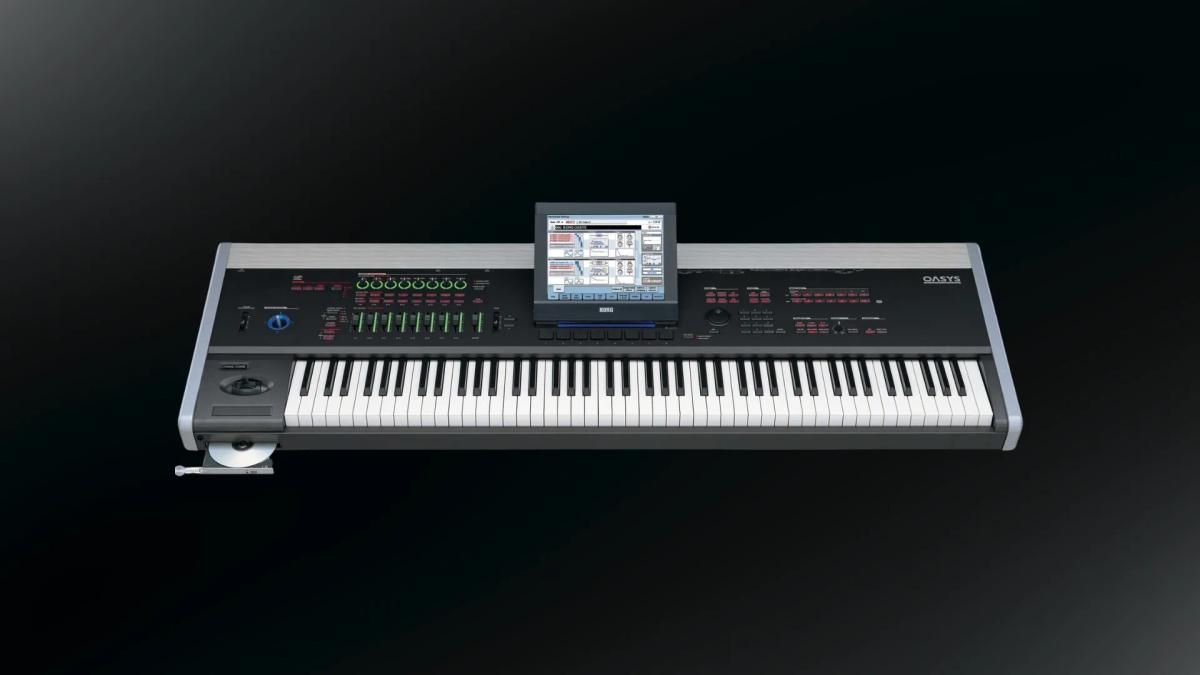
The Korg OASYS is a keyboard workstation launched at Winter NAMM in January 2005, offered in a 76-key synth-action version and an 88-key weighted hammer-action version. Built around a 2.8GHz Pentium 4 running a custom Linux-based operating system, it combined a high-definition PCM engine, a virtual analog synth and a tonewheel organ model with sampling, KARMA, a MIDI sequencer, hard disk recording and a 10.4-inch touchscreen, and it grew new synthesis engines through software updates. Its name, Open Architecture Synthesis Studio, revived a project Korg had shown and shelved a decade earlier, and its US price of around $8,000 placed it well above Korg’s mainstream workstations.
Table of Contents
Sound and character
The Korg OASYS sounds polished, wide and very clean, and that is both its signature and its main point of debate. Launch reviews centred on the HD-1 engine and its 616MB of uncompressed waveforms. Gordon Reid, testing it for Sound On Sound, concluded that “HD1 can sound superb”, praising its orchestral, percussive and pad sounds and low aliasing, while hearing audible multisample seams on some patches. AudioTechnology’s Brad Watts was less reserved, calling the sounds lush and rich. This is a top-tier Korg workstation voice: bright, detailed, effects-rich and built to sit finished in a mix.
The more distinctive side of the instrument lives in its other engines. The AL-1 virtual analog synth, with its dual multimode filters, a MultiFilter that morphs between more than twenty filter types and a per-voice 32-step step sequencer, moves easily from familiar analog basses to animated, sequenced textures. Reid found its factory patches underwhelming but discovered a strong character when programming from scratch.
The CX-3 tonewheel model, played with nine sliders acting as drawbars, divided opinion: MusicRadar called it “plastic” next to Native Instruments’ B4, while Reid heard a slightly muted top end. Later engines widened the palette further, from the plucked-string physical modeling of STR-1 to the FM and waveshaping territory of MOD-7.
What ties these engines together is layering. Combinations stack up to 16 Programs, each with its own engine, and the effects section, with 12 insert, two master and two total effects drawn from 185 algorithms, is a large part of why the Korg OASYS sounds expansive rather than merely accurate.
Features and architecture
- Manufacturer: Korg
- Year introduced: 2005 (unveiled at Winter NAMM, January 2005)
- Production years: 2005 to the late 2000s, with 2009 commonly cited as the end of production
- Synthesis type: multi-engine digital workstation; PCM sample playback with wave sequencing and vector synthesis (HD-1), virtual analog (AL-1), tonewheel organ modeling (CX-3), plucked-string physical modeling (STR-1, from OS 1.1), MS-20 and Polysix models (LAC-1, from OS 1.2), waveshaping and VPM/FM synthesis (MOD-7, from OS 1.3), plus sampling
- Category: flagship keyboard workstation
- Polyphony: up to 172 voices with HD-1 and CX-3; AL-1 84 voices at launch, raised to 96 in OS 1.2; STR-1 32 voices, raised to 48 in OS 1.2; actual polyphony shared dynamically and reduced by effects load
- Multitimbrality: 16 parts
- Original price: around $8,000 in the US; £5,149 (OASYS 76) and £5,399 (OASYS 88) including VAT in the UK; A$13,999 and A$14,999 in Australia
- Oscillators: HD-1 offers two oscillators per voice with velocity-switched multisamples and wave sequences; AL-1 offers two oscillators per voice with waveform morphing and ring modulation, plus sub oscillator, noise and live audio input
- Filter: HD-1 has two filters per voice; AL-1 has two resonant multimode filters per voice plus a morphing MultiFilter
- LFOs: AL-1 provides four LFOs with a wide choice of wave shapes
- Envelopes: AL-1 provides five multi-stage envelopes; a dedicated vector envelope drives Advanced Vector Synthesis
- Modulation system: Korg’s AMS modulation routing with AMS Mixers; vector synthesis via a dedicated joystick
- Sequencer / arpeggiator: second-generation KARMA with 2,048 Generated Effect presets; 16-track MIDI sequencer, 1/192 resolution, up to 400,000 events; 16-track hard disk recorder recording four tracks at once; AL-1 per-voice step sequencer
- Effects: 12 insert, 2 master and 2 total effects with 185 types; 3-band EQ per timbre or track
- Memory: 1,152 factory Programs and 384 factory Combinations at launch; 1GB RAM, user-expandable to 2GB from OS 1.1; 40GB internal hard disk; internal CD-R/RW drive
- Keyboard: OASYS 76 with 76-key synth action; OASYS 88 with 88-key RH2 weighted hammer action
- Controllers: two joysticks (one for vector synthesis), ribbon controller, eight knobs, nine sliders, 16 switches, eight velocity-sensitive pads, three pedal inputs
- Inputs / outputs: four analog inputs (two with mic/line switching and phantom power), main stereo outputs plus eight individual outputs, headphones, optical S/PDIF in and out; optional EXB-DI board for eight-channel ADAT output and word clock input
- MIDI / USB: MIDI In, Out and Thru; four USB 2.0 Type-A ports
- Display: 10.4-inch adjustable-angle color TFT touchscreen, 640 × 480 pixels
- Dimensions / weight: OASYS 76: 1,266 × 484 × 135 mm, 25.7 kg; OASYS 88: 1,458 × 484 × 135 mm, 32.1 kg
- Power: internal supply, 130 W consumption
Strengths
- It treated the workstation as a platform rather than a fixed product. STR-1, the LAC-1 analog models and MOD-7 arrived through operating system updates, so an Korg OASYS bought in 2005 became a substantially larger instrument by 2008.
- The engines are integrated rather than bolted together. Every EXi engine works inside Combinations, KARMA and the sequencer, and two engines can share one Program, which makes hybrid layers practical.
- The touchscreen and control set were widely praised. Reid called the large, bright touchscreen “simply excellent”, and the combination of joysticks, ribbon, sliders, knobs and pads gives serious real-time control over very deep patches.
- It behaves like an instrument rather than a computer. MusicRadar reported that it never crashed or froze during weeks of testing, and Reid argued that its integrated design handled resource overload more gracefully than a PC.
- Its connectivity was unusually broad for a keyboard: four analog inputs, ten analog outputs, S/PDIF and optional ADAT made it usable as a recorder, sampler and effects processor as well as a synth.
Limitations
- The price restricted its audience from day one. Reid wrote that “Korg didn’t build the Korg OASYS for you,” and MusicRadar argued it would be a world-beater only at roughly half its UK price.
- The sequencer and recorder lagged behind the sound engines. Reid called text-based event editing “archaic”, noted the absence of a piano-roll view and timecode, and found the 16-bit recorder an odd choice at this price, a point AudioTechnology also raised.
- The “open” architecture was open only to Korg. There was no third-party developer kit, no VST support and no way to run other PC software, and several expansions were paid unlocks.
- Early versions had real rough edges: limited RAM at launch, a power cycle needed to switch between EXs sample sets until OS 1.3, and a sampler that offered less memory than expected in Reid’s tests.
- Its weight, 25.7 kg for the OASYS 76 and 32.1 kg for the OASYS 88, makes it a fixed centerpiece rather than a portable instrument.
- Some physical details raised durability questions, notably the screen hinges, which Reid noted were rated for about 2,000 movements.
Historical context
The OASYS name first appeared in the early 1990s, when Korg’s California R&D team began work on an Open Architecture Synthesis System: a DSP-based instrument whose synthesis types could be reconfigured in software, with algorithms designed in an in-house tool called SynthKit. Korg demonstrated an Korg OASYS keyboard at Winter NAMM in January 1995, but it never reached production because the company judged it too expensive to be commercially viable.
Its research survived: the touchscreen interface surfaced in the Trinity, and its algorithms fed the Prophecy, the Z1, the MOSS boards and the Electribe line. In 2000, the OASYS PCI card, a Mac-hosted card with five Motorola DSPs, brought some of that synthesis to computer users.
By the early 2000s, general-purpose processors had made the original dream feasible in a different form. Sound On Sound’s 2005 preview reported that the new OASYS had been developed afresh over five years rather than recycled from the 1995 specification, though Korg’s Jerry Kovarsky framed it as continuing the original spirit of combining different technologies for making sound. The key change was the platform: the synthesis now ran as software on a PC-class processor sealed inside a keyboard.