Home›Synths›Korg Nautilus (61, 73, 88 keys): The nine-engine workst…
Synths

Korg Nautilus (61, 73, 88 keys): The nine-engine workstation that distilled the Kronos for working players

The Korg Nautilus is a digital music workstation announced in November 2020 and shipped from early 2021 in 61-, 73- and 88-key versions. It runs the same nine sound engines as Korg’s Kronos, from the SGX-2 acoustic piano and CX-3 tonewheel organ to the MS-20EX and PolysixEX…

Bernardo de Azevedo
Bernardo de Azevedo
· Updated
Korg Nautilus (61, 73, 88 keys): The nine-engine workstation that distilled the Kronos for working players

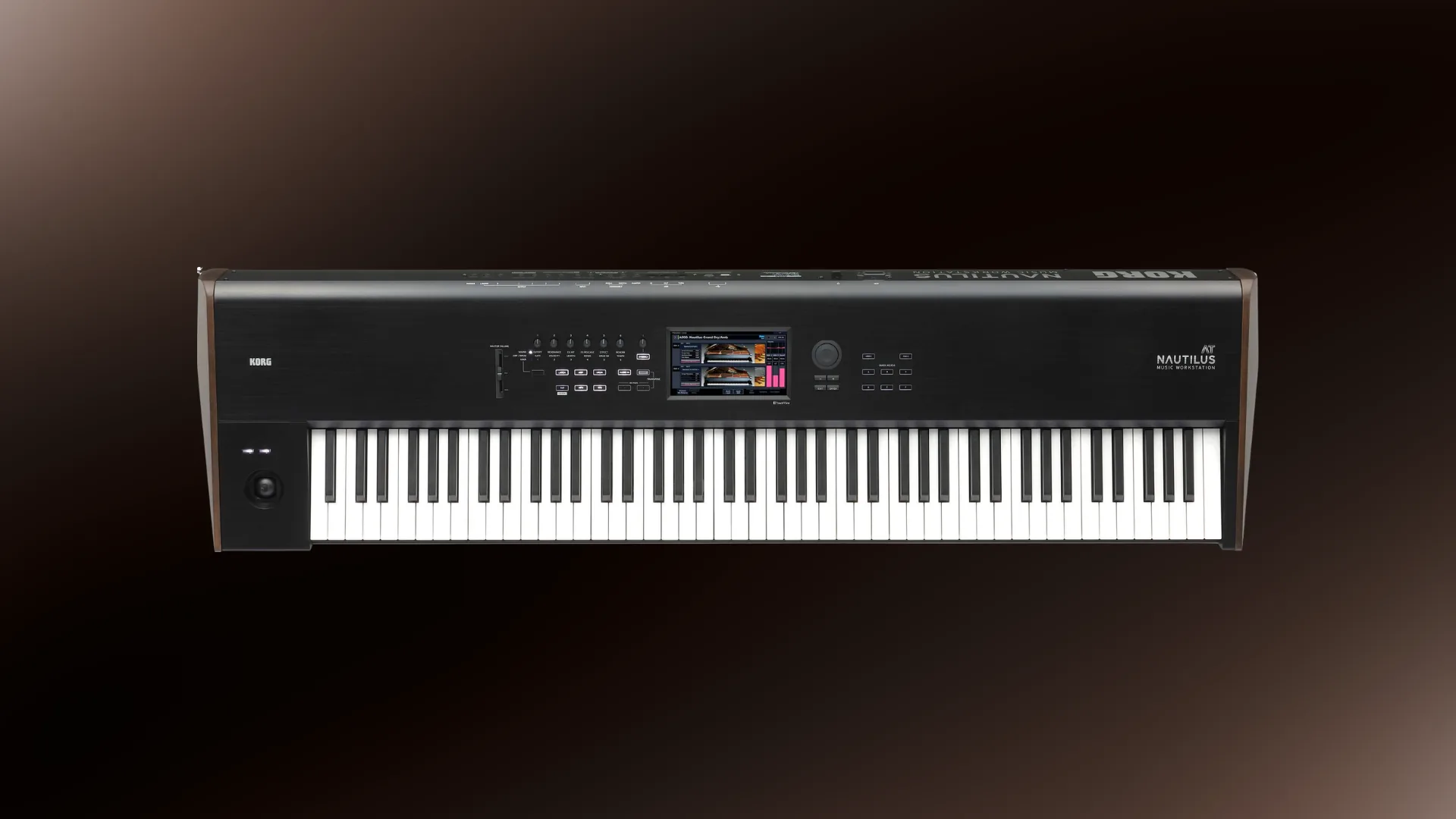
The Korg Nautilus is a digital music workstation announced in November 2020 and shipped from early 2021 in 61-, 73- and 88-key versions. It runs the same nine sound engines as Korg’s Kronos, from the SGX-2 acoustic piano and CX-3 tonewheel organ to the MS-20EX and PolysixEX analog models, but packages them in a slimmer chassis with a 7-inch touchscreen, a reduced control surface and a lower price.

In 2023 Korg added the Nautilus AT, a 61- and 88-key revision with channel aftertouch. What makes the Korg Nautilus meaningful at a glance is less novelty than continuity: it kept the deepest sound platform Korg had built alive and affordable at a moment when the instrument it was derived from had all but left the market.

Sound and character

The Korg Nautilus sounds like a Kronos, because underneath it essentially is one. Sound On Sound’s reviewer described it as “pretty much a Kronos as far as the underlying sound generation and programming is concerned,” and that sentence explains its tonal identity better than any single preset could.

Its strongest territory is the keyboard player’s core repertoire. The SGX-2 engine delivers multi-velocity grand pianos with modelled damper and string resonance, and new pianos let the player balance close and ambient microphone layers. MusicRadar found them rich and detailed; Sound On Sound preferred them after rebalancing those layers with the user knobs. The EP-1 engine covers Rhodes and Wurlitzer types with amp and cabinet modelling, and the CX-3 organ was judged as good as ever.

Beyond the stage-piano core, the instrument leans polished rather than raw. Orchestral sounds, pads and lead synths were singled out by Sound On Sound as particularly strong, and MusicTech called the synthesis side the instrument’s greatest asset, praising its “astonishing flexibility.”

HD-1 sample synthesis, AL-1 virtual analog, MOD-7 waveshaping and phase modulation, STR-1 physical modelling and the MS-20EX and PolysixEX models of Korg’s own analog past make it a workstation that can move from a convincing ballad piano to a gritty MS-20 bass to a modulated hybrid texture without leaving the instrument, and it does so with the clean, high-resolution finish typical of Korg’s flagship platform rather than with vintage instability.

Features and architecture

  • Manufacturer: Korg
  • Year introduced: announced November 2020, shipping from early 2021
  • Production years: 2021 to present; the Nautilus AT (61 and 88 keys) was announced in July 2023 with availability set for September 2023, and both AT models were still listed and on order at major US retailers in October 2026
  • Synthesis type: multi-engine digital workstation combining sample playback, physical modelling, virtual analog, component modelling and waveshaping/phase modulation
  • Category: keyboard music workstation
  • Polyphony: per-engine maxima range from 40 voices (STR-1, MS-20EX) to 200 voices (CX-3), with 140 for HD-1, 100 dual-stereo notes for SGX-2, 104 for EP-1, 80 for AL-1, 52 for MOD-7 and 180 for PolysixEX; Korg’s US launch material quoted up to 240 notes with dynamic voice allocation; 16-part multitimbral
  • Original price: US $1,999.99 (61), $2,399.99 (73) and $2,699.99 (88); UK £1,949, £2,199 and £2,549; Nautilus AT launched at $2,199.99 (61) and $2,899.99 (88)
  • Oscillators: nine engines, namely SGX-2 Premium Piano, EP-1 MDS Electric Piano, HD-1 High Definition Synthesizer, AL-1 Analog Synthesizer, CX-3 Tonewheel Organ, STR-1 Plucked String, MOD-7 Waveshaping VPM Synthesizer, MS-20EX and PolysixEX
  • Filter: engine-dependent, including the AL-1, MS-20EX and PolysixEX filter models
  • LFOs: engine-dependent, as on the Kronos
  • Envelopes: engine-dependent, as on the Kronos
  • Modulation system: Kronos-derived programming; six push-to-lock real-time knobs, a Dynamics knob for velocity response, three pedal inputs, and channel aftertouch on AT models only
  • Sequencer / arpeggiator: 16-track MIDI sequencer plus 16-track audio recorder; dual polyphonic arpeggiator replacing the Kronos’s KARMA, with 1,593 preloaded patterns; drum track with 1,272 preloaded patterns; Set List mode
  • Effects: 12 insert, 2 master and 2 total effects, 197 effect types, 783 presets, and a three-band EQ per timbre or track
  • Memory: 2,560 programs (1,920 preloaded) and 1,792 combinations (256 preloaded); about 2 GB of RAM for sample data; sampling and resampling, with import of AIFF, WAV, SoundFont 2.0 and Akai S1000/S3000 files
  • Keyboard: 61 and 73 keys with Natural Touch semi-weighted action; 88 keys with RH3 weighted hammer action; velocity sensitive, no aftertouch on the original models; AT versions add channel aftertouch on 61 and 88 keys only
  • Inputs / outputs: balanced 1/4-inch main L/R and four individual outputs, headphone jack, two balanced 1/4-inch audio inputs with line and mic levels (no phantom power)
  • MIDI / USB: MIDI In, Out and Thru; USB-B for MIDI and 2-channel 24-bit/48 kHz audio; USB-A host ports for storage and class-compliant controllers
  • Display: 7-inch color TouchView touchscreen, 800 x 480
  • Storage: 60 GB internal SSD
  • Dimensions / weight: 61 keys 1,062 x 386 x 116 mm, 13.0 kg; 73 keys 1,227 x 386 x 116 mm, 14.6 kg; 88 keys 1,437 x 387 x 139 mm, 23.1 kg
  • Power: internal AC supply, 40 W consumption

Strengths

  • It puts the full Kronos sound engine in a cheaper, lighter instrument. All nine engines survived the transition, so the Korg Nautilus is a “Kronos lite” in surface, not in sound.
  • The core stage sounds are deep and well judged. Multi-layer pianos with adjustable ambience, modelled electric pianos and a respected tonewheel organ cover most of what a working keyboardist is asked to play in one night.
  • Live-performance plumbing is mature. Smooth Sound Transition keeps reverb and release tails intact during sound changes, Set List mode turns the touchscreen into a grid of color-coded buttons, and a master graphic EQ helps adapt the overall tone to a room. MusicRadar called the 88-key model a great instrument for serious giggers.
  • The Dynamics knob is small but practical: it makes the keyboard respond harder or softer without menu diving, useful when moving between pianos, organs and synths.
  • It is a complete production environment without a computer. Sampling, resampling, a 16-track audio recorder, a MIDI sequencer and a large effects library can carry an arrangement from sketch to finished track.
  • The 2023 AT revision addressed the most common complaint, adding channel aftertouch and factory programs optimized for it.

Limitations

  • The original Nautilus has no aftertouch on any model. Sound On Sound considered this a serious loss and MusicTech called it “a step too far.” The AT models fix it, but there is no AT version of the 73-key instrument, and the factory retrofit for existing owners was offered through Korg UK for customers in the UK and Ireland only.
  • The control surface is much thinner than the Kronos’s: no assignable faders, no vector joystick, no ribbon, no numeric keypad and no dedicated sequencer transport. Without faders, CX-3 drawbars cannot be ridden by hand.
  • Boot time is long. Sound On Sound and MusicRadar both measured close to three minutes from power-on, a real concern if a gig requires a quick restart.
  • The touchscreen carries much of the interface. MusicTech found some pages dense and hard to select from accurately, and MusicRadar noted that it needed firm pressure.
  • KARMA is gone. The new dual arpeggiator is capable and editable, but players invested in KARMA’s generative phrase system lose it.
  • Some studio details feel limited: the sequencer is workable but no match for a DAW, the audio inputs have no phantom power, and there is no digital audio I/O.

Historical context

The Korg Nautilus descends from the Kronos, which Korg introduced in 2011 and which became its flagship workstation through the following decade. The Korg Nautilus, announced on November 9, 2020, answered a narrower question: how much of the Kronos could be kept if the price, size and panel were cut back? Korg’s US launch material promised “the power and sound quality of KRONOS in a streamlined design.” The answer was almost all of the sound and much less of the surface. Sound On Sound put it precisely: the Korg Nautilus “is not a successor to the Kronos; it’s a cut-down version for a significantly lower price.”

Timing gave it a larger role than that description suggests. Around the pandemic years the Kronos faded from the market, with Sonicstate later citing component and regulation challenges, and for several years the Nautilus became the instrument that carried the platform forward. Synth Anatomy later observed that musicians received this replacement less warmly than the Kronos, mainly because of the missing aftertouch and the heavy reliance on touch control, and that reception helps explain the Nautilus AT of 2023.

The story turned again at NAMM 2025, when Korg brought the Kronos back with a new CPU, a larger SSD and an 8-inch screen. That return repositioned the Korg Nautilus as the more compact and affordable door into the same nine-engine ecosystem, with Korg promising soundpacks to bring newer Kronos content to existing Nautilus owners.

Legacy and significance

The Korg Nautilus matters mainly as an act of preservation. Working keyboardists still needed one instrument that could play convincing pianos, organs, strings, synths and drums with seamless program changes. By keeping the Kronos engines in production at a lower price, the Korg Nautilus kept that kind of instrument available while its predecessor was absent.

It also clarified what was essential about the Kronos. Stripping away faders, ribbon, vector joystick and KARMA showed that the platform’s value lay in its engines, sampling and live-performance logic rather than its control surface. Players who prized the physical interface felt the loss; players who prized sound per dollar got close to the full flagship for considerably less. Its identity has also kept shifting after launch, through system updates, new sound libraries, the aftertouch revision and the return of the Kronos above it.

Artists, users, and curiosities

Korg introduced the Korg Nautilus with demonstrations rather than a signature artist. Jordan Rudess, best known as Dream Theater’s keyboardist, hosted a live Nautilus and opsix performance demo with Korg on January 21, 2021, as the instrument reached stores, and the Woody Piano Shack channel published a launch-day overview comparing it with the Kronos.

So far the Korg Nautilus is better documented in demos and stage rigs than on landmark records, which suits an instrument built for live work rather than for a signature studio sound.

The most telling curiosity concerns aftertouch. When Korg corrected its absence in 2023, it did so with new AT models and a hardware and software conversion rather than a simple update. Korg UK offered existing 61- and 88-key owners that factory conversion, with Synth Anatomy reporting prices of £429 for the 61 and £599 for the 88, including collection and return. The 73-key model, which also differs from the Kronos 73 by using a semi-weighted action instead of RH3 hammer keys, never received an AT version.

Korg Nautilus market value

  • Current market position: a current-production, mid-to-upper-priced hardware workstation that sits below the revived Kronos and gives access to the same nine-engine platform
  • New price signal: in October 2026 Sweetwater listed the Nautilus AT 61 at $2,299.99 and the AT 88 at $2,999.99, both backordered with further stock expected from Korg; Equipboard’s price aggregation showed the original Nautilus 61 commonly at $1,799.99 new from US retailers
  • Used market signal: Sweetwater’s Price Advisor showed a used range of roughly $936 to $1,386 for the original Nautilus 61, Reverb’s price recommendation for the Nautilus 88 sat around $1,752, and Sweetwater’s Gear Exchange had a used AT 61 listed at $1,700
  • Availability: easy to find new and used; AT models remain in production even when retailers are temporarily backordered
  • Buyer notes: confirm whether a unit is an original or an AT model (AT units carry an AT mark above the Korg Nautilus logo); test key velocity response and the whole touchscreen, check the SSD and system version, and budget for shipping the 23 kg 88-key model
  • Support ecosystem: Korg continues to publish system updates (v1.3.5 appeared in October 2025) and Kronos/Nautilus sound libraries from several developers, much of it shared with the Kronos
  • Market character: stable and practical rather than collectible; used prices track condition, key count and AT status more than rarity
  • Long-term position: likely to remain a respected working instrument rather than a speculative one, with its value tied to how long Korg supports the shared Kronos platform

Conclusion

The Korg Nautilus represents a deliberate trade: almost all of the Kronos sound for a fraction of its control surface and a lower price. That trade cost it some affection at launch, and Korg spent the following years refining it. What it ultimately delivered was continuity.

When the Kronos was absent, the Korg Nautilus kept Korg’s most ambitious sound engine in the hands of working musicians, and after the Kronos returned it remained the more accessible door into the same world. It matters not because it reinvented the workstation, but because it proved how much of a flagship’s value lives in its engines, and how far that value can travel in a leaner body.

Sources

  1. Korg Nautilus review, Sound On Sound
  2. Review: Korg Nautilus, MusicTech
  3. Korg Nautilus 88 Music Workstation review, MusicRadar
  4. Nautilus specifications, Korg
  5. Nautilus product page, Korg
  6. Nautilus AT product page, Korg UK
  7. KORG NAUTILUS press release, Korg USA via Clyne Media
  8. Korg launches Nautilus, a powerful little brother to the Kronos synth workstation, MusicTech
  9. Korg Nautilus AT Workstations Add Channel Aftertouch, Synthtopia
  10. Korg Nautilus AT, flagship keyboard synth workstation now with aftertouch, Synth Anatomy
  11. Korg Kronos synth workstation is back in a fourth generation for NAMM 2025, Synth Anatomy
  12. NAMM 2025: Korg Kronos 3, Sonicstate
  13. Live Nautilus and opsix performance demo with Jordan Rudess, JordanRudess.com
  14. Korg Nautilus 61 Synthesizer Workstation with Aftertouch, Sweetwater
  15. Korg Nautilus, Equipboard
Bernardo de Azevedo
Written by
Bernardo de AzevedoFounder & Editor

His connection with music began at age 6, in the 1980s, when his father introduced him to Jean-Michel Jarre's Rendez-Vous on vinyl. He works professionally in the legal field, while synthesizers became his space for abstraction and creative exploration. Founder of The Synth Source.