

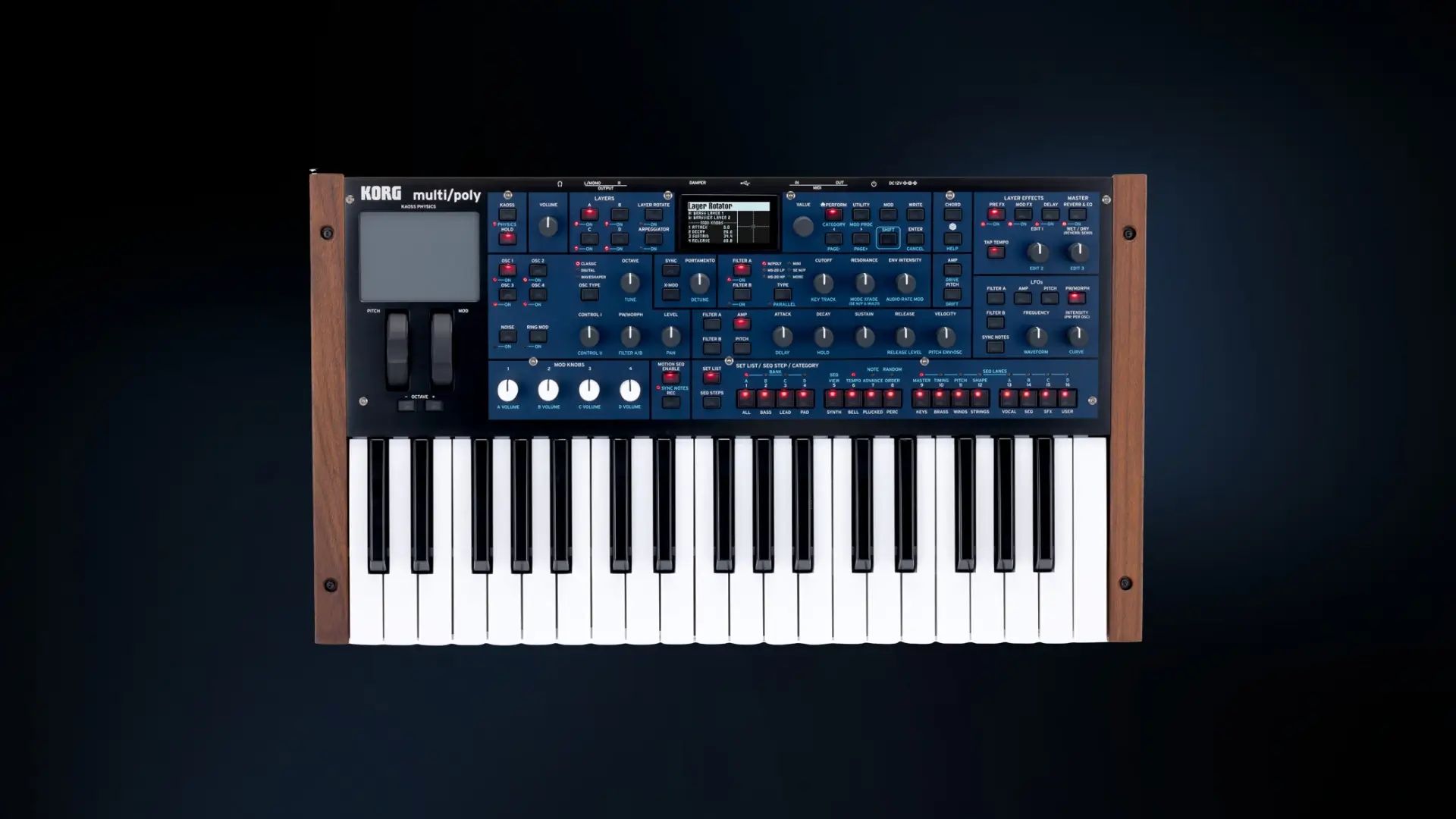
The Korg Multi/Poly is a four-part multitimbral digital synthesizer introduced on October 24, 2024. It combines analog modeling, wavetable synthesis, wave shaping, dual modeled filters, Motion Sequencing 2.0 and up to 60 voices of polyphony in a compact 37-key instrument. Although its name, colors and Layer Rotate function refer directly to the 1981 Korg Mono/Poly, it is neither a circuit recreation nor a conventional software emulation of that instrument. It is better understood as a modern Korg synthesis platform that takes several ideas from the Mono/Poly and expands them through digital polyphony, layered sound design and extensive modulation.
Table of Contents
Korg Multi/Poly sound and character
The Korg Multi/Poly does not have one fixed sonic identity in the way that a narrowly designed analog synthesizer often does. Its defining characteristic is controlled plurality. One Program can combine four oscillators drawn from virtual-analog, wavetable and waveshaping engines, while a complete Performance can contain four Programs operating as layers, splits or rotating sound sources. The result is an instrument capable of moving between traditional subtractive patches, bright digital motion, aggressive cross-modulated textures and elaborate composite sounds without changing synthesis platforms.
Its most convincing analog-style sounds derive from more than modeled oscillator waveforms and filters. Korg’s Virtual Voice Card system introduces controllable differences between voices, including oscillator drift and variations in envelopes, LFOs, portamento and other modeled behavior. Oscillators and LFOs can continue running between notes, envelopes can retain their evolving state, and different modeled VCA responses and envelope curves can be selected. These details matter because much of what listeners perceive as analog character comes from movement, inconsistency and transient behavior rather than from a static waveform alone.
At restrained settings, the engine can produce polished polyphonic pads, brass, basses, plucks and leads with enough variation to avoid sounding mechanically identical from note to note. Increasing drift, stacking oscillators or driving the filters moves it toward wider, rougher and less predictable territory. The analog modeling is therefore not simply an imitation layer placed over a digital engine. It is one component within a larger system that can be made stable and modern or deliberately unstable and vintage-leaning.
The Digital oscillator extends the palette through factory and user-imported wavetables, while modifiers and morphing functions reshape their harmonic movement. The Waveshaper oscillator approaches timbre from a different direction, applying wavefolding-style processes and a large collection of shaping functions, some derived from ideas previously used in Korg’s 01/W workstation. These engines give the Korg Multi/Poly a harder, more animated side that distinguishes it from synthesizers designed primarily to reproduce familiar analog circuits.
The dual-filter architecture is equally important. Modeled low-pass, high-pass and multimode designs can be arranged in series or parallel, balanced against one another and driven after filtering. This allows the Korg Multi/Poly to behave like a conventional one-filter polysynth when simplicity is required, but it can also divide or recombine the spectrum in ways associated with larger modular and digital systems. Audio-rate filter modulation, oscillator sync, ring modulation and cross-modulation can push it into metallic, unstable and abrasive sounds without requiring external processing.
Layer Rotate provides the clearest link between sound and historical concept. Instead of merely stacking four Programs, the Korg Multi/Poly can trigger them sequentially or randomly as new notes are played. Each layer can use a different synthesis method, filter, tuning, effect chain or modulation pattern. A repeated figure can therefore change color with every note, producing movement that comes from voice allocation rather than from a conventional LFO or sequence. This is the feature that gives the Korg Multi/Poly a distinctive performance identity rather than making it merely another deep Korg digital synthesizer.
Features and architecture
- Manufacturer: Korg.
- Year introduced: Announced and launched on October 24, 2024.
- Production years: 2024 to the present. The keyboard remains an active product, with official software and system updates released during 2026.
- Synthesis type: Digital synthesis combining next-generation analog modeling, wavetable synthesis and wave shaping.
- Category: Four-part multitimbral digital polysynth and performance synthesizer. A Performance contains four independently configurable Layers.
- Polyphony: Up to 60 voices, with the practical total varying according to engine settings and processing demands.
- Original and current price: The European launch announcement indicated €949 and December 2024 availability. As of August 1, 2026, Korg’s US store and Sweetwater list the keyboard at $899.99, reduced from a regular price of $999.99.
- Oscillators: Four oscillators per Program, with Classic, Digital and Waveshaper types. Classic offers modeled analog-style waveforms and combinations; Digital supports wavetables of up to 64 steps, more than 200 factory wavetables and user imports; Waveshaper provides more than 90 shaping types. Noise, ring modulation, oscillator sync and cross-modulation are also available.
- Filter: Two independent filter slots per Program, configurable in series or parallel. Available models include Mono/Poly-inspired, ladder, MS-20-style and other modeled filter responses, together with a flexible Multi Filter, audio-rate modulation and post-filter drive.
- LFOs: Five LFOs per Program. Virtual Voice Card behavior can introduce modeled variations between individual voices.
- Envelopes: Four loopable DAHDSR envelopes per Program, with selectable curvature behavior based on several historical synthesizer families.
- Modulation system: Eight Mod Processors across the Performance structure, four front-panel Mod Knobs, Kaoss Physics, keyboard and MIDI sources, Motion Sequence lanes and modulation access to most parameters. Korg specifies more than 5,500 destinations across the architecture, while the number available inside an individual Program depends on its Motion Sequence configuration.
- Sequencer and arpeggiator: Motion Sequencing 2.0 separates timing, pitch, shape and four step-value streams into independently looping lanes. It supports probability, lane randomization and per-note variation. A Performance also contains an arpeggiator, chord function and Layer Rotate system.
- Effects: Each Layer has three insert stages consisting of Pre FX, Mod FX and Delay. The Performance adds master reverb and a four-band parametric master EQ. Available algorithms include compressors, distortion, chorus, phaser, rotary speaker, wah, tape echo, reverse delay and the Overb reverb derived from Korg’s OASYS and Kronos systems.
- Memory: Sounds are stored in an internal database that can contain Performances, Programs, Motion Sequences, user wavetables, effect presets and related data. Each Set List contains 64 slots, and multiple Set Lists can be stored. The system displays remaining storage capacity in megabytes rather than imposing a simple fixed number of user patches.
- Keyboard: 37-key semi-weighted keyboard with velocity and release-velocity sensitivity. The internal keyboard does not generate aftertouch, although the sound engine responds to channel and polyphonic aftertouch received from external MIDI controllers.
- Inputs and outputs: Impedance-balanced left/mono and right 6.3 mm TRS outputs, 6.3 mm stereo headphone output and damper-pedal input. It has no listed audio input or CV/gate connections.
- MIDI and USB: Five-pin MIDI input and output plus a USB-B connection. USB is class-compliant for MIDI and Editor/Librarian communication; the documentation does not specify USB audio functionality.
- Display: OLED display with page-based parameter navigation.
- Dimensions and weight: 566 × 319 × 93 mm and 3.5 kg. A fitted soft case is included with the keyboard version.
- Power: External 12-volt, 2.5-amp adapter with 5-watt stated power consumption.
Strengths
- Unusually broad synthesis range: The combination of analog-modeled, wavetable and waveshaping oscillators means that one instrument can cover conventional subtractive patches and far more digital, metallic or evolving material. The three engines can also coexist within the same Program instead of operating as separate modes for the entire synthesizer.
- Behavioral analog modeling: Voice-to-voice variation, modeled envelopes, different VCA responses, oscillator drift and persistent phase behavior address aspects of analog character that simpler virtual-analog designs often reduce to detuning and filter emulation.
- Four genuinely useful layers: The four-part architecture supports large composite patches, keyboard and velocity splits, independent MIDI channels and Layer Rotate. It is not merely a unison-stacking function.
- Layer Rotate creates a recognizable performance language: Alternating complete Programs can turn a basic arpeggio or repeated line into a sequence of different timbres, tunings and effects. It is a historically informed feature that produces musically relevant results rather than functioning as decorative nostalgia.
- Deep modulation and sequencing: Motion Sequencing 2.0, Kaoss Physics, Mod Processors and the large destination system support rhythmic animation, generative variation and complex timbral movement without external modular equipment.
- Strong effects integration: Three insert stages per Layer allow different components of a Performance to receive separate processing before reaching the shared reverb and EQ. This helps complex patches remain differentiated rather than forcing every layer through one global effect chain.
- Portable relative to its capabilities: At 3.5 kg, the Korg Multi/Poly contains a four-part engine, a semi-weighted keyboard and substantial front-panel control in a format that is practical for smaller studios and live setups.
- Expanding hardware and software ecosystem: Programs can move across the keyboard, the rackable desktop module and Multi/Poly Native, while the Editor/Librarian provides computer-based organization and editing support.
Limitations
- It is not a Mono/Poly replacement: Players expecting a close recreation of the original instrument’s circuitry, limitations and immediate panel interaction may find the name misleading. Its architecture and sonic range are considerably broader, but they also make it less inherently identifiable as the vintage Mono/Poly.
- The interface cannot expose the entire engine at once: Important controls are available directly, but four Layers, multiple oscillator engines, two filters, Motion Sequencing and thousands of modulation destinations inevitably require display navigation and menu work.
- Motion Sequencing trades immediacy for depth: The sequencing system is extremely flexible, but creating a simple round-robin pattern can demand more programming than using a conventional step sequencer. MusicRadar reported turning to an external MIDI sequencer for faster pattern creation during testing.
- The 37-key range is restrictive for complex splits: Four-layer Performances and keyboard zones can exceed the practical playing space of a three-octave keyboard, especially when the Korg Multi/Poly is used for bass-and-pad splits or broad two-handed parts. The module or an external controller may be more appropriate for those applications.
- No onboard aftertouch: Although the engine accepts channel and polyphonic aftertouch over MIDI, the keyboard itself supplies only velocity and release velocity. Accessing the full expressive potential therefore requires an external aftertouch-capable controller.
- Limited physical connectivity: There is no documented audio input, CV/gate interface or USB audio implementation. Integration with modular systems, external signal processing and computer audio therefore requires additional hardware.
- Maximum polyphony is conditional: The stated ceiling is 60 voices, but actual availability varies with sound settings. Dense four-layer Performances, long releases and demanding processing can lead to voice stealing.
- Construction may feel less premium than the engine: Korg uses an aluminum front panel and wooden side panels, but the Korg Multi/Poly remains lightweight, and MusicRadar criticized the wider chassis and control platform for feeling comparatively plastic at its launch price.
Historical context
The original Korg Mono/Poly arrived in 1981 alongside the Polysix. Its architecture placed four voltage-controlled oscillators before a shared voltage-controlled filter and amplifier. That allowed exceptionally thick monophonic sounds, oscillator sync and cross-modulation, while also permitting the four oscillators to be assigned across four notes. Because those notes still shared one filter and amplifier, the result involved significant polyphonic compromises and is now commonly understood as paraphonic rather than fully polyphonic in the modern sense.
The original instrument was interesting precisely because it sat between categories. It could act as a large four-oscillator monosynth, a chord machine or a restricted polyphonic instrument. Its oscillator-assignment modes were not merely technical workarounds; they affected phrasing, articulation and the rhythmic behavior of arpeggiated passages.
The 2024 Korg Multi/Poly translates this principle rather than reproducing the original signal path. Its four oscillators are fully polyphonic within each Program, and four Programs can coexist inside one Performance. Layer Rotate transfers the round-robin concept from individual oscillators to complete synthesis layers. This changes the scale of the idea: what was once a consequence of limited analog voice allocation becomes an intentional compositional tool for alternating entire timbres.
The Korg Multi/Poly also belongs to Korg’s family of compact digital synthesizers associated with the Wavestate, Opsix and Modwave format. Reviewers noted the common physical platform and the inheritance of technologies such as Motion Sequencing and wavetable processing. The Korg Multi/Poly therefore represents both a new analog-modeling engine and a continuation of Korg’s strategy of placing specialized, software-scale synthesis systems inside portable hardware interfaces.
Its timing was significant because Korg did not answer renewed interest in the Mono/Poly by releasing another straightforward analog recreation. Instead, it used the historical instrument as a design prompt. The new model preserves the themes of oscillator interaction, unstable analog behavior and rotating allocation, but combines them with technologies that could not have existed in 1981.