

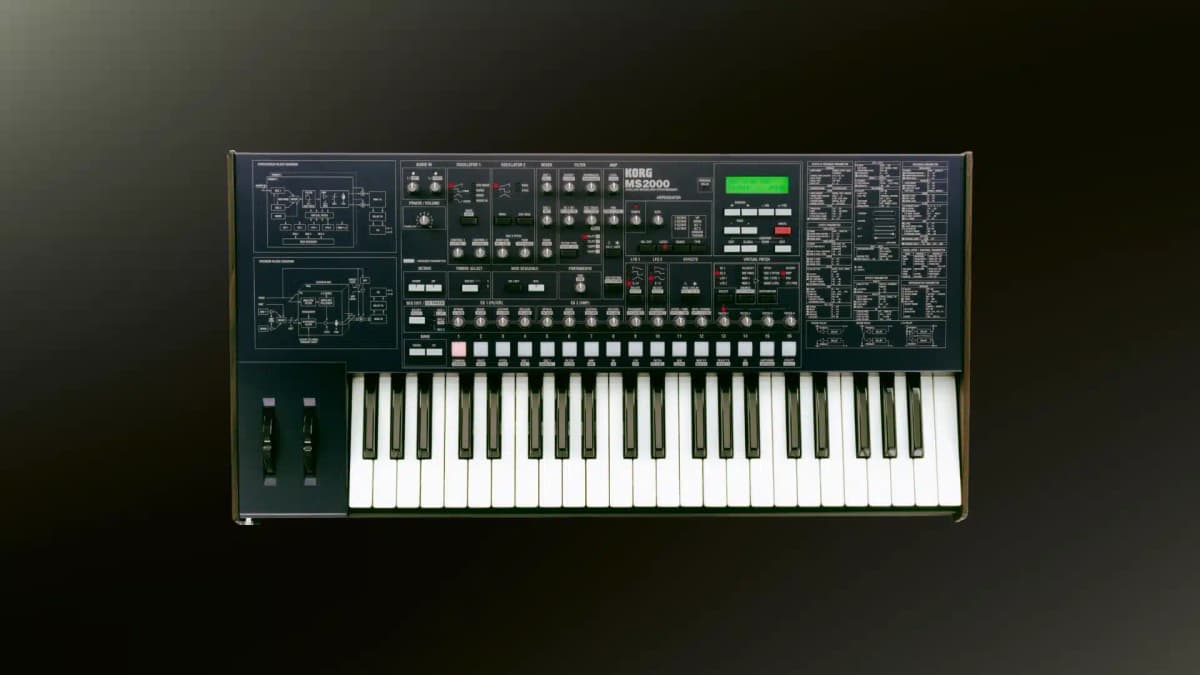
The Korg MS2000 is a four-voice virtual analog synthesizer and vocoder that Korg released in 2000, in a 44-key keyboard and a rackmount MS2000R. Its digital engine models two-oscillator subtractive synthesis with a self-oscillating multimode filter, adds Korg’s DWGS waveforms, and pairs it with a 16-band vocoder, an arpeggiator, and a three-lane motion sequencer. The blue panel with wooden end cheeks and printed block diagrams nodded deliberately to the MS-10, MS-20, and VC-10 of the late 1970s. It matters for two reasons: it gave Korg an affordable, hands-on answer to the virtual analog boom, and its engine became the basis of the microKORG, a synthesizer widely reported as one of the best sellers of the following decades.
Table of Contents
Korg MS2000 sound and character
The Korg MS2000 sounds bright, direct, and electronic. Oscillator 1 offers sawtooth, pulse with modulation, triangle, sine with cross-modulation, a vocal-style Vox wave, 64 DWGS waveforms carried over from Korg’s DW series, noise, and an external audio input; oscillator 2 provides sawtooth, square, and triangle with ring modulation and sync. That gives it the classic two-oscillator palette plus a set of hollow, bell-like, and digital timbres that a pure analog emulation would not have.
The filter is the core of its analog character. It offers 24dB and 12dB per octave low-pass, plus 12dB band-pass and high-pass, and it self-oscillates. Sound On Sound’s Derek Johnson heard an authentic analog-style sound and described the Korg MS2000 as one of his favorite modelling synths, and Gordon Reid later noted that it could deliver both 24dB analog tones and FM- or additive-like digital sounds. The bipolar filter envelope, two syncable LFOs, and four Virtual Patch routings per timbre cover most of what dance and electronic patches need.
Its weak points are just as audible. Four voices make pads and sustained chords thin and prone to note stealing, and the effects section (a modulation effect, a delay, and a two-band EQ) is functional rather than lush. The factory sounds leaned toward techno and dance, and Reid observed that the Korg MS2000 was built around that market.
The vocoder is a distinct instrument within the Korg MS2000. Its 16 bands, with formant shift of up to two octaves and resonance control, give clear, intelligible robot voices and can process any input, not only a microphone. In the broad map of synthesizers it sits squarely in the first generation of affordable virtual analogs: digital, slightly clean, and immediate, with a sound more Korg than Moog.
Features and architecture
- Manufacturer: Korg Inc., Japan
- Year introduced: 2000; Sound On Sound reviewed it in May 2000
- Production years: 2000 to around 2004; the revised MS2000B and rack MS2000BR appeared in 2003
- Synthesis type: virtual analog subtractive (DSP modelling), with DWGS digital waveforms and vocoder
- Category: compact virtual analog synthesizer and vocoder, in keyboard and 4U rackmount versions
- Polyphony: 4 voices; two keyboard or rack units can be linked over MIDI for an eight-voice setup
- Multitimbrality: two timbres per program in Single, Layer, and Split modes, each timbre assignable to its own MIDI channel
- Original price: launch list prices are not consistently documented in the sources consulted; it was positioned below the Nord Lead and Roland JP-8000, the rack version cost £100 less than the keyboard in the UK, and Sweetwater described the 2003 MS2000B as well under $1,000
- Current market price: Reverb’s price guide suggests around $515 for the keyboard, with listings commonly between about $470 and $900; rack units often sell for roughly $450 to $600
- Oscillators: 2 per voice plus noise; oscillator 1 offers saw, pulse, triangle, sine (cross-modulation), Vox, 64 DWGS waves, noise, and audio input; oscillator 2 offers saw, square, and triangle with ring modulation and sync
- Filter: resonant multimode filter, 24dB or 12dB per octave low-pass, 12dB band-pass and high-pass, self-oscillating, with keyboard tracking
- LFOs: 2 per timbre with four waveforms each, including sample and hold, syncable to MIDI clock
- Envelopes: 2 ADSR envelopes per timbre (filter and amplifier), with bipolar filter envelope depth and a gate option for the amplifier
- Modulation system: Virtual Patch with four routings per timbre from envelopes, LFOs, velocity, keyboard tracking, and MIDI controllers
- Sequencer / arpeggiator: Mod Sequencer with three lanes of up to 16 steps each, recordable in step or real time and able to sequence pitch and most panel parameters; arpeggiator with six modes, one to four octaves, gate time, and swing
- Effects: modulation effect (chorus/flanger, ensemble, phaser), delay (stereo, cross, L/R, syncable), and two-band EQ
- Vocoder: 16-band, with formant shift, resonance, and an envelope follower; oscillator 1 serves as the carrier
- Memory: 128 programs in eight banks of 16
- Keyboard: 44 keys (F to C) with velocity; aftertouch is received over MIDI but not generated by the keybed
- Controls: 35 knobs and about 50 switches with printed signal-flow diagrams; pitch and modulation wheels
- Inputs / outputs: two audio inputs (line and mic/line), left/mono and right outputs, headphones, assignable pedal and footswitch inputs; the MS2000B adds a gooseneck vocoder microphone
- MIDI / USB: MIDI In, Out, and Thru with knob and arpeggiator output; no USB
- Display: 16 x 2 character backlit LCD
- Dimensions / weight: 737.8 x 371.3 x 147.7 mm, 7.1 kg (keyboard)
- Power: external 9V adapter, about 8W; no power switch, power is controlled from the volume knob
Strengths
- It is fast to program. With dozens of dedicated knobs and the signal flow printed on the panel, the Korg MS2000 teaches subtractive synthesis while you use it.
- The vocoder is genuinely good. Sixteen bands, formant shift, and two audio inputs make it a serious voice and texture processor rather than a novelty.
- The Mod Sequencer adds motion that most rivals lacked. Three 16-step lanes can sequence pitch, filter, and other parameters, recalling Korg’s SQ-10 analog sequencer.
- The oscillator section goes beyond plain virtual analog. Cross-modulation, ring modulation, sync, and the DWGS waves extend it into digital and metallic timbres.
- It works as a controller. Knob movements are sent as MIDI data, and later software such as Spectrasonics’ Omnisphere recognizes it as a hardware control surface.
- Used prices are modest for a complete synth, vocoder, and sequencer in one box.
Limitations
- Four voices is the most frequent complaint. Chords and pads run out of notes quickly, and the two-timbre modes divide that polyphony further.
- The Mod Sequencer does not send its steps over MIDI, so its patterns cannot drive external instruments.
- Virtual Patch offers only four routings per timbre, which limits complex modulation compared with later virtual analogs.
- The effects are basic, with one modulation effect and one delay per program, and the delay runs out of memory at very slow tempos with long note values.
- The keyboard does not generate aftertouch, and 44 keys restrict two-handed playing.
- In vocoder mode oscillator 2, Virtual Patch, and the Mod Sequencer are unavailable.
- The rack version places its connections on the top panel, which needs extra rack space, and all models rely on an external power adapter.
Historical context
By the late 1990s analog modelling had become a market of its own. Clavia’s Nord Lead and Roland’s JP-8000 and JP-8080 had shown that DSP could imitate analog synthesizers convincingly, but they were expensive. Korg’s own modelling work had produced the MOSS-based Prophecy and Z1, and its Electribe EA1 of 1999 had applied modelling to a two-voice groovebox. Gordon Reid’s history of Korg describes the company as turning away from acoustic physical models after the Z1 and toward analog-style synthesis aimed at electronic and dance music.
The Korg MS2000 arrived in 2000 as the result. Korg trimmed polyphony to four voices to reach a lower price and built the design around its own past: the MS-10 and MS-20 for synthesis, the VC-10 for the vocoder, and the SQ-10 for the step sequencer. The keyboard and the MS2000R rack were launched together, and Sound On Sound’s review concluded that the combination of synth, vocoder, analog-style sequencer, and arpeggiator was unbeatable for the money.