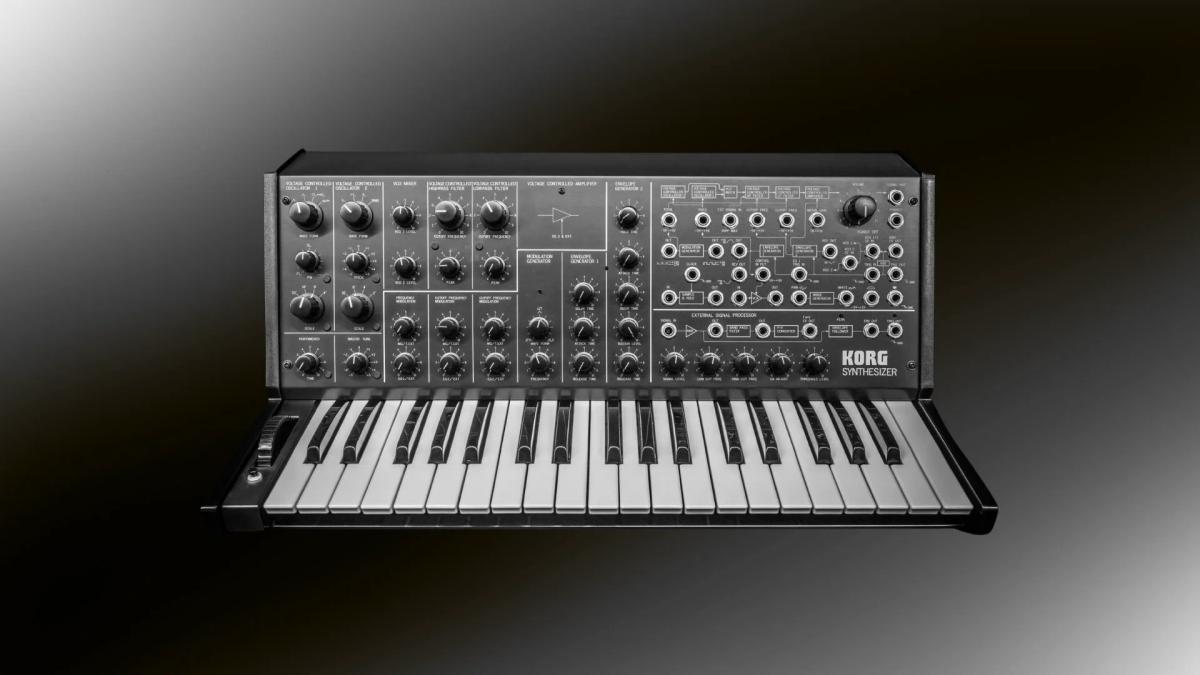
Its commercial path was less straightforward than its later fame suggests. Perfect Circuit notes that the instrument did not sell as strongly as Korg hoped at first, and by the late 1980s it was a common sight in second-hand shops. In 1996, Sound On Sound advised that a private seller should ask no more than £350 for one. That cheap afterlife, during the MIDI and digital era, is precisely what put it into the hands of a new generation of producers.
Legacy and significance
The Korg MS-20 matters because it democratized a way of thinking about synthesis. It was not the first patchable synthesizer, but it was one of the first to make patching feel like a normal part of a compact, affordable keyboard rather than an expensive specialist pursuit. Normalled connections that can be broken with cables became a defining idea of the semi-modular format, and the Korg MS-20 is one of its most influential early examples.
Its sonic legacy is just as important. The filter’s unruly resonance became shorthand for a certain kind of electronic aggression, first in synth-pop, post-punk and industrial music, later in French house and electronic music of the 1990s and beyond. Unlike many vintage instruments revered for warmth or polish, the Korg MS-20 is valued for edge, grit and instability.
The strongest proof of its significance is how often Korg has returned to it. The Korg MS-20 has been recreated in the Korg Legacy Collection software, on the Nintendo DS through the DS-10, on iPad as iMS-20, and in hardware as the MS-20 mini (2013), the full-size MS-20 Kit, the keyboardless MS-20M Kit and the MS-20 FS. Third parties followed, including Behringer’s K-2 clone. Few synthesizers have been reissued so persistently by their original maker.
Artists, users, and curiosities
The Korg MS-20 has a long and varied list of users. Paul Humphreys of Orchestral Manoeuvres in the Dark used it across the band’s first three albums, and it supplies the bassline of “Bunker Soldiers” from the 1980 debut. D.A.F. paired it with the SQ-10 sequencer for their pounding early-1980s sound; Robert Görl later called the Korg MS-20 one of the most affordable synths the band could get, “the synth for the people.” Air used it on Moon Safari, where it is reported both on “La Femme d’Argent” and in vocal treatments on “Sexy Boy.” Vince Clarke, Aphex Twin and William Orbit also appear repeatedly in user lists.
Its most famous second-hand story belongs to Quentin Dupieux, better known as Mr. Oizo. He bought his MS-20 from a friend who had grown bored with it, and playing it convinced him that music could be more than a hobby. The rudimentary bassline of “Flat Beat,” made famous by the Levi’s advert with the puppet Flat Eric, was played on that second-hand MS-20, and its pitch-bent squeal effectively gave Flat Eric a voice. He went on to use it throughout the album Analog Worms Attack.
Much later, Jon Hopkins built the main riff of “Open Eye Signal,” from Immunity, on what he described as a 1979 MS-20, saying he spent around four months on that riff alone.
One persistent myth deserves a footnote. Daft Punk’s “Da Funk” is often attributed to the Korg MS-20, but a Homework-era gear list from a 1999 Japanese magazine feature, reported by MusicRadar and MusicTech, does not include it. The attribution remains common, but it is not settled.
Perhaps the oddest anecdote comes from Korg itself. After Gotthold Meyer of the company’s German distributor suggested the Korg MS-20 could be used to teach science, Korg built an oversized MS-20 roughly the size of a blackboard. The original manual had its own eccentricities too, including a suggestion to use a boom box as an external sound source.
Korg MS-20 market value
- Current market position: a recognized vintage classic and one of the most sought-after analog monosynths from the late 1970s
- New price signal: no new original units; the closest new alternatives are Korg’s MS-20 mini and MS-20 FS reissues
- Used market signal: originals generally sell well above $1,000, with Reverb listings in recent years ranging from around $1,400 to the high $2,000s depending on condition and filter revision
- Availability: moderately hard to find in good condition; listings appear regularly but well-maintained examples are less common
- Buyer notes: check whether the unit has the early or later filter, test every patch jack, inspect the keyboard contacts, confirm tuning stability, and budget for a Hz/V-compatible MIDI-to-CV converter if MIDI control is needed
- Support ecosystem: owner’s and service manuals are widely circulated, and the reissues and software versions keep knowledge of the architecture current
- Market character: collectible and stable, supported by its cultural reputation as much as its rarity
- Long-term position: likely to remain a blue-chip vintage monosynth; the reissues have broadened access to the sound without displacing demand for originals
Conclusion
The Korg MS-20 represents a moment when modular ideas were folded into an instrument ordinary musicians could buy, carry and learn. Its cost-conscious design produced a raw, unstable sound that outlived a slow commercial start to become one of the most cited voices in electronic music. It matters because it changed who could patch a synthesizer and because its filter gave aggression a recognizable analog shape. More than four decades after its launch, and after numerous reissues, the original MS-20 remains the reference point that every later version is measured against.
Sources
- MS-20 mini: The History of KORG Analog Synthesizers, Korg
- MS-20 mini: Developer Interview, Korg
- Korg MS-20, Vintage Synth Explorer
- Korg MS20 (retro review, November 1996), Sound On Sound
- Korg MS-20: The semi-modular revolution, GreatSynthesizers
- Korg MS-20, Perfect Circuit Signal
- Korg MS-20, Sound Programming
- Korg MS-20 mini: analog classic reissued, CDM
- The songs behind the synths: Korg MS-20, The Ransom Note
- Orchestral Manoeuvres in the Dark: How to sound like OMD, Gearnews
- Key 1999 Tracks: Mr. Oizo, “Flat Beat”, Red Bull Music Academy Daily
- Sound Behind the Song: “Flat Beat” by Mr. Oizo, Roland
- Jon Hopkins on the Korg MS-20 and “Open Eye Signal”, MusicRadar
- Daft Punk’s gear list for their 1997 album Homework has surfaced online, MusicTech
- Lost Albums: Robert Görl, Night Full of Tension, The Electricity Club