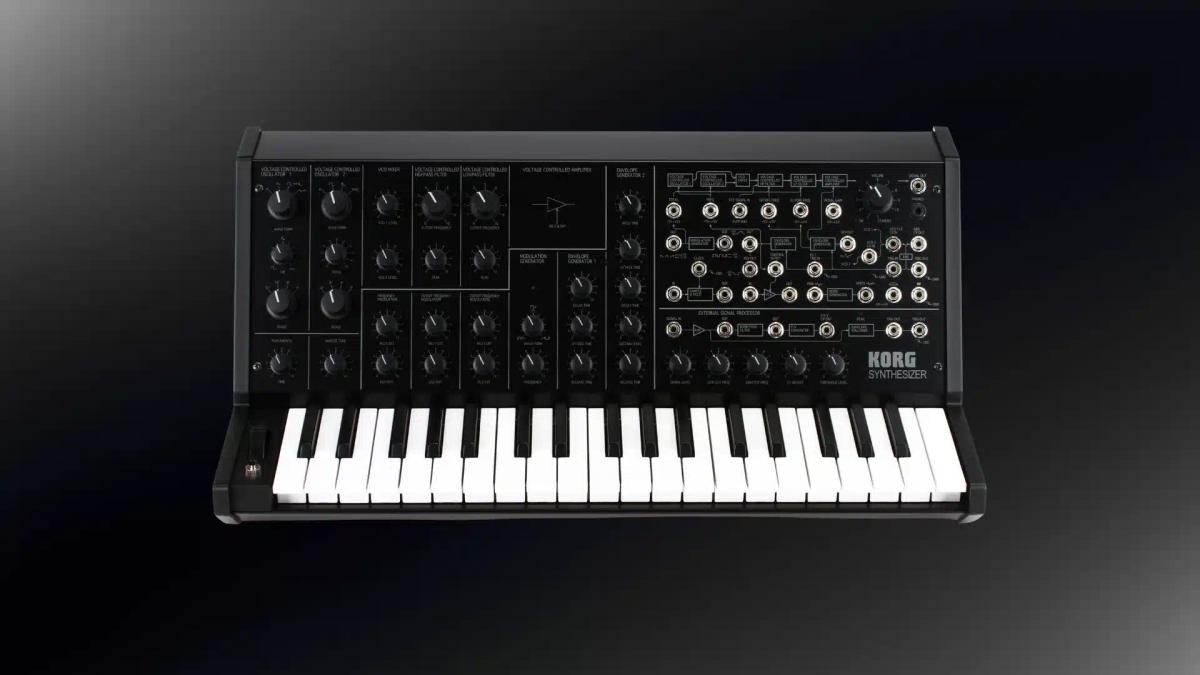
Korg followed quickly. A full-size MS-20 Kit appeared in 2014, an MS-20M desktop module bundled with the SQ-1 sequencer came in 2015 as a limited run of 1,000 units, and the ARP Odyssey reissue arrived in the same period. The full-size MS-20 FS, covered separately on this site, came later still, with the mini remaining the affordable, permanent version of the design.
Legacy and significance
The MS-20 mini matters because it showed that the major manufacturers could profitably return to their own analog past. Before it, vintage analog was something you bought used at collector prices or approximated in software. MusicTech described the Mini as “considered by many to have been the harbinger of the analogue synth boom” of the following decade, and that is the most accurate way to frame it. It was not the only cause, but it was one of the earliest and most visible signals.
Its significance is also tied to the choices Korg made about fidelity. The team did not modernize the voice, add presets, or attach a display. They reproduced the circuit, chose the earlier and more aggressive filter by ear, selected replacement transistors by listening rather than by spec sheet, and even replicated the original packaging and owner’s manual. Nishijima’s stated goal was a Mini that could not be told apart from an original played side by side. In an era of approximations, Korg sold the real behavior.
The 86% scale is part of its identity too. Korg’s engineers presented the reduced size as a mark of respect, arguing that an identical copy would devalue the original. Reviewers suspected cost was the more practical reason. Either way, the compromise shaped how it is used: as a voice played from a larger keyboard, as an outboard filter, or as a patchable desktop module as much as a performance keyboard. That flexibility helps explain why it has stayed in production for more than a decade while the MS-20 Kit and MS-20M came and went as limited runs.
Artists, users, and curiosities
The clearest documented users of the mini itself tend to be working musicians rather than headline names. MusicTech’s 2023 feature describes Danny Herbert, who records as Redolent, as a longtime MS-20 Mini user who relies on it for strange, organic noises, chaining and overdriving the filters. The same piece describes Matt Baty of the band Pigs x7 performing live hunched over a battered white-finish MS-20 Mini, using it as a counterpoint to the band’s guitars. Resident Advisor’s review also pointed to a Rob Papen video course that uses the Korg MS-20 mini patchbay to teach signal flow, an apt role for a panel that prints its own signal-flow chart.
The most charming curiosity is the packaging. Korg shipped the Korg MS-20 mini in a box that replicated the original’s, along with a reproduction of the original owner’s manual and settings chart, an unusual gesture for a mass-market product.
The color history is another. In January 2017 Korg announced the MS-20 mini WM, a limited white edition with white panel and knobs and unchanged circuitry. Coverage at the time called it the first new color in nearly 40 years since the original Korg MS-20 mini went on sale.
The developer interview adds a telling detail: Mieda recalled that a German distributor once suggested the original MS-20 could teach science, which led to a blackboard-sized version.
Korg MS-20 mini market value
- Current market position: a long-running, still-current reissue and the most accessible official way to get the Korg MS-20 mini sound in hardware
- New price signal: around $899.99 at major US retailers in 2026, well above its $599 launch price and the roughly $449 street price Korg set after a 2015 price cut
- Used market signal: Reverb showed a price recommendation of about $646 at the time of writing, meaning a used mini commands a meaningful share of the new price
- Availability: easy to find both new and used; stocked by major retailers and regularly listed on used marketplaces
- Buyer notes: check pot wobble and noise, the condition of the 3.5 mm patch jacks, key contacts on the mini keyboard, and that the original 9V 1.7A adapter or a correct replacement is included; the white WM edition is a cosmetic variant with identical circuitry
- Support ecosystem: Korg still lists the instrument with specifications and documentation, and it shares a broad Korg MS-20 mini ecosystem that includes the iMS-20 app, Korg’s MS-20 software, and the full-size MS-20 FS
- Market character: stable and practical rather than collectible; the mini is valued as a working instrument, not as a rarity
- Long-term position: likely to remain a fixture of the affordable analog market for as long as Korg keeps building it, and a reference point for how well a faithful reissue can work
Conclusion
The Korg MS-20 mini is easy to underestimate because it adds so little. Its value lies in what it preserved: two screaming filters, a patch panel that invites experiment, and a sound its own designers wanted to be indistinguishable from the 1978 original. By putting that sound back into stores at a reachable price in 2013, it helped prove that the classic analog catalog was not only a matter of nostalgia or software. More than a decade later it remains in production, still raw, still useful, and one of the clearest markers of the moment the analog revival became real.
Sources
- Korg MS20 Mini review, Sound On Sound
- Korg MS-20 mini review, MusicRadar
- Korg MS-20 Mini review, Resident Advisor
- MS-20 mini specifications, Korg
- MS-20 mini history, Korg
- MS-20 mini developer interview, Korg
- Korg MS-20 Mini recreates the 1978 classic, Synthtopia
- WNAMM13: The Korg MS-20 is back, Sonicstate
- How the Korg MS-20 and the MS-20 Mini became a parent-child powerhouse, MusicTech
- Korg re-release ARP Odyssey: time machine goes 1972, CDM
- NAMM 2017: KORG MS-20 Mini WM announced, Synth Anatomy
- Korg MS-20 Mini price cut to $449, Synthtopia
- Korg MS-20 Kit w/SQ-1 analog sequencer, KVR Audio
- Korg MS-20 mini monophonic analog synthesizer, Sweetwater
- Korg MS-20 mini, Reverb