

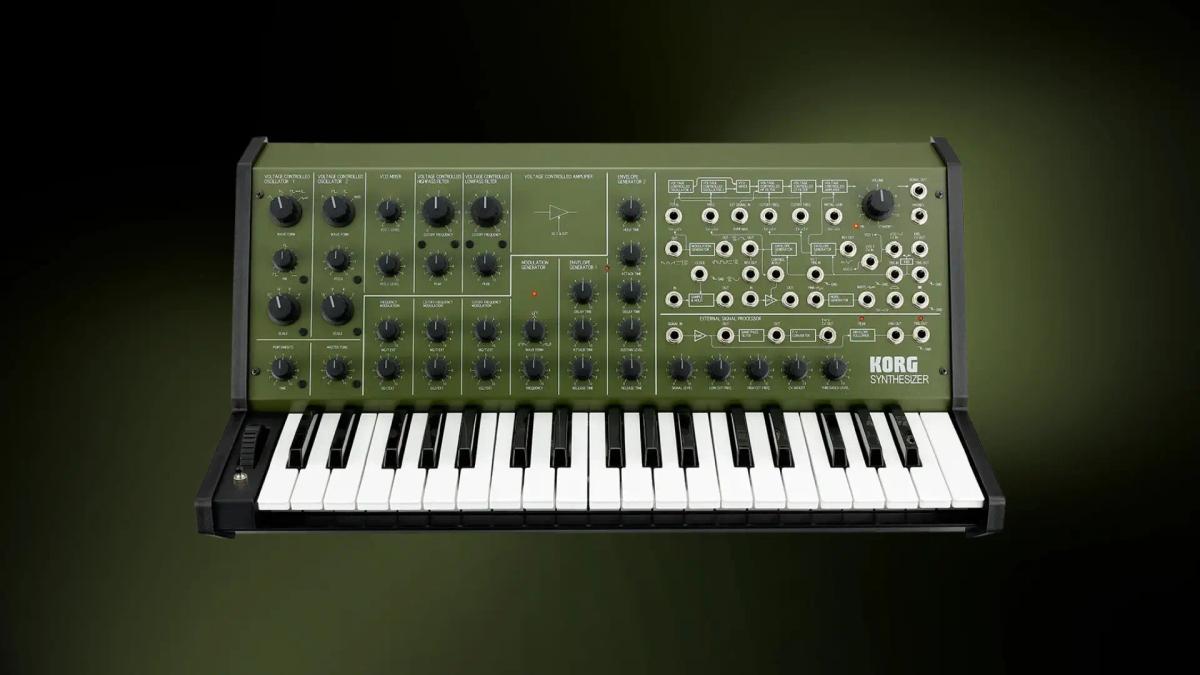
The Korg MS-20 FS is a full-size, monophonic semi-modular analog synthesizer announced in 2020 and made available in limited quantities during 2021. It restores the physical scale and 37-note keyboard of Korg’s original 1978 MS-20 while adding MIDI, USB connectivity, and selectable versions of the two filter circuits used during the vintage model’s production. More than a nostalgic reproduction, it preserves an instrument whose identity depends on aggressive resonance, nonlinear interaction, physical patching, and a productive degree of unpredictability.
Table of Contents
Korg MS-20 FS sound and character
The Korg MS-20 FS does not behave like an analog synthesizer designed primarily for smooth pads, harmonically polite leads, or perfectly controlled studio layering. Its basic oscillator sound is solid and direct, but much of its personality emerges when that signal is pushed through the serial high-pass and low-pass filters. Both filters can self-oscillate, allowing resonance to become an audible source rather than merely a method of emphasizing frequencies. The result can move from lean, hollow basses to nasal leads, whistling resonances, metallic interactions, abrasive percussion, and effects that seem partially detached from conventional pitch.
The selectable filter circuits broaden that vocabulary without turning the Korg MS-20 FS into two entirely different synthesizers. Korg describes them as recreations of the earlier and later MS-20 filter designs. In practice, the early circuit is generally perceived as rougher, noisier, and more prone to screaming resonance, while the later version is comparatively smoother and less unruly. The distinction matters because the MS-20 sound was never completely fixed during its original production life. The Korg MS-20 FS acknowledges that history rather than selecting one period as the definitive version.
Its two voltage-controlled oscillators provide conventional analog waveforms, octave ranges, detuning, pulse-width control, and ring modulation. On paper, this is a relatively economical oscillator section. Musically, however, the slightly austere architecture directs attention toward interaction: detuned oscillators beating against one another, ring modulation generating metallic spectra, envelopes driving filter cutoff beyond ordinary tonal shaping, and patch connections breaking the assumptions of the fixed signal path.
The MS-20 is especially effective at basses that need to occupy a mix through texture rather than sheer low-frequency mass. Its dual-filter arrangement can remove the deepest frequencies with the high-pass filter while emphasizing a narrow region with resonance, producing bass sounds that remain aggressive without becoming excessively broad. Leads tend to be vocal, acidic, or distressed rather than polished. Noise, self-oscillation, the sample-and-hold circuit, and fast envelope behavior also make the instrument unusually capable of analog percussion, mechanical pulses, unstable drones, and transitional effects. These qualities follow directly from its resonant filters, modulation generator, noise sources, patch panel, and envelope architecture.
Its defining character is therefore not simply “vintage warmth.” The Korg MS-20 FS can sound warm, but warmth is only one corner of its identity. It is better understood as tense, physical, nasal, grainy, and occasionally hostile. That range is why the Korg MS-20 FS has remained relevant in techno, industrial music, experimental electronic production, IDM, synth-pop, and soundtrack work. The design can produce familiar subtractive sounds, but its cultural reputation was built on how easily those sounds can be pushed toward instability.
Features and architecture
- Manufacturer: Korg.
- Year: Announced at the beginning of 2020 and released to dealers in limited quantities during 2021.
- Production years: The Korg MS-20 FS was introduced as a limited-production model rather than a permanent mass-market redesign. Korg has not published a definitive end-of-production date, but by August 2026 major American retailers describe it as sold out, unavailable, or no longer available.
- Synthesis type: Fully analog subtractive synthesis with a semi-modular architecture and an internally connected default signal path.
- Category: Monophonic analog keyboard synthesizer with patchable control and audio routing.
- Polyphony: One voice with highest-note priority.
- Original price and current market price: The US advertised price at general availability was approximately $1,399.99. There is no dependable current average for used examples because transaction volume is limited and Reverb does not presently provide a price estimate for the model.
- Oscillators: Two analog VCOs. VCO 1 provides triangle, sawtooth, variable pulse/square, and white-noise selections across 32’, 16’, 8’, and 4’ ranges. VCO 2 provides sawtooth, square, narrow pulse, and ring-modulation modes across 16’, 8’, 4’, and 2’ ranges, with approximately one octave of detuning in either direction.
- Filter: One resonant high-pass filter followed by one resonant low-pass filter. Both can self-oscillate. The Korg MS-20 FS can reproduce either the earlier or later MS-20 filter circuit, selected through a key combination during startup.
- LFOs: One modulation generator with an approximate range of 0.1 to 20 Hz. Its waveform can move continuously between sloped and pulse-like shapes rather than relying only on fixed waveform selections.
- Envelopes: EG1 provides delay, attack, and release controls. EG2 provides hold, attack, decay, sustain, and release stages and serves as the principal contour generator for amplitude and filter modulation.
- Modulation system: Patchable modulation includes the modulation generator, two envelopes, noise outputs, sample-and-hold circuitry, a modulation VCA, keyboard control voltage, trigger signals, a performance wheel, and a momentary switch.
- External Signal Processor: The ESP section accepts an external audio source and includes filtering, level detection, envelope following, pitch extraction, and trigger generation. It can therefore use voices, guitars, drum machines, or other signals as processing material or as control sources, although pitch extraction is inherently less precise than modern digital audio-to-MIDI conversion.
- Sequencer and arpeggiator: None built in. Sequencing must come from an external MIDI, USB, trigger, or control-voltage source. Korg’s SQ-1 sequencer was explicitly designed to integrate with instruments including the MS-20.
- Effects: No internal effects.
- Memory: No patch memory or preset storage. Sounds must be documented manually, photographed, or recorded before the controls are changed.
- Keyboard: 37 full-size keys covering three octaves. The synthesis engine does not respond to velocity or aftertouch.
- Inputs and outputs: Rear connections include a quarter-inch signal input, quarter-inch signal output, quarter-inch headphone output, MIDI input, USB-B port, and 12-volt DC power input. The front patch panel provides additional audio, control-voltage, trigger, noise, sample-and-hold, and ESP connections.
- MIDI and USB: The five-pin MIDI input receives note messages only, uses MIDI channel 1, and does not respond to velocity. USB transmits and receives note information, with transmitted notes fixed at velocity 64. Pitch-bend and modulation-wheel movements are not transmitted through USB.
- Display: None.
- Dimensions and weight: Approximately 573 × 316 × 248 millimetres and 6.3 kilograms.
- Power: External 12-volt DC adapter. Korg states that the internal circuit voltages remain equivalent to those of the original instrument despite the use of an external supply.
Strengths
- Two historically relevant filter personalities: The ability to select the early or later filter circuit is more than an added tonal option. It recognizes that surviving vintage MS-20 units do not all respond identically and gives the Korg MS-20 FS a broader historical scope than a reissue based on only one production period.
- Full-size physical interaction: Compared with the reduced-scale MS-20 mini, the Korg MS-20 FS restores full-size keys, wider control spacing, and a cabinet closer to the dimensions of the original. This improves precision when adjusting resonance near self-oscillation or working rapidly across several patch cables and control sections.
- A simple architecture with disproportionate depth: Two oscillators, two filters, two envelopes, and one LFO may appear limited beside modern modulation-heavy synthesizers. The patch panel, ESP, sample-and-hold circuit, modulation VCA, and access to control signals allow those components to be recombined in ways that greatly exceed the apparent simplicity of the front panel.
- Distinctive filter interaction: The combination of resonant high-pass and low-pass filters allows the player to sculpt a band of energy rather than merely remove treble. This is central to the MS-20’s ability to produce focused basses, thin vocal tones, resonant percussion, and sounds that shift between pitched and noise-like behavior.
- External audio integration: The External Signal Processor makes the Korg MS-20 FS useful even when its keyboard is not being played. External sounds can be filtered, reshaped, tracked, or converted into envelopes and triggers, turning the MS-20 FS into an analog processing and control environment rather than only a monosynth.
- Direct, menu-free workflow: Every principal synthesis parameter is available from a physical control, and the absence of presets prevents hidden parameter states. The Korg MS-20 FS rewards listening, experimentation, and physical recall rather than screen-based programming.
- Modern note control without rewriting the Korg MS-20 FS: MIDI and USB make the Korg MS-20 FS easier to incorporate into a contemporary studio, yet Korg did not replace the analog signal architecture or expand it into a digitally managed preset synthesizer.
Limitations
- Strictly monophonic operation: The Korg MS-20 FS cannot produce chords, layered voices, or multitimbral parts internally. Its musical value depends on the strength of a single line, bass part, sequence, drone, or processed external signal.
- Very limited MIDI implementation: MIDI and USB handle basic note information, but not velocity-sensitive articulation, pitch-bend transmission, modulation-wheel transmission, parameter automation, program changes, or patch storage. The implementation is convenient for sequencing notes, not for deep DAW control.
- No presets or automated recall: Every sound is temporary. This is creatively valuable but inefficient in productions that require exact revisions, live set changes, or repeated synchronization between sessions. Korg provides patch sheets and setting examples, but they cannot reproduce the small analog variations that occur when controls are restored manually.
- No internal effects, sequencer, or arpeggiator: A complete performance setup generally requires external sequencing and processing. This is consistent with the vintage design but makes the Korg MS-20 FS less self-contained than many contemporary monosynths.
- Three-octave keyboard: The full-size keys are comfortable, but the 37-note range remains restrictive for players who want extended bass and lead ranges without changing octave settings or using an external controller.
- A large instrument for one voice: At 573 millimetres wide and 6.3 kilograms, the Korg MS-20 FS occupies substantially more studio and stage space than compact analog monosynths while remaining monophonic. Its scale is part of its appeal, but it reduces portability.
- Filter selection is unnecessarily awkward: The filter version is selected by holding a keyboard key while powering on the Korg MS-20 FS. The later filter setting is not retained after shutdown, so the instrument returns to the early circuit at the next startup.
- The ESP is experimental rather than precise: Its pitch-tracking and signal-derived control functions are valuable for unconventional modulation, but they should not be mistaken for the accuracy of modern digital pitch detection. Complex or harmonically dense sources can produce unstable results.
- High cost relative to function count: The original US price of approximately $1,399.99 placed the Korg MS-20 FS above many analog monosynths offering presets, velocity, sequencers, digital modulation, or effects. Its value rests on construction, scale, historical fidelity, and a particular circuit identity rather than feature quantity.
Historical context
Korg released the original MS-20 in 1978 as part of a family that also included the simpler MS-10, the keyboardless MS-50 expansion module, and the SQ-10 analog sequencer. Korg’s historical account describes the design concept as a “wall on your desktop”: a compact instrument intended to bring some of the flexibility and visual logic of large modular systems into a more affordable keyboard format. Its circuitry drew on ideas developed for Korg’s PS-series polyphonic synthesizers but reduced them to a more economical monophonic architecture.
That economy was central to the original instrument. The MS-20 did not attempt to compete with large modular synthesizers by matching their number of oscillators or modules. Instead, it exposed strategically chosen points in the signal and control paths. The player could use the normal internal routing for conventional subtractive synthesis or interrupt and extend it through the patch panel. The External Signal Processor further distinguished the Korg MS-20 FS by connecting synthesis with outside audio and control extraction.
After the original model’s five-year production period, the MS-20’s status expanded through second-hand use in electronic, industrial, experimental, and dance music. Its filters, patchability, and comparatively attainable used prices made it attractive to musicians who were less interested in recreating expensive American polyphonic synthesizers than in extracting aggressive and unconventional sounds from limited hardware.
Korg formally revived the design with the reduced-size MS-20 mini in 2013. It then released the full-size MS-20 Kit in 2014 and the keyboardless MS-20M Kit in 2015. The Korg MS-20 FS, announced in 2020, effectively transformed the earlier full-size kit concept into a factory-assembled instrument and offered it in black, white, blue, and green finishes.
The timing was significant. By 2020, the market already contained numerous affordable analog monosynths, modular systems, software emulations, and reinterpretations of vintage circuits. Korg was therefore no longer solving the problem of basic access to the MS-20 architecture; the mini had already done that. The Korg MS-20 FS instead addressed musicians who regarded scale, control spacing, keyboard feel, physical construction, and direct correspondence with the original instrument as essential parts of the experience.