

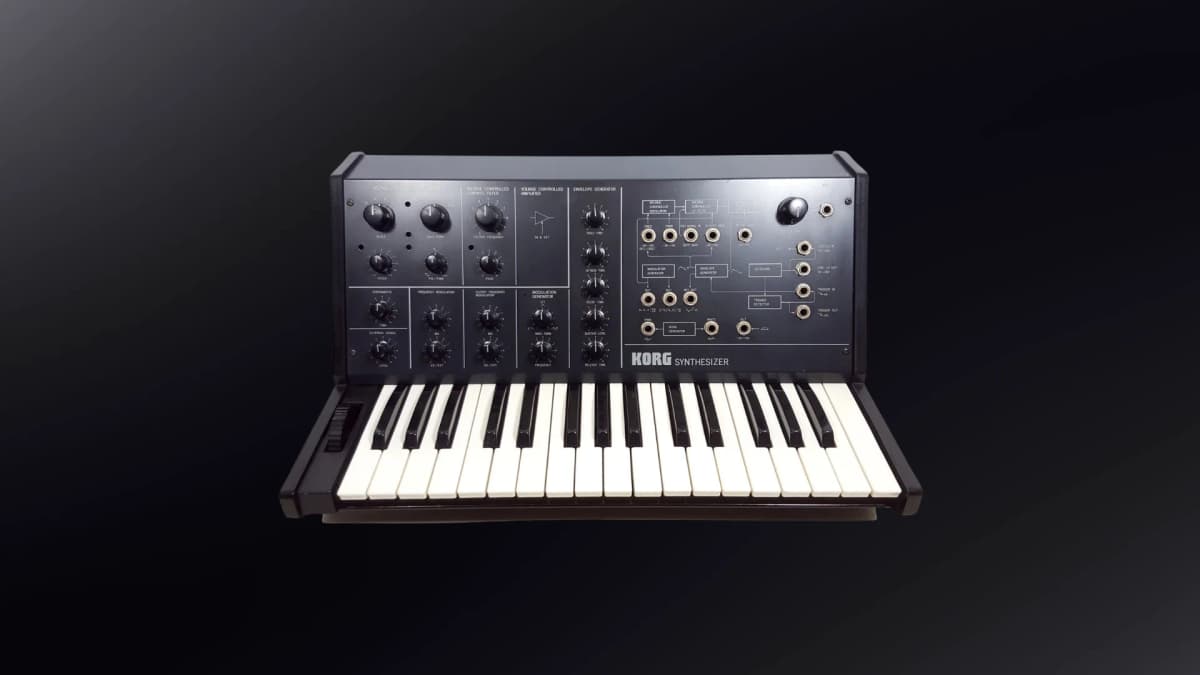
The Korg MS-10 is a monophonic analog synthesizer that Korg introduced in 1978 as the smallest and cheapest member of its MS series, launched alongside the MS-20, the SQ-10 sequencer and the VC-10 vocoder. It has one voltage-controlled oscillator, a self-oscillating 12dB/octave low-pass filter built around Korg’s own Korg35 module, a five-stage envelope, a variable-shape modulation generator and a 32-key keyboard, all prewired but open to rerouting through a 16-jack patch panel on the right side of the case. It matters because it put the MS sound and a genuine taste of modular patching into the hands of players who could not stretch to an MS-20, and several of them went on to shape electronic music.
Table of Contents
Korg MS-10 sound and character
The Korg MS-10 sounds lean, bright and edgy rather than fat. Its single oscillator offers triangle, sawtooth, a pulse wave whose width can be swept all the way from a square to silence, and white noise, across four footages from 32′ to 4′. With only one oscillator there is no detuned thickness to lean on, so the character comes from the filter. Sound On Sound’s Kingsley Sage, reviewing it in 1999, described Korg filters as having a more fragile, rather European tone than the American sound of a Moog, and that is a fair summary: the Korg MS-10 cuts and squelches instead of rumbling.
The filter is the same Korg35 design found in the first MS-20s and in Korg’s PS polyphonic synths. Tim Stinchcombe’s technical study of the MS filters describes it as a Sallen-Key low-pass circuit with nonlinear diodes in the forward signal path, which helps explain why it distorts across the whole spectrum and why its resonance behaves asymmetrically. In practice, that means the Korg MS-10 can go from a soft, rounded tone to a screaming, whistling peak, and it self-oscillates readily. Sage called that self-oscillation incredible and judged it stronger than the filters on Yamaha’s CS monosynths.
The envelope adds a hold stage before the usual attack, decay, sustain and release, which guarantees a minimum gate length and is useful for consistent percussive hits. Its linear curves, though, do not snap as hard as some rivals’ envelopes. Where the Korg MS-10 shines is in electro basses, short percussive blips, noise effects and resonant sweeps; it is far less convincing at the thick, multi-oscillator leads and heavy basses that a Pro-One or Moog Rogue handle easily.
The patch panel widens that palette. Routing the modulation generator to pulse width, using the negative envelope output, feeding pink noise into the filter or processing an external signal with the oscillator silenced gives the Korg MS-10 a vocabulary of drones, sound effects and filtered textures that its small panel does not suggest at first glance.
Features and architecture
- Manufacturer: Korg (Keio Electronic Laboratories), Tokyo
- Year introduced: 1978 in Japan; Sound On Sound’s 1999 retrospective gives 1979 for its UK release
- Production years: 1978 to around 1981 according to most references; Korg wound down the MS series as a whole by 1983. Korg told Sound On Sound that around 9,000 units were made
- Synthesis type: analog subtractive
- Category: compact semi-modular monosynth, prewired with a patch panel
- Polyphony: monophonic
- Original price: 53,500 yen in Japan; £299 in the UK at launch; references give US$450 in the United States
- Current market price: recent Reverb listings have run from roughly $800 to $1,450 depending on condition
- Oscillators: 1 VCO with triangle, sawtooth, variable-width pulse and white noise; footages 32′ to 4′ with a fine pitch control; portamento
- Noise: separate patchable white and pink noise outputs
- Filter: Korg35 12dB/octave low-pass VCF with cutoff and peak (resonance); self-oscillating; no high-pass filter, unlike the MS-20
- LFOs: one modulation generator with continuously variable shape (sawtooth through triangle to ramp, and variable-width pulse) and separate pulse and sloped outputs
- Envelopes: one five-stage EG with hold, attack, decay, sustain and release; a negative EG output on the patch panel
- Modulation system: dedicated depth controls for VCO frequency and VCF cutoff from the modulation generator, the envelope or an external patched source; control wheel on the left
- Patch panel: 16 quarter-inch jacks covering VCO frequency and pulse width, VCF cutoff, VCA gain, modulation generator outputs, noise, EG output, external signal input, and CV and trigger in and out
- Sequencer / arpeggiator: none; designed to pair with the SQ-10 analog sequencer
- Effects: none onboard
- Memory: no patch memory
- Keyboard: 32 full-size keys, no velocity or aftertouch
- Inputs / outputs: audio output, external signal input with level control, CV and trigger in and out, plus the patch points listed above
- MIDI / USB: none; CV follows Korg’s Hz/V standard rather than the volt-per-octave scheme used by Roland and Moog
- Display: none
- Dimensions / weight: roughly 499 x 309 x 249 mm and about 6.3 kg according to published specifications
- Power: internal power supply, about 5 W consumption
Strengths
- The Korg35 filter gives it real personality. It self-oscillates easily and moves from soft to aggressive with a single knob, which is why the Korg MS-10 earned its reputation for electro basses and squelchy sweeps.
- The patch panel makes a cheap synth genuinely educational. Every normalled connection can be overridden with a cable, so the Korg MS-10 teaches modular thinking without requiring a modular system.
- It plays well with other MS gear. The SQ-10 sequencer, the MS-50 expander and the MS-20 all speak the same Hz/V and trigger language, so the Korg MS-10 can grow into a larger system.
- The external signal input turns it into a filter and envelope processor for drum machines, guitars or other synths, and the oscillator can be fully silenced by sweeping the pulse width to zero.
- It is compact, light and simple to use. With one oscillator and one filter, the signal path can be understood at a glance and patches come together quickly.
- It remains one of the more affordable routes into a vintage Korg MS instrument, typically costing well below an original MS-20.
Limitations
- One oscillator limits its range. There is no detuning, sync or oscillator mixing, so thick leads and heavy basses need layering or a second synth.
- There is no high-pass filter, ring modulator or external signal processor, all of which the MS-20 offers.
- The modulation generator has no delay control, so delayed vibrato has to be faked with the wheel or a patch.
- The Hz/V and trigger conventions are not directly compatible with volt-per-octave gear, so most modern CV and MIDI setups need a converter that supports Hz/V.
- The 32-key keyboard is short for two-handed playing and has no velocity or aftertouch.
- There is no memory, and vintage units now need the usual attention: noisy pots and jacks, worn keys and recalibration.
- Korg35 modules are reliable but spares are rare, so a damaged filter is harder to repair than a standard discrete circuit.
Historical context
By the late 1970s Korg had already built the miniKORG 700 and the ambitious PS series of polyphonic synths, whose Korg35 filter modules were designed by engineer Fumio Mieda. According to Sound On Sound’s 2024 retrospective, Mieda led a plan in late 1977 to create a range of affordable synthesizers, a project that was finished by the end of spring 1978. Korg presented the result as the second generation of Korg synthesizers.
The MS series launched in 1978 with the MS-20, the MS-10, the SQ-10 sequencer and the VC-10 vocoder, followed by the keyboardless MS-50 and a set of accessories, the MS-01 to MS-04 pedals and interfaces. The Korg MS-10 was the entry point: Korg’s own history page says its 53,500 yen price made it a common first synthesizer for young musicians. It shared its basic chassis with the VC-10 and its filter with the early MS-20, and its patch panel sat on the right so that cables would not obscure the knobs.