

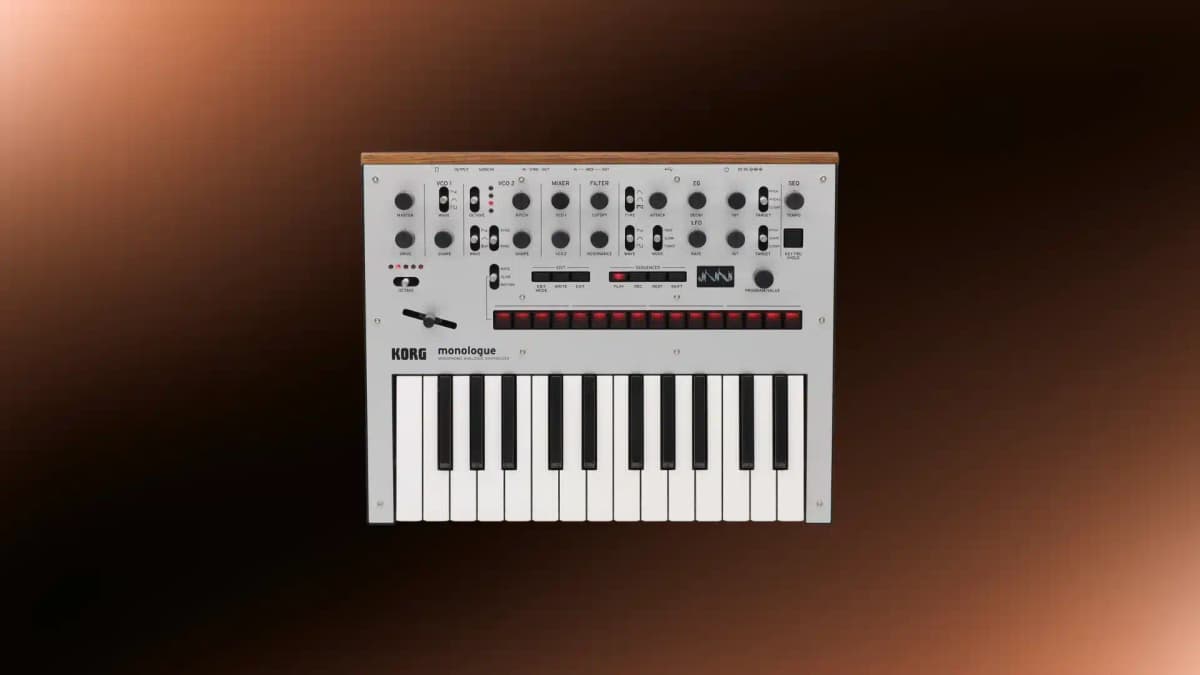
The Korg Monologue (styled “monologue” by Korg) is a monophonic analog synthesizer announced on November 1, 2016 and shipped from January 2017 at $299. It pairs two voltage-controlled oscillators with a two-pole low-pass filter, a single envelope, one LFO, an analog drive circuit, a 16-step sequencer with four lanes of motion recording, and a full microtuning system, all on 25 slim velocity-sensitive keys in a case that runs on six AA batteries. Designed by Tatsuya Takahashi’s team as the monophonic sibling of the Minilogue, and shaped in part by Richard D. James (Aphex Twin), it matters as a cheap, portable acid and bass machine that also made alternative tunings something a player could edit by hand rather than by software.
Table of Contents
Korg Monologue sound and character
The Korg Monologue is at its best in the bass and acid register. Its two oscillators are close relatives of the Minilogue’s, with an important twist: oscillator 1 offers sawtooth, triangle and square, while oscillator 2 swaps the square for white noise. A Shape control on each oscillator changes pulse width on the square, folds the triangle, and adds harmonics to the sawtooth, so even a single oscillator can move a long way from a plain waveform. Oscillator 2 adds hard sync or ring modulation, which covers the metallic and tearing timbres that a two-oscillator design usually needs.
The filter is a fixed two-pole low-pass, which Korg described as voiced with more bite than the Minilogue’s. Sound On Sound’s Paul Nagle found the low end warm and full, and Attack Magazine’s Greg Scarth placed its character somewhere between a Roland TB-303 and Korg’s MS-10 and MS-20 low-pass filter, depending on input level and modulation. It self-oscillates at high resonance and can be tracked from the keyboard at 0, 50 or 100 percent, so it can act as a playable third tone. The drive circuit at the end of the chain roughens and darkens the sound; reviewers liked it on percussive and bass patches, though Attack wanted more gain on some sources.
Modulation is deliberately sparse. There is one two-stage envelope that can work as attack/decay, attack/gate/decay or a plain gate on the amplifier, and when it is not shaping volume it can be sent to cutoff or pitch. The LFO reaches audio rates in its fast mode and has a one-shot setting that turns it into a simple second envelope. That economy is the source of the Korg Monologue’s main weakness: soft pads, slow evolving leads and complex articulations are hard to build, and Nagle noted that the envelope restarts from zero when a new note arrives during the release.
Where it sits is clear. The Korg Monologue is a modern, slightly raw analog monosynth with a squelchy, forward sound, closer in spirit to the SH-101 and TB-303 school than to the rounded Moog style. Nagle suggested it could become an acid classic in that company, and the combination of slides, drive and a resonant two-pole filter explains why.
Features and architecture
- Manufacturer: Korg Inc., Japan
- Year introduced: announced November 1, 2016; shipping began in January 2017
- Production years: 2017 to present; still listed by Korg and in stock at major US retailers in October 2026
- Synthesis type: analog subtractive, with digital control, patch memory and sequencing
- Category: compact battery-powered analog monosynth
- Polyphony: monophonic, monotimbral
- Original price: $299 in the US and £299 in the UK
- Current market price: $399.99 new at Sweetwater (list $449.99, power supply not included); used units around $210 to $310
- Oscillators: 2 VCOs; VCO1 with sawtooth, triangle and square, VCO2 with sawtooth, triangle and white noise; Shape control on both (pulse width, wavefolding, added harmonics); VCO2 octave, pitch, and sync or ring modulation
- Mixer: individual levels for VCO1 and VCO2; external audio input feeds the filter
- Filter: two-pole (12dB/octave) low-pass with cutoff and resonance, self-oscillating; keyboard tracking at 0, 50 or 100 percent set in the program menu
- LFOs: 1, with sawtooth, triangle and square; fast, slow and one-shot modes; targets pitch, shape or cutoff; tempo sync
- Envelopes: 1 two-stage envelope with A/D, A/G/D and gate types; intensity and target (pitch, pitch of VCO2 only, or cutoff)
- Effects: analog drive circuit on the master section; no delay or reverb
- Sequencer / arpeggiator: 16-step monophonic sequencer with step and real-time recording, per-step slide, swing, and motion sequencing of up to four parameters; no arpeggiator, but Key Trigger mode lets a held key transpose the sequence
- Microtuning: 32 settings in total (20 preset tunings, 6 user scales, 6 user octaves), including historical temperaments, gamelan scales and scales contributed by Richard D. James
- Memory: 100 programs (80 factory, 20 user), each storing sound, sequence and tuning assignment
- Keyboard: 25 slim keys from E to E, velocity sensitive with eight curves, no aftertouch; assignable slider instead of pitch and modulation wheels
- Inputs / outputs: 6.3 mm mono output, 6.3 mm stereo headphones, 6.3 mm audio input, 3.5 mm sync in and out; no CV or gate
- MIDI / USB: MIDI in and out on 5-pin DIN; USB Type B for MIDI
- Display: small OLED screen that works as a real-time oscilloscope
- Dimensions / weight: 350 x 276 x 76 mm; 1.7 kg (3.78 lb)
- Power: six AA alkaline or NiMH batteries (about 6 hours alkaline, 8 hours NiMH) or an optional 9V DC adapter, sold separately; 2.5 W consumption
Strengths
- The sequencer is the core of the Korg Monologue. Step and real-time entry, per-step slides and four lanes of parameter motion make it quick to build moving bass lines that would need a separate sequencer on most synths at this price.
- Microtuning is fully editable from the panel. Users can retune each note of a scale or an entire octave, assign tunings per program, and exchange Scala files through Korg’s librarian, a capability rare in hardware at any price when it launched.
- It is genuinely portable. Battery power, a 1.7 kg weight and a laptop-sized footprint make it easy to play on a sofa, a train or a small stage without a wall socket.
- The filter and drive suit acid and bass well. A resonant two-pole response with slides and drive gives the squelchy, aggressive tone associated with the TB-303 and SH-101 tradition.
- Wavefolding through the Shape control adds more harmonic range than the two-oscillator count suggests, and sync and ring modulation cover harder timbres.
- The oscilloscope display shows what each control does to the waveform, which makes the Korg Monologue useful as a learning tool as well as a sound source.
Limitations
- There is only one envelope with two stages. Building a sound with separate filter and amplitude contours means borrowing the LFO in one-shot mode, and slow attacks can drop out because the envelope restarts from zero on new notes.
- The filter is a single two-pole low-pass. There is no four-pole, high-pass or band-pass option.
- The slim, two-octave keyboard limits playing range and comfort, and a slider replaces pitch and modulation wheels.
- Twenty user program slots are few for a sequencing synth, since each pattern lives inside a program.
- Knobs transmit standard 7-bit MIDI CCs despite higher internal resolution, and motion sequence data is not sent over MIDI.
- There is no CV or gate, so integration with modular or vintage analog gear depends on the sync jacks or a MIDI-to-CV converter.
- No power adapter comes in the box, and the US street price has risen well above the launch figure.
Historical context
The Korg Monologue came out of the analog revival that Korg had driven since the Monotron of 2010. Under chief synth engineer Tatsuya Takahashi, Korg had released the Volca series, the MS-20 mini, the ARP Odyssey reissue and, earlier in 2016, the four-voice Minilogue, covered separately on this site. According to Takahashi’s conversation with Richard D. James published by Warp, the initial brief for the next product was simply “smaller than the minilogue and monophonic”. The team kept the Minilogue’s oscillator core, redesigned the filter, reduced the modulation, and borrowed the step-based workflow of the Volca sequencers.
Microtuning was the distinctive addition. Takahashi credited James directly, telling him that microtuning was included “completely because of you”. Before that, Takahashi and engineer Kazuki Saita had built a MIDI box that transposed incoming notes by note and cent so any monosynth could be microtuned, and testing it convinced them to build the feature in. James also worked as an advisor on presets, scales and sequences, and suggested ideas such as random sequence and scale generators. Korg announced the Korg Monologue on November 1, 2016, in five colors (silver, black, red, dark blue and gold), with shipments starting in January 2017.