

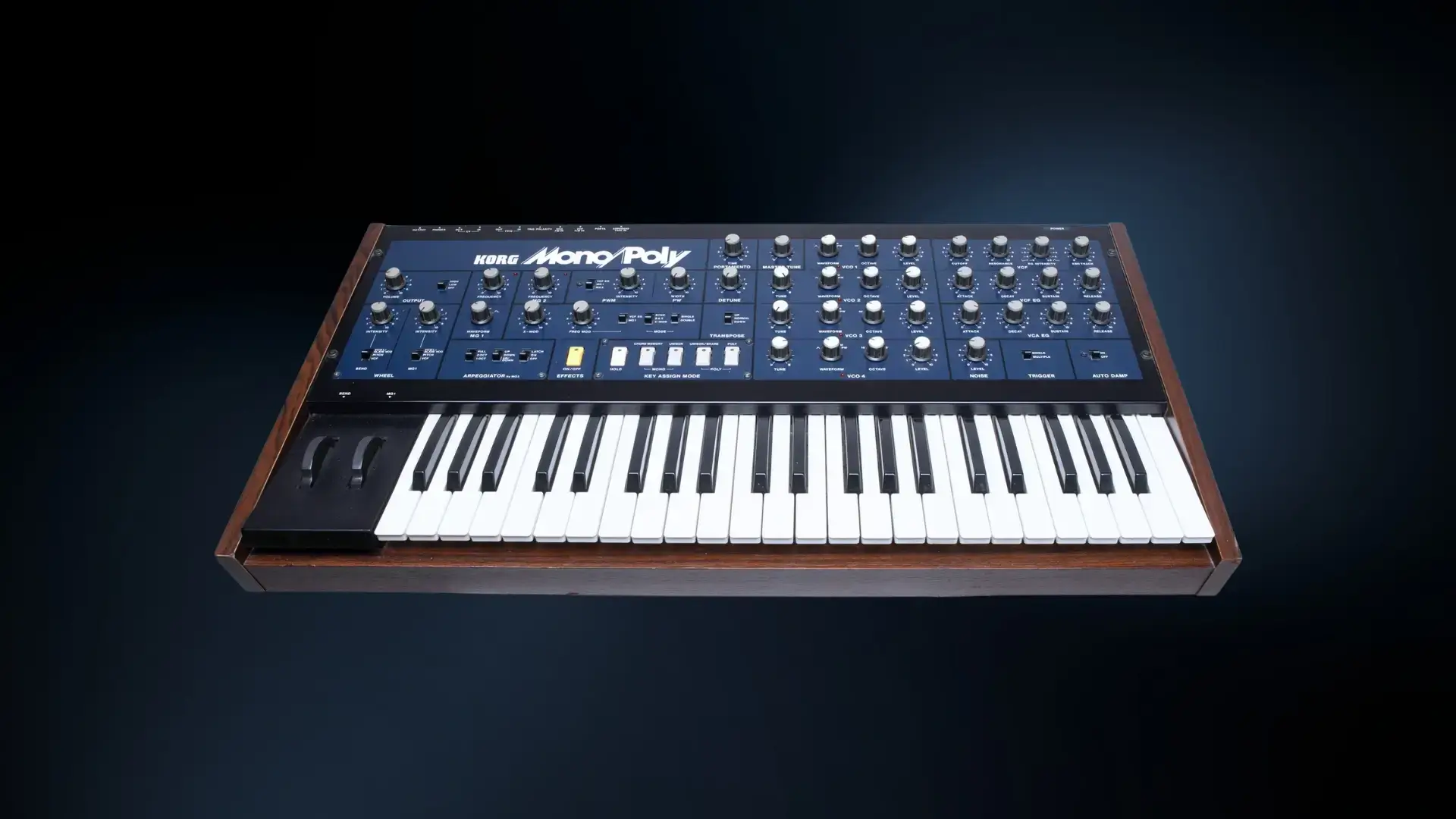
Introduced in 1981 alongside the Polysix, the Korg Mono/Poly is a four-VCO analog subtractive synthesizer designed to operate either as a densely layered monophonic instrument or as a four-note paraphonic keyboard. Its importance lies less in conventional polyphony than in the unusual freedom it gives musicians to redistribute, retune, synchronize, and cross-modulate four independent oscillators. The result is an instrument that occupies a productive space between performance monosynth, experimental sound-design system, and limited chordal synthesizer.
Table of Contents
Korg Mono/Poly Sound and Character
The Korg Mono/Poly is strongest when treated as a four-oscillator monosynth rather than as an economical substitute for a conventional polysynth. Each oscillator can be assigned its own octave, waveform, level, and relative tuning, allowing the instrument to construct sounds from closely detuned unisons, octave stacks, or wider harmonic intervals. In Unison mode, the four VCOs produce dense basses, forceful lead sounds, and sustained tones with natural oscillator movement.
Its 24 dB-per-octave resonant low-pass filter gives those oscillators a comparatively focused and controlled foundation. The filter can self-oscillate and includes keyboard tracking and bipolar envelope modulation. It can sound rounded at moderate resonance settings, but it becomes sharper and more synthetic as resonance increases. Unlike the more abrasive filter behavior associated with some earlier Korg designs, the Korg Mono/Poly generally preserves the clarity of its oscillator relationships.
Because the filter and articulation architecture are shared during polyphonic operation, chords behave as unified harmonic structures rather than collections of independently articulated voices. This is a technical limitation, but it is also part of the Korg Mono/Poly’s identity. Poly mode can produce animated, mechanical, or slightly unstable chordal textures that differ fundamentally from the smooth note-by-note response of a conventional polysynth.
Oscillator synchronization and cross-modulation move the instrument into more aggressive territory. Sync generates cutting harmonic sweeps, while cross-modulation creates metallic overtones, unstable pitch relationships, and timbres approaching early analog frequency modulation. The two functions can also be combined and configured through different oscillator-routing arrangements.
These facilities make the Korg Mono/Poly particularly effective for animated sequences, science-fiction effects, metallic leads, drones, and sounds that evolve through interaction among oscillators rather than through elaborate effects processing.
The arpeggiator further defines its character. In Poly mode, successive notes can activate oscillators with different waveforms, octave settings, levels, and tunings. A simple repeating pattern can therefore change timbre from step to step without requiring a sequencer. This oscillator-rotation behavior helps explain the Korg Mono/Poly’s continuing relevance to ambient, techno, experimental electronic music, and other styles built around gradual transformation.
Features and Architecture
- Manufacturer: Korg.
- Year introduced: 1981, at approximately the same time as the Korg Polysix.
- Production years: Generally documented as 1981 to 1984.
- Synthesis type: Fully analog subtractive synthesis.
- Category: Four-oscillator monophonic and four-note paraphonic keyboard synthesizer.
- Polyphony: Four VCOs can be stacked on a single note or distributed across as many as four simultaneous notes. The oscillators share the principal filter and articulation architecture, so the instrument is paraphonic rather than a true four-voice polysynth.
- Original price: Contemporary British reviews from 1982 listed recommended prices of approximately £689 to £699.
- Current market price: Vintage units commonly occupy a broad used-market range, with value depending heavily on condition, servicing, location, voltage configuration, and modifications.
- Oscillators: Four voltage-controlled oscillators with triangle, sawtooth, pulse, and pulse-width-modulated waveform options. Each oscillator has individual octave, level, and tuning controls, with octave ranges of 16’, 8’, 4’, and 2’.
- Filter: One resonant, self-oscillating 24 dB-per-octave low-pass VCF with cutoff, resonance, keyboard tracking, and positive or negative envelope modulation.
- LFOs: Two modulation generators. MG-1 offers multiple waveforms and a broad speed range. MG-2 uses a triangle waveform and also contributes to pulse-width modulation and arpeggiator timing.
- Envelopes: Two ADSR envelope generators, associated primarily with the filter and amplifier sections, with selectable single or multiple triggering.
- Modulation system: Oscillator sync, cross-modulation, combined sync and cross-modulation, alternative oscillator-routing configurations, pulse-width modulation, portamento, pitch bend, and modulation-wheel control.
- Sequencer and arpeggiator: No internal sequencer. The arpeggiator provides upward, downward, and alternating directions, selectable octave ranges, latch operation, and external triggering.
- Effects: No conventional chorus, delay, reverb, or distortion. The panel section labeled “Effects” controls oscillator synchronization and cross-modulation functions rather than audio effects in the modern sense.
- Memory: No programmable patch storage. Chord Memory stores a chord or interval structure for transposition from individual keys. Hold sustains played notes.
- Keyboard: 44 keys covering approximately three and a half octaves, from F to C.
- Inputs and outputs: Connections include arpeggiator trigger, portamento control, filter-frequency control, oscillator-frequency modulation, trigger input and output, one-volt-per-octave CV input and output, headphones, and mono audio output.
- MIDI and USB: Neither was included on the original instrument. MIDI functionality can be added through third-party retrofit systems.
- Display: None.
- Dimensions and weight: Approximately 744 × 450 × 144 mm and 12 kg.
- Power: Internal region-specific mains power supply, operating at 50 or 60 Hz, with stated consumption of 28 watts.
Strengths
- A genuinely distinctive oscillator architecture. Four independently configured VCOs allow the Korg Mono/Poly to move between detuned unison, fixed-interval structures, four-note patterns, and oscillator-by-oscillator sequences without fundamentally changing the patch.
- Voice allocation becomes part of sound design. Unison, Unison/Share, Poly, and Chord Memory modes change not only the number of notes that can be played but also the way the four oscillators are distributed.
- Powerful sync and cross-modulation facilities. Combining oscillator synchronization with cross-modulation gives the Korg Mono/Poly a broader experimental range than many straightforward early-1980s monosynths.
- An arpeggiator that participates in synthesis. Because each oscillator can have a different waveform, octave, level, and tuning, the arpeggiator can generate repeating timbral cycles rather than merely playing the same sound at different pitches.
- A direct physical interface. The principal synthesis functions are controlled from the front panel without menus, displays, or numerical parameter entry.
- Strong monophonic performance. Four stacked analog oscillators give basses, leads, drones, and interval-based sounds substantial harmonic density.
- Useful analog integration. CV, gate, trigger, filter-control, and oscillator-modulation connections allow the Mono/Poly to communicate with sequencers, modular equipment, and other pre-MIDI instruments.
- Productive limitations. Its architecture encourages musicians to build movement from oscillator tuning, allocation, and interaction instead of relying on patch memory, effects, or large modulation matrices.
Limitations
- The polyphonic mode is paraphonic rather than fully polyphonic. Each note can receive a separate oscillator, but the shared filter and articulation system prevents the notes from behaving as four complete independent synthesizer voices.
- There is no patch memory. Sounds must be recreated manually or documented using photographs, diagrams, or parameter sheets.
- The original instrument has no MIDI or USB. Modern sequencing generally requires CV equipment or an internal retrofit.
- The output architecture is monaural. There is no native stereo voice placement, chorus, or spatial processing.
- The keyboard is not velocity-sensitive or pressure-sensitive. Expression must come from the wheels, modulation routing, articulation settings, and external control inputs.
- It is relatively large and heavy for a 44-key instrument. At approximately 12 kg, it occupies more space than many contemporary paraphonic or four-voice synthesizers.
- Its strengths are highly specific. Musicians seeking conventional pads, independently articulated chords, extensive modulation routing, or immediate preset recall may find it restrictive.
- Condition varies significantly among surviving examples. Four vintage VCOs, aging switches, key contacts, calibration-sensitive circuitry, and decades-old power components make service history important.
Historical Context
The Korg Mono/Poly appeared during a transitional period in synthesizer history. Polyphonic instruments were becoming increasingly desirable, but complete voice-per-note architectures and programmable memory still carried considerable cost. Manufacturers were exploring several ways to offer more notes without multiplying every part of the signal path.
Korg approached this market from two directions in 1981. The Polysix offered six complete analog voices, patch memory, and an integrated ensemble effect. The less expensive Korg Mono/Poly concentrated four oscillators into an instrument that could approximate polyphonic playing without replicating an entire synthesizer voice for every note.
The price difference reflected their separate roles. Contemporary British reviews placed the Mono/Poly at roughly £689 to £699, while the Polysix occupied a considerably higher price category. The Korg Mono/Poly therefore offered access to four analog pitches and a sophisticated oscillator section at a lower cost, but it did so by accepting shared articulation and eliminating programmable storage.
This compromise became more difficult to market as affordable programmable polysynths multiplied. Keyboardists primarily interested in chords could choose instruments with independent voices and memories. Players needing a monophonic lead synthesizer could select smaller and often less expensive alternatives.
The Korg Mono/Poly therefore occupied an awkward commercial position. It was neither a conventional monosynth nor a complete polysynth, and its most unusual capabilities required musicians to understand oscillator allocation, sync, cross-modulation, and paraphonic behavior.
Yet the same ambiguity that complicated its original marketing ultimately preserved its individuality. The Mono/Poly was not simply a reduced Polysix. Its independently configurable oscillators, unusual voice allocation, synchronization system, cross-modulation, and performance modes made it closer to a compact keyboard instrument assembled from modular principles.
Legacy and Significance
The Korg Mono/Poly matters because it makes voice allocation audible.
On most polyphonic synthesizers, voice assignment is an invisible technical process. Notes are passed to available voices according to rules the performer rarely needs to consider. On the Korg Mono/Poly, the relationship between four oscillators and four possible pitches becomes a central compositional parameter.