

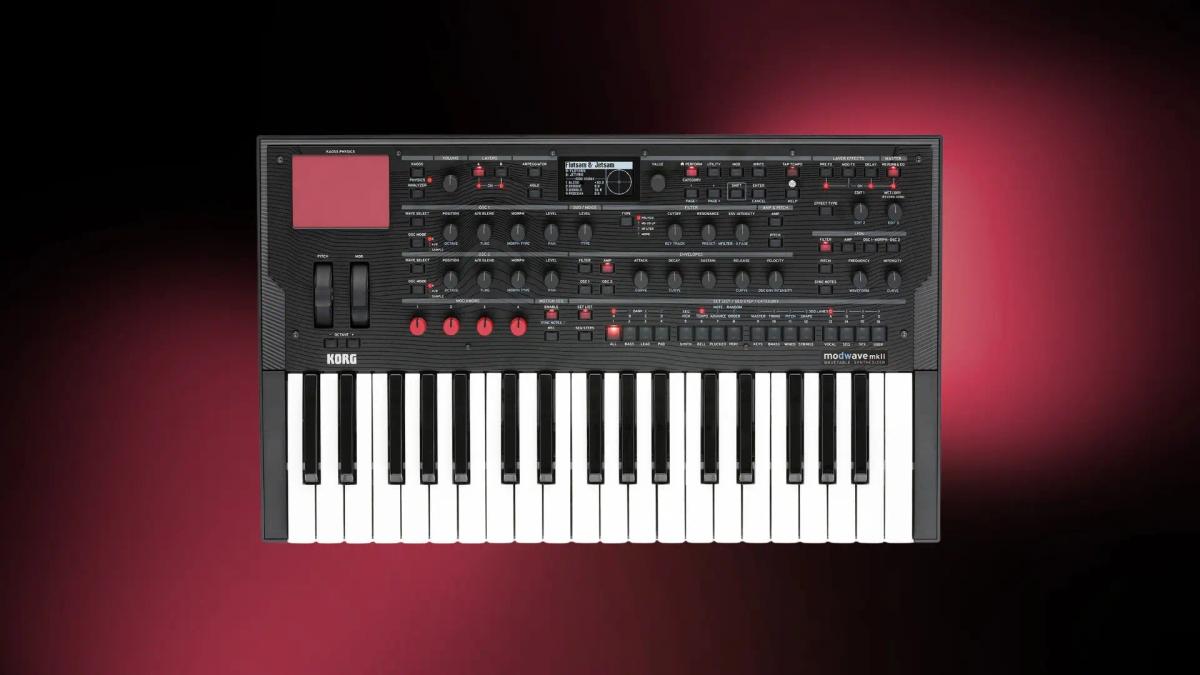
The Korg Modwave is a 37-key digital wavetable synthesizer introduced in 2021, originally offering 32 stereo voices, two programmable layers, sample playback, modeled filters, Motion Sequencing 2.0, and the physics-based Kaoss Physics controller. Although Korg connected it historically to the 1985 DW-8000, the Korg Modwave is not a reissue. It transforms the broad idea of combining complex digital waveforms with subtractive filtering into a modern instrument built around continuously changing timbre, per-voice sequencing, deep modulation, and real-time physical interaction.
Table of Contents
Korg Modwave sound and character
The Korg Modwave’s natural voice is distinctly digital: detailed, animated, sometimes glassy or metallic, and especially effective when a sound must change internally rather than remain fixed. Its two oscillators can each blend two wavetables, allowing one Program to contain as many as four independently evolving wavetable streams before its sub oscillator, noise source, filtering, modulation, and effects are considered. Each oscillator can alternatively play a multisample, which substantially broadens the Korg Modwave beyond conventional wavetable synthesis.
This architecture makes the Korg Modwave particularly strong at expansive pads, spectral drones, digital bells, metallic percussion, animated basses, sequenced textures, vocal-like timbres, cinematic atmospheres, and leads whose harmonic structure changes across a phrase. It can produce comparatively restrained analog-style sounds through its modeled Polysix and MS-20 filters, but using it only as a virtual analog synthesizer misses its defining advantage. The instrument becomes more distinctive when wavetable position, A/B blending, morphing, filter response, effects, and amplitude are all moving at different rates.
The oscillator section does more than move linearly through a sequence of waveforms. More than 30 wavetable modifiers can reshape the tables, while 13 Morph Types alter their playback in real time. Because morphing, position, blending, and modifiers can interact, a relatively plain source can be pushed toward narrow, hollow, distorted, resonant, or harmonically unstable territory without immediately relying on the filter.
Motion Sequencing 2.0 is equally important to the sound. Instead of attaching one fixed automation lane to the entire instrument, the Korg Modwave can run sequences independently for each sounding voice. Timing, pitch, shape, and four parameter-sequencing lanes can use different lengths, loop points, directions, probabilities, and modulation. Chords can therefore behave less like duplicated copies of one sequence and more like clusters of related events gradually moving out of alignment.
Kaoss Physics adds another type of movement. The X/Y surface can behave conventionally, but its physics mode models a ball moving across a surface with adjustable launch force, direction, gravity, friction, wall behavior, bumps, and holes. Its position generates modulation signals, allowing one gesture to continue evolving after the performer has removed a finger from the pad. The musical result can range from a controlled macro transition to semi-predictable instability.
The Korg Modwave can sound polished and precise, but it does not have to sound clean. The MS-20 filter models become increasingly saturated as resonance rises, while the Multi Filter can combine low-pass, high-pass, band-pass, and dry signals. Together with wavetable modifiers and effects, these options let the Korg Modwave move from smooth ambient material to abrasive basses and sharply contoured electronic percussion.
Features and architecture
- Manufacturer: Korg.
- Year introduced: Announced in January 2021 and released during 2021.
- Production years: Korg does not publish a precise factory production window for the original keyboard. It entered the range in 2021 and was superseded by the Korg Modwave mkII, announced on October 25, 2023 and commercially available by late 2023.
- Synthesis type: Digital wavetable synthesis, multisample playback, subtractive filtering, per-voice Motion Sequencing, extensive modulation, and digital effects.
- Category: Compact, two-layer performance synthesizer. One Performance contains Layers A and B, with separate Programs, arpeggiators, MIDI channels, and keyboard or velocity zones.
- Polyphony: 32 stereo voices in the original Korg Modwave. The later Korg Modwave mkII and module increased this to 60 stereo voices.
- Original price: Approximately US$799 and £699 around its 2021 launch and review period; the announced European price was €799.
- Current price context: In the United States, the current Korg Modwave mkII keyboard was listed at approximately US$699.99 in August 2026, while the module was listed at approximately US$649.99. Original keyboards now primarily occupy the used market.
- Oscillators: Two main oscillators per Program. Each can play one wavetable, blend two wavetables through its A/B structure, or play a multisample. A complete Program can therefore use four wavetable streams, plus a separate sub oscillator or noise generator.
- Wavetable system: More than 200 supplied wavetables, with as many as 64 waveforms in a table, more than 30 modifiers, 13 real-time Morph Types, and support for importing user wavetables through the Editor/Librarian.
- Filter: Twelve stereo filter types, including modeled Polysix and MS-20 low-pass filters, an MS-20 high-pass model, two-pole and four-pole low-pass, high-pass, band-pass and band-reject modes, and a configurable Multi Filter.
- LFOs: Five LFOs per Program.
- Envelopes: Four envelopes per Program.
- Modulation system: Four envelopes, five LFOs, two modulation processors, two key-tracking generators, Kaoss Physics, velocity, release velocity, MIDI aftertouch sources, modulation knobs, and Motion Sequence lanes. Depending on sequence length and configuration, Korg specifies more than 1,000 potential modulation targets.
- Motion Sequencer and arpeggiator: Each layer has an arpeggiator. Motion Sequencing 2.0 provides separate Timing, Pitch, Shape, and Sequencing A–D lanes, per-voice playback, independent loop parameters, step probability, keyboard pitch entry, scale constraint, and real-time recording from knobs or the modulation wheel.
- Effects: Each layer has a Pre FX slot, Mod FX slot, and delay. The complete Performance adds master reverb and four-band parametric EQ. Algorithms include compression, distortion, wave shaping, phasing, chorus, flanging, ensemble, rotary speaker, delays, and modeled effects associated with earlier Korg instruments.
- Memory and content: More than 200 factory sounds, more than 200 factory wavetables, storage capacity for thousands of user sounds, and user multisample support added through the 1.1 system update. Korg specifies up to 4GB for imported user samples.
- Keyboard: 37 velocity-sensitive and release-velocity-sensitive keys. The keyboard does not generate aftertouch, although aftertouch and polyphonic aftertouch can be received from compatible external controllers.
- Performance controls: Pitch wheel, modulation wheel, four programmable Mod Knobs, category controls, and a Kaoss Physics X/Y surface.
- Audio inputs and outputs: L/Mono and R balanced 6.35mm TRS outputs, 6.35mm stereo headphone output, and a damper pedal input without half-damper support. There is no external audio input.
- MIDI and USB: Five-pin MIDI IN and OUT plus a USB Type-B port for computer communication.
- Display: OLED display with contextual parameter pages and a real-time output oscilloscope or analyzer.
- Dimensions: 565 × 338 × 92mm.
- Weight: 2.9kg.
- Power: External 12V DC, 2.5A power supply; approximately 5W power consumption.
Strengths
- A genuinely deep oscillator architecture: The ability to combine four wavetable streams in one Program, replace oscillators with multisamples, import custom wavetables, and reshape tables through modifiers gives the Korg Modwave considerably more timbral range than a basic two-oscillator wavetable instrument.
- Movement is part of the synthesis engine: Motion Sequencing is not merely a pattern recorder attached to an otherwise static synthesizer. Its lanes, probabilities, independent loops, and per-voice operation allow motion to become part of the identity of each note.
- Kaoss Physics provides meaningful performance control: Rather than functioning only as an X/Y macro pad, it can generate continuing, repeatable, or semi-predictable modulation trajectories from a physical model. This makes complex movement accessible without requiring every transition to be programmed step by step.
- Broad filtering without forcing an analog identity: Polysix and MS-20 models provide recognizably different saturation and resonance behaviors, while the Multi Filter supports more structural experimentation. The variety lets the oscillator section remain digitally explicit or be pulled toward more conventional subtractive territory.
- Strong layering in a portable instrument: Two complete Programs can be layered, split by key or velocity, placed on separate MIDI channels, and processed through their own effect chains. At 2.9kg, the original keyboard places substantial sound-design depth in a format that remains practical to transport.
- Immediate macro editing without eliminating depth: Four Mod Knobs allow factory and user sounds to expose musically useful parameter groups. This does not replace detailed programming, but it means complex patches can still be altered quickly during performance.
- Hardware and software compatibility: Modwave Native can exchange sounds with the hardware through the respective librarian systems. The Korg Modwave can therefore function as a physical synthesizer, a software production environment, or a transferable library spanning both.
- An active support ecosystem: The Editor/Librarian, Sample Builder, user wavetable import, hardware-software patch exchange, commercial sound libraries, and continuing system updates have expanded the instrument beyond its original 2021 specification.
Limitations
- The original keyboard lacks aftertouch: The sound engine can respond to aftertouch and polyphonic aftertouch received over MIDI, but the internal 37-key keyboard cannot generate either. This limits direct expression on patches designed around pressure unless an external controller is used.
- Thirty-two voices are not excessive in a two-layer stereo instrument: The original model’s polyphony is respectable, but layered Programs, sustained envelopes, unison, and dense sequences can reduce practical note headroom. The mkII’s increase to 60 voices directly addressed this constraint.
- The interface cannot make every function immediate: The front panel exposes many primary parameters, but detailed wavetable operations, modulation lists, probability settings, and Motion Sequence lane editing depend on the small display and contextual controls. Deep programming therefore involves more navigation than the knob density initially suggests.
- It is only two-part multitimbral: A Performance contains two layers and the Korg Modwave plays one Performance at a time. This is sufficient for splits, stacks, and complementary sequences, but it does not replace a workstation or a larger multitimbral module.
- Motion Sequencing is not a conventional song sequencer: It is designed primarily to animate notes, parameters, timing, and pitch within Programs. Users expecting linear multitrack composition, extensive arrangement tools, or complete song construction will still need an external sequencer or DAW.
- Connectivity is streamlined: There is no audio input, CV/gate interface, balanced XLR output, digital audio connection, or half-damper support. Its integration model is based primarily on conventional analog outputs, MIDI, and USB data communication.
- The lightweight format involves physical compromises: The 37-key chassis and external power supply favor portability and lower cost over a larger keyboard, internal power supply, or more substantial performance surface. Its sound engine is more ambitious than its physical presentation.
- The factory library can obscure the underlying architecture: Many Performances contain extensive sequencing, effects, and modulation. They demonstrate the engine effectively, but reducing a complex preset to a simple starting point can require understanding several interacting layers rather than adjusting one obvious oscillator-filter path.
Historical context
Korg presents the Korg Modwave as a descendant of the DW-8000, released in 1985. That relationship is real but should not be interpreted too literally. The DW-8000 used two digital DWGS oscillators with a selection of fixed waveforms, followed by an analog resonant filter and amplifier. It expanded the oscillator vocabulary of an analog-style polysynth, but it did not offer the continuously scanned, multi-frame wavetable structures associated with later wavetable synthesis.
The Korg Modwave preserves the conceptual contrast at the center of the DW-8000: digital harmonic complexity shaped through subtractive filtering. Everything else is substantially reinterpreted. The filters are modeled rather than analog, the waves can be scanned and morphed, two tables can be blended inside each oscillator, samples can replace wavetables, and nearly every stage can be placed in continuous motion. It is therefore better understood as a modern continuation of a design question than as a reproduction of a vintage circuit.
Its 2021 arrival also formed part of a broader Korg strategy. The Wavestate had reformulated Wave Sequencing, the Opsix had expanded six-operator FM beyond conventional algorithms, and the Korg Modwave approached wavetable synthesis through motion, modifiers, physical interaction, and a dense modulation system. All three instruments treated an established digital method as material for redesign rather than preservation.
This distinction matters historically. Much of the Korg Modwave revival of the preceding decade had been driven by renewed analog production, recreations, compact monosynths, and instruments that deliberately referenced older circuitry. The Korg Modwave instead belongs to the parallel history of 2020s hardware that tried to give software-scale digital synthesis a dedicated physical interface. At its original US price of roughly $799, it placed an unusually deep wavetable and modulation environment below the flagship price category.
The 2023 Korg Modwave mkII did not replace the synthesis concept. Its principal hardware change was an increase from 32 to 60 stereo voices, accompanied by refinements such as expanded LFO behavior, additional modulation sources, and revised reverb routing. The continuity between the original, mkII, module, and Native software confirms that Korg increasingly regarded Korg Modwave as a platform rather than a single fixed product.