

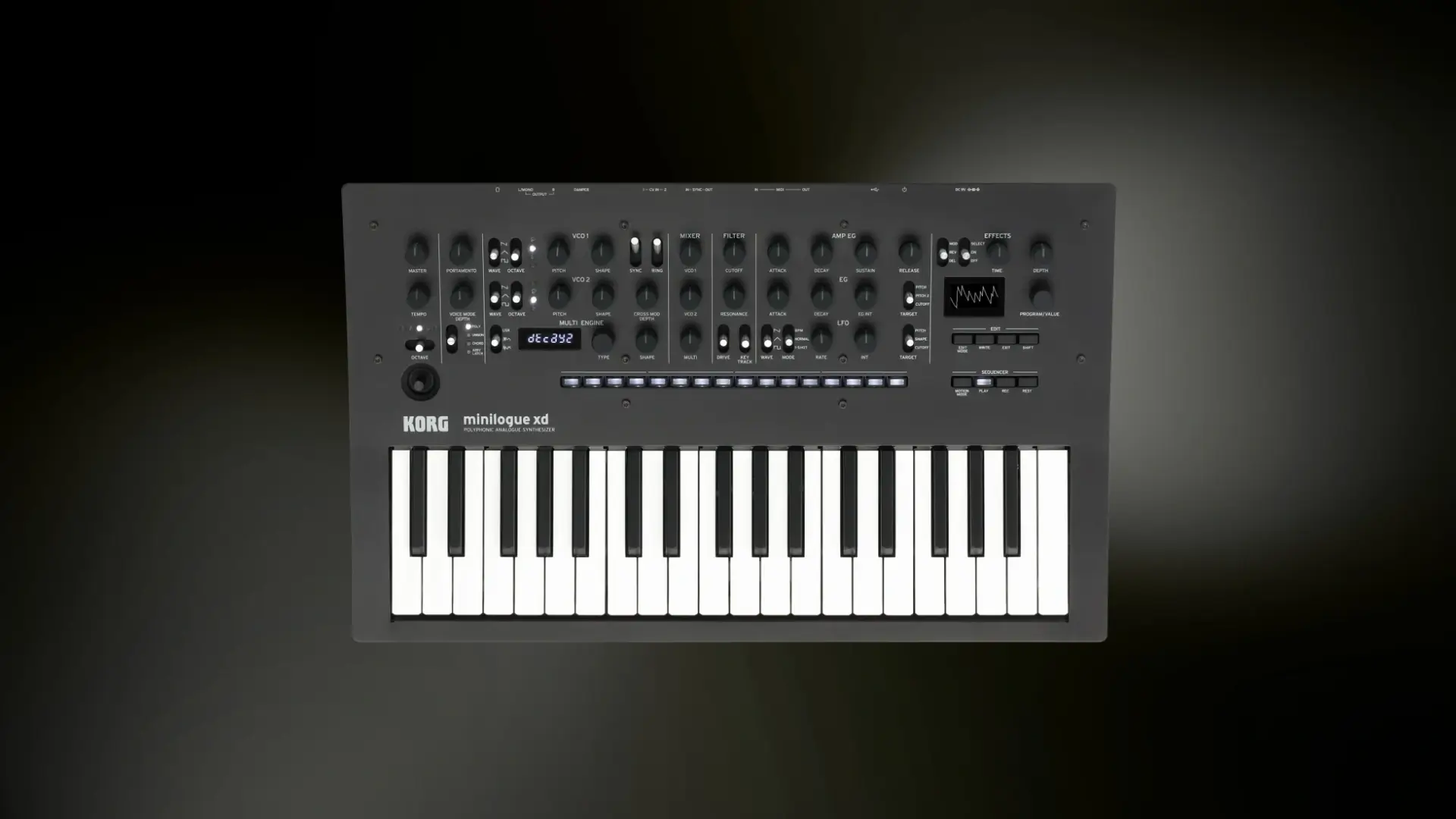
The Korg Minilogue XD is a four-voice hybrid polysynth announced at Winter NAMM in January 2019. It combines two analog voltage-controlled oscillators per voice with an analog low-pass filter and amplifier, while adding the digital Multi Engine, stereo effects, microtuning, motion sequencing, and user-programmable oscillator and effect slots inherited from Korg’s larger Prologue architecture. Its importance lies not in having the greatest polyphony or deepest modulation system in its class, but in turning an affordable analog synthesizer into an expandable platform whose digital capabilities could evolve after purchase.
Table of Contents
Korg Minilogue XD Sound and Character
The Korg Minilogue XD has a clearer, tighter, and more contemporary personality than the phrase “analog polysynth” might suggest. Its two analog VCOs provide the expected sawtooth, triangle, and square waves, but oscillator sync, ring modulation, cross-modulation, variable wave shaping, and a three-level drive circuit allow the basic architecture to move quickly from restrained subtractive sounds into harder, more animated territory. The analog core is especially convincing for compact basses, sharply articulated plucks, sync leads, pulsing sequences, and chords that need definition rather than excessive softness.
Its two-pole low-pass filter does not reproduce the darker weight or progressively rounded response associated with every vintage polysynth. Instead, it tends to preserve clarity and upper-midrange presence, even when the resonance is raised. SonicState specifically observed that the Korg Minilogue XD’s Prologue-derived filter retained low frequencies more effectively under resonance than the filter in the original Minilogue. The result is useful in arrangements: basses remain audible, resonant sequences retain their foundation, and chords can cut through without requiring aggressive equalization. The tradeoff is that players seeking an inherently thick, slow, or heavily saturated vintage response may find the Korg Minilogue XD more controlled than romantic.
The digital Multi Engine is what prevents the Korg Minilogue XD from becoming merely an improved version of the original Minilogue. Its VPM section uses two-operator phase-modulation synthesis and provides 16 oscillator types capable of metallic overtones, bells, glassy transients, digital basses, inharmonic textures, and percussive material. A noise generator adds four noise algorithms, while 16 user-oscillator slots allow third-party or self-developed algorithms to become part of the oscillator section. Because the digital oscillator passes through the same analog filter and amplifier as the VCOs, it can sound integrated with the analog architecture rather than attached as a separate effect.
This interaction between the analog and digital sections defines the Korg Minilogue XD more convincingly than either section alone. A digital attack can be layered over analog oscillators to sharpen a bass; a VPM tone can supply upper harmonics while the VCOs provide body; noise can become a rhythmic or atmospheric component; and custom oscillators can introduce wavetable-like, additive, wavefolded, or otherwise unconventional behavior depending on the installed algorithm. The Korg Minilogue XD can therefore move from traditional polysynth vocabulary into more synthetic and abstract territory without abandoning its direct subtractive workflow.
The effects are also central to its perceived size. Modulation, delay, and reverb sections can operate simultaneously, with processing performed by 32-bit floating-point DSP. Choruses and ensembles can widen the four analog voices, delays can turn short sequences into interlocking patterns, and the reverbs can push relatively simple patches toward large atmospheric spaces. Sound On Sound found the Korg Minilogue XD capable of moving from basic timbres to expansive soundscapes, while SonicState highlighted its darker textures, atmospheric patches, and reverb-enhanced pads.
Four voices remain four voices, however. Long releases, large chord voicings, and sustained ambient playing can expose voice stealing. The Korg Minilogue XD is therefore at its best when its polyphony is treated as a compositional boundary rather than ignored. It rewards economical chord voicings, sequenced movement, layered recording, and sounds whose identity comes from articulation and timbral evolution rather than sheer note density.
Features and Architecture
- Manufacturer: Korg, Japan.
- Year introduced: Announced in January 2019 during Winter NAMM 2019.
- Production years: 2019 to the present as of August 2026. Korg continues to list the keyboard model, and new units remain available through major retailers.
- Synthesis type: Hybrid analog and digital synthesis. Each voice combines two analog VCOs with a digital Multi Engine before passing through an analog filter and amplifier stage.
- Category: Four-voice programmable polyphonic synthesizer with a 37-note keyboard, integrated sequencer, arpeggiator, digital effects, and external control connectivity.
- Polyphony: Four voices. Voice modes include Poly, Unison, Chord, and Arp/Latch configurations. The Poly Chain function allows a second compatible Korg Minilogue XD to expand the system to eight voices.
- Original and current price: The announced United States price in 2019 was $619.99. In August 2026, the observed new price was $699.99, while Reverb’s estimated used-value range was approximately $381 to $534.
- Oscillators: Two analog VCOs per voice, each offering sawtooth, triangle, and square waves with octave, pitch, and shape controls. The oscillator section includes sync, ring modulation, and cross-modulation.
- Digital Multi Engine: Noise, VPM, and User oscillator modes. The noise engine contains four types, the VPM engine contains 16 types, and the Korg Minilogue XD provides 16 locations for downloadable or user-created oscillator algorithms.
- Filter: Analog two-pole resonant low-pass filter with cutoff, resonance, keyboard tracking, and three drive settings: off, 50 percent, and 100 percent.
- LFOs: One LFO with sawtooth, triangle, and square waveforms. It provides BPM-synchronized, normal, and one-shot operation, with pitch, oscillator shape, or filter cutoff as selectable destinations.
- Envelopes: One ADSR amplitude envelope and one attack-decay modulation envelope. The second envelope can target oscillator pitch, oscillator-two pitch, or filter cutoff.
- Modulation system: Front-panel oscillator modulation, joystick control, envelope and LFO routing, keyboard tracking, velocity response, and motion sequencing for recording changes to as many as four panel parameters. It does not use a large programmable modulation matrix.
- Sequencer and arpeggiator: A 16-step polyphonic sequencer supports real-time and step recording. Motion sequencing can record up to four knob movements, while the arpeggiator is accessed through the voice-mode system.
- Effects: Three digital effect sections covering modulation, delay, and reverb, all usable simultaneously. The Korg Minilogue XD includes 16 user-effect slots for programs developed through the logue SDK ecosystem.
- Memory: 500 program locations, comprising 200 factory programs and 300 user-programmable locations. Programs can store sound parameters and sequence data.
- Microtuning: 23 preset tuning systems plus six user scales and six user-octave tunings.
- Keyboard: 37 velocity-sensitive slim keys. The keyboard itself does not generate aftertouch.
- Audio and control connections: Left/mono and right quarter-inch outputs, headphone output, damper-pedal input, two CV inputs, and synchronization input and output. There is no external audio input.
- MIDI and USB: Five-pin MIDI input and output plus USB-B connectivity for MIDI communication and librarian functions.
- Display: Main OLED display with a real-time oscilloscope and motion-sequence visualization, accompanied by a separate six-character display for Multi Engine information.
- Dimensions and weight: 500 × 300 × 85 millimetres, with a weight of 2.8 kilograms, or approximately 6.17 pounds.
- Power: Nine-volt DC operation using the supplied KA-350 adapter, with specified power consumption of eight watts.
Strengths
- A genuinely integrated hybrid architecture: The digital oscillator is not simply an additional sound module. It shares the analog signal path with the VCOs, allowing digital harmonics, noise, and custom algorithms to be shaped by the analog filter, envelope, amplifier, and drive circuit.
- Substantial sonic range without abandoning immediacy: The basic panel remains understandable as a conventional subtractive synthesizer, yet VPM synthesis, oscillator interaction, microtuning, motion sequencing, and custom algorithms provide considerably more range than the straightforward layout initially suggests.
- Expandable oscillator and effect architecture: Sixteen user-oscillator and 16 user-effect locations allow the Korg Minilogue XD to acquire new synthesis and processing functions through the logue SDK and librarian software. This gives the hardware a degree of post-purchase evolution uncommon among compact analog polysynths released during the same period.
- Useful sequencing rather than decorative sequencing: Four lanes of motion recording can animate filter cutoff, oscillator parameters, effect values, and other controls over a 16-step pattern. The sequencer therefore acts as a sound-design system as much as a note recorder.
- Stereo effects that compensate intelligently for limited polyphony: Chorus, ensemble, delay, and reverb treatments can enlarge four-note patches without requiring external processors. The ability to run modulation, delay, and reverb simultaneously is particularly useful for pads, ambient sequences, and recorded layers.
- Strong integration with modular and synchronized hardware: Two CV inputs and dedicated sync connections make the Korg Minilogue XD easier to incorporate into Eurorack, Volca, sequencer, and hybrid computer-hardware setups than many similarly sized keyboard polysynths.
- Microtuning is treated as a practical performance function: Preset and user tuning locations make alternative temperaments accessible without requiring external pitch processing or specialist software during performance.
- Compact without becoming menu-dependent: Although several secondary functions require menus, oscillator shaping, filtering, envelopes, LFO control, effects, sequencing, and voice modes retain dedicated physical controls.
Limitations
- Four voices impose a real musical ceiling: Dense chords, overlapping releases, sustained pads, and passages played with a sustain pedal can trigger audible voice reassignment. The Poly Chain feature offers an expansion route, but it requires purchasing and connecting another Korg Minilogue XD.
- The 37-note slim keyboard is functional rather than luxurious: It keeps the chassis portable, but its reduced key size and three-octave range are less comfortable for pianistic playing, wide two-handed voicings, or players accustomed to full-sized keys.
- No aftertouch is generated by the keyboard: Firmware version 2.01 added reception and assignment of incoming MIDI aftertouch, but expressive pressure control still requires an external controller.
- The modulation architecture is narrower than the oscillator section suggests: One LFO, one attack-decay modulation envelope, fixed destination choices, and the absence of a broad modulation matrix limit complex continuously evolving patches. Motion sequencing partly compensates for this, but it is step-based rather than a replacement for freely routed modulation.
- The main analog filter is low-pass only: There are no analog high-pass, band-pass, or continuously variable filter modes. Players who make filter topology central to sound design may find this more restrictive than instruments with multimode or state-variable filters.
- Its 16-step sequencer is designed for patterns, not complete arrangements: It is effective for motifs, bass lines, parameter automation, and rhythmic sound design, but it is not a substitute for a workstation sequencer or a dedicated multi-track hardware sequencer.
- The open digital architecture still depends on a computer: Installing, organizing, and backing up user oscillators and effects requires Korg’s librarian software. The front panel can edit parameters exposed by an algorithm, but it cannot create new oscillator code independently.
- There is no external audio input: Outside signals cannot be routed through the analog filter or onboard effects, reducing its usefulness as a general processing device.
Historical Context
The original Minilogue arrived in 2016 at a moment when affordable analog synthesis was expanding rapidly but programmable polyphony was still relatively expensive. Its four genuine analog voices, patch memory, oscilloscope, sequencing, and approachable panel made it an important entry point into polyphonic analog hardware. Korg followed it with the Monologue, which adapted the concept to a monophonic instrument and introduced features such as expanded sequencing and microtuning.
The Prologue, announced in 2018, established the next technical direction. Alongside its analog oscillators, it introduced the digital Multi Engine and the logue SDK, enabling developers to create custom oscillator and effect algorithms. The Prologue demonstrated that an analog synthesizer did not have to remain a closed, permanently fixed architecture, although its larger keyboards, greater polyphony, and higher price placed it above the original Minilogue’s market position.
The Korg Minilogue XD effectively condensed these separate lines of development. It retained the four-voice compact format associated with the 2016 Minilogue, incorporated the Prologue’s Multi Engine and expandable digital processing, and adopted microtuning and performance ideas associated with the Monologue. Contemporary coverage correctly described it as a convergence of Korg’s recent analog designs rather than a simple cosmetic update.
Its timing mattered. By 2019, analog revivalism alone was no longer unusual. The market already contained inexpensive monophonic analog synthesizers, compact polysynths, boutique recreations, and digitally modelled instruments. The Korg Minilogue XD responded by making hybridity and extensibility its central argument. Instead of asking buyers to choose strictly between analog authenticity and digital flexibility, it placed both methods inside one signal path and one immediate control surface.