

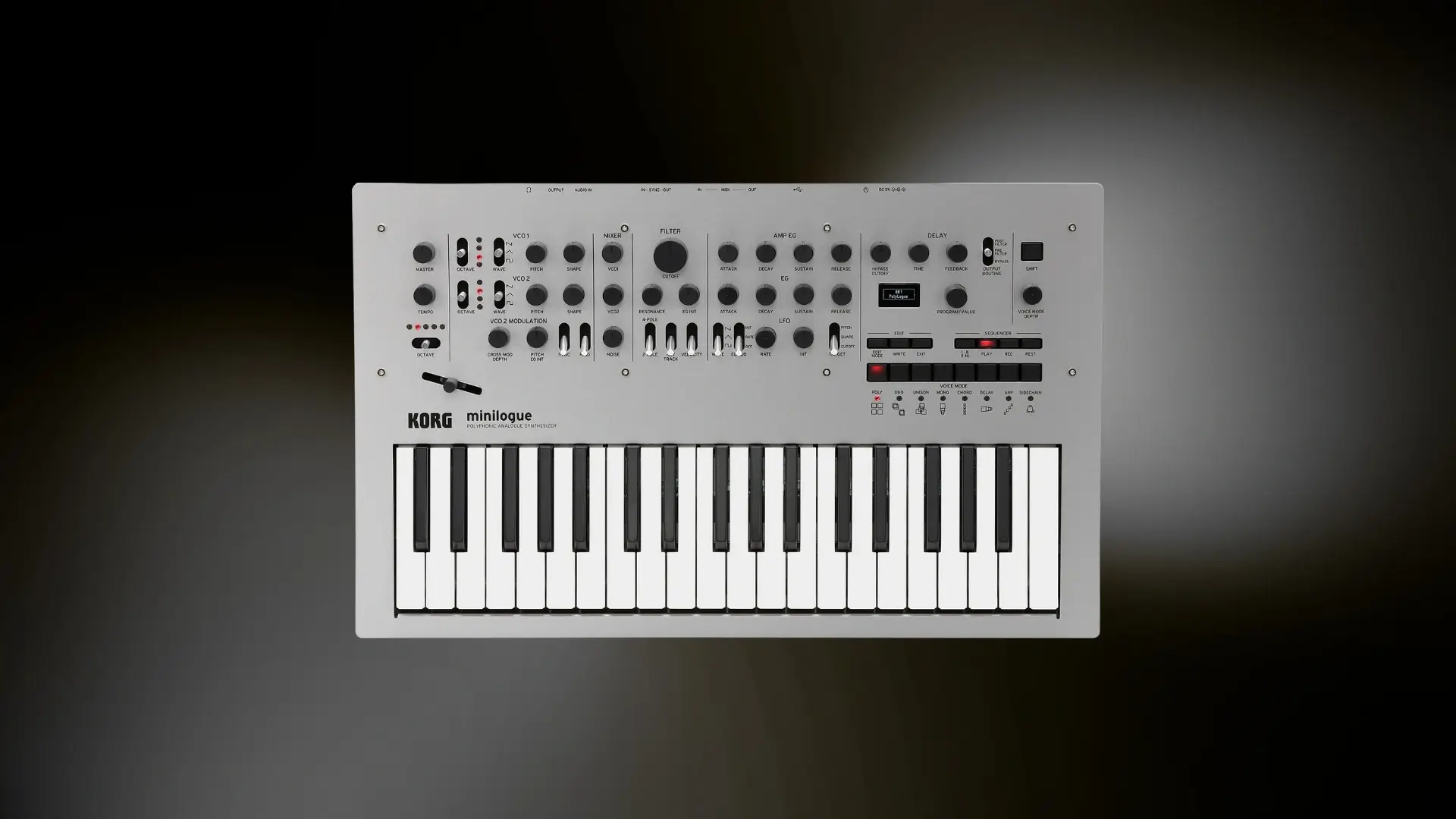
The Korg Minilogue is a four-voice programmable analog polysynth introduced in January 2016, immediately before the Winter NAMM show. Built around an entirely new analog voice circuit rather than a recreation of an earlier Korg instrument, it combined two voltage-controlled oscillators per voice, patch memory, a polyphonic motion sequencer, a tape-inspired delay and an unusually direct control panel for an original US price of $499. That combination made the Korg Minilogue more than a compact synthesizer: it was an argument that a serious analog polyphonic instrument no longer had to be large, vintage or financially inaccessible.
Table of Contents
Korg Minilogue sound and character
The Korg Minilogue has a recognizably analog foundation, but it does not imitate one particular vintage Korg. Its oscillators are stable and accurately calibrated, giving sustained notes and chords a cleaner, more controlled quality than musicians sometimes associate with aging analog hardware. Detuning, voice stacking and oscillator-shape modulation can introduce movement and width, but the basic character remains relatively clear, immediate and adaptable rather than overwhelmingly thick or aggressively coloured. Contemporary reviews consequently described it as classically informed without possessing the dominant sonic fingerprint of an Oberheim, Minimoog or other strongly voiced vintage design.
Two VCOs per voice provide sawtooth, triangle and square waves with continuously variable shape controls. The second oscillator can be synchronized, ring-modulated or cross-modulated against the first, allowing the Korg Minilogue to move from straightforward analog basses, leads and pads into metallic, unstable or harmonically abrasive territory. A white-noise source and an LFO capable of reaching audio-rate modulation further extend the palette beyond conventional subtractive synthesis.
The switchable two-pole and four-pole low-pass filter responses are central to the Korg Minilogue’s versatility. The filter can self-oscillate at high resonance and includes envelope intensity, keyboard tracking and velocity control. Combined with the oscillator-shaping system, it can produce rounded basses and restrained polyphonic textures, but it can also become lean, resonant and cutting. The Minilogue is therefore better understood as a flexible modern analog voice than as a machine designed exclusively for oversized vintage warmth.
Its eight voice modes change the practical identity of the same four analog voices. Poly mode provides conventional four-note playing, Duo assigns two stacked voices to each note, and Unison concentrates all four voices into a monophonic sound. Mono mode introduces a sub-oscillator function, while Chord, Delay, Arp and Side Chain modes create harmonized, staggered, arpeggiated or dynamically displaced patterns. These modes do not increase the voice count, but they make the existing voices behave like several different instruments.
The onboard digital delay contributes a rougher and less polished dimension. Inspired loosely by tape-echo behaviour, it includes its own high-pass filter and can be placed before or after the Korg Minilogue filter. At high feedback settings it enters self-oscillation, turning a conventional patch into a source of noise, rhythmic instability and dub-like trails. It is not a pristine studio effect, but its imperfections complement the directness of the analog engine.
Features and architecture
- Manufacturer: Korg Inc., Japan.
- Year introduced: 2016, with the public launch taking place around the January 2016 Winter NAMM show.
- Production years: 2016 to the present catalog period. Korg continued to list the original model in 2026, although retail stock status varied between pages and regions.
- Synthesis type: Programmable analog subtractive synthesis with digitally managed control, calibration, memory, sequencing and display functions.
- Category: Compact analog polyphonic keyboard synthesizer and step sequencer.
- Polyphony: Four analog voices.
- Original price: Approximately $499 in the United States and £435 in the United Kingdom at launch.
- Current price signal: Korg’s US store listed the original Korg Minilogue at $699.99 in 2026. Reverb showed an estimated used value of approximately $321 to $423, depending on condition and market activity.
- Oscillators: Two analog VCOs per voice, each offering sawtooth, triangle and square waveforms, octave selection, pitch and variable wave shaping. VCO2 adds oscillator sync, ring modulation, cross modulation and pitch-envelope control. A separate noise generator is included.
- Filter: Resonant low-pass VCF with switchable two-pole and four-pole responses, cutoff, resonance, envelope intensity, keyboard tracking and velocity response.
- LFOs: One LFO with sawtooth, triangle and square waveforms. It can target oscillator pitch, oscillator shape or filter cutoff and is capable of audio-rate modulation.
- Envelopes: One dedicated ADSR amplifier envelope and a second ADSR envelope used principally for pitch and filter modulation.
- Modulation system: Fixed but accessible routing built around the second envelope, LFO, velocity, keyboard tracking, oscillator sync, ring modulation, cross modulation, wave shaping and a per-program assignable performance slider. There is no open-ended modulation matrix.
- Voice modes: Poly, Duo, Unison, Mono, Chord, Delay, Arp and Side Chain, with a Voice Mode Depth control that changes function according to the selected mode.
- Sequencer and arpeggiator: A 16-step polyphonic sequencer with step recording, real-time recording, overdubbing and motion recording for as many as four parameters. The arpeggiator operates through the Arp voice mode; latch functionality was added through a firmware update.
- Effects: One digital tape-echo-inspired delay with high-pass cutoff, delay time, feedback and pre-filter, post-filter or bypass routing. No chorus, reverb or multi-effect section is included.
- Memory: 200 program locations, comprising 100 factory programs and 100 user locations. Programs store voice-mode and sequence information, and eight programs can be registered as favourites.
- Keyboard: 37 velocity-sensitive slim keys. The keyboard does not generate or receive aftertouch.
- Inputs and outputs: One quarter-inch monaural audio output, one quarter-inch stereo headphone output, one quarter-inch monaural audio input, 3.5 mm Sync In and Sync Out connectors, MIDI In and MIDI Out.
- MIDI and USB: Five-pin MIDI In and Out plus USB Type-B for MIDI communication. USB does not transmit audio.
- Display: OLED display providing program information, parameter values, sequencer information and a real-time waveform oscilloscope.
- Controls: 41 dedicated front-panel controls, supplemented by menu functions and an assignable performance slider.
- Dimensions: 500 × 300 × 85 mm, or approximately 19.69 × 11.81 × 3.35 inches.
- Weight: 2.8 kg, or approximately 6.17 pounds.
- Power: External 9-volt DC adapter with stated power consumption of 8 watts.
Strengths
- A genuine analog polyphonic signal path at a historically disruptive launch price: Two VCOs per voice, a resonant analog filter and four-note polyphony were delivered at a price previously associated more commonly with digital instruments or analog monosynths.
- Immediate programming: The front panel exposes nearly every regularly used synthesis parameter, allowing musicians to build and alter sounds without repeatedly navigating menus. The oscilloscope adds useful visual feedback without replacing ear-based programming.
- A broad oscillator vocabulary: Variable wave shaping, sync, ring modulation and cross modulation give the Korg Minilogue considerably more harmonic range than a basic two-oscillator subtractive design might suggest.
- Efficient use of four voices: Duo, Unison, Chord, Delay, Arp and Side Chain modes turn a limited voice count into a performance and sound-design resource rather than treating polyphony as a fixed specification.
- An unusually integrated sequencer: Because every program can include sequence and motion data, sound design, automation and musical phrases become parts of the same saved object. This encourages patches to function as complete musical gestures rather than static timbres.
- Useful external-audio processing: The monaural audio input allows another instrument or signal to pass through the Korg Minilogue’s filter, envelopes and delay, extending its value beyond its internal oscillators.
- Portable but substantially constructed: Its aluminum panel, chassis-mounted controls, wooden rear panel, compact dimensions and 2.8 kg weight make it practical for small studios and live rigs without reducing it to a lightweight controller-style enclosure.
- Approachable without being sonically trivial: Factory programs provide usable starting points, while the analog controls make it easy to transform those sounds substantially and store the results in 100 user locations.
Limitations
- Four voices remain a strict ceiling: Sustained chords, long release times and overlapping sequencer notes can produce audible voice stealing. Duo and Unison modes reduce effective polyphony to two voices or one voice.
- The slim keyboard will not suit every player: Its reduced key dimensions improve portability, but musicians accustomed to full-sized keys may find chord voicings and expressive performance less comfortable. Aftertouch is absent.
- The main output is monaural: The Korg Minilogue does not provide stereo line outputs, and its USB connection carries MIDI rather than audio. External effects or recording hardware are required for a stereo production chain.
- Modulation is versatile but structurally restricted: One LFO, fixed destination choices and the absence of a general modulation matrix place clear limits on complex evolving patches. Most modulation is immediate, but it is not deeply freely routable.
- The effects section is narrow: The delay has character and can become part of the synthesis process, but there is no onboard chorus, reverb, phaser, ensemble or broader multi-effects system.
- The sequencer is designed for phrases rather than complete arrangements: Sixteen steps and four motion lanes are excellent for riffs and evolving loops but restrictive for longer harmonic development or full-track sequencing.
- Its 2026 new-price proposition is weaker than it was in 2016: Korg listed both the original Korg Minilogue and the more extensively equipped Minilogue XD at a $699.99 sale price. At equal pricing, the original must be chosen for its particular filter, voice modes and simpler identity rather than for superior specification value.
Historical context
The Korg Minilogue arrived during Korg’s sustained return to analog instrument design. The Monotron, Monotribe, Volca series, MS-20 revival and ARP Odyssey project had already demonstrated renewed interest in analog circuitry, but most of those instruments were monophonic, limited in polyphony or based on earlier designs. The Minilogue was different: it was a completely new programmable analog polysynth intended for contemporary production rather than a recreation of a historical Korg circuit.
It was also Korg’s first keyboard-equipped analog polyphonic synthesizer since the DCO-based Poly-800 MkII of the mid-1980s. That long absence gave the release symbolic importance. Korg was not simply adding another inexpensive box to its catalog; it was re-entering a category associated with instruments such as the Polysix, Mono/Poly and Trident, but doing so with a new architecture and a radically lower entry price.
The timing mattered because credible analog polysynth keyboards were still substantially more expensive. Contemporary comparisons placed instruments such as the DSI Mopho x4 and Elektron Analog Keys well above the Korg Minilogue’s $499 or £435 launch price. The Korg Minilogue therefore addressed a clear gap between inexpensive analog monosynths and professional polyphonic instruments costing considerably more.
Its affordability was partly enabled by combining analog sound generation with modern digital control. Designer Tatsuya Takahashi explained that each voice used an ARM microprocessor to generate control voltages and gate signals and to perform automatic calibration. That reduced the amount of factory adjustment required while preserving budget for real VCOs, wave shaping and ring modulation. The Korg Minilogue’s economics were therefore inseparable from its hybrid engineering philosophy, even though its principal sound path remained analog.
Legacy and significance
The Korg Minilogue’s importance does not rest on having the largest voice count, the deepest modulation system or the most luxurious keyboard. Its contribution was to reorganize expectations. In 2016, a musician could purchase a new, programmable, patch-storing analog polysynth with VCOs, a motion sequencer and a nearly knob-per-function interface for the price of many premium monosynths. Reviews at the time described it as a watershed release and a new benchmark for affordable analog polyphony.