

Table of Contents
Korg miniKORG 700Sm Sound and Character
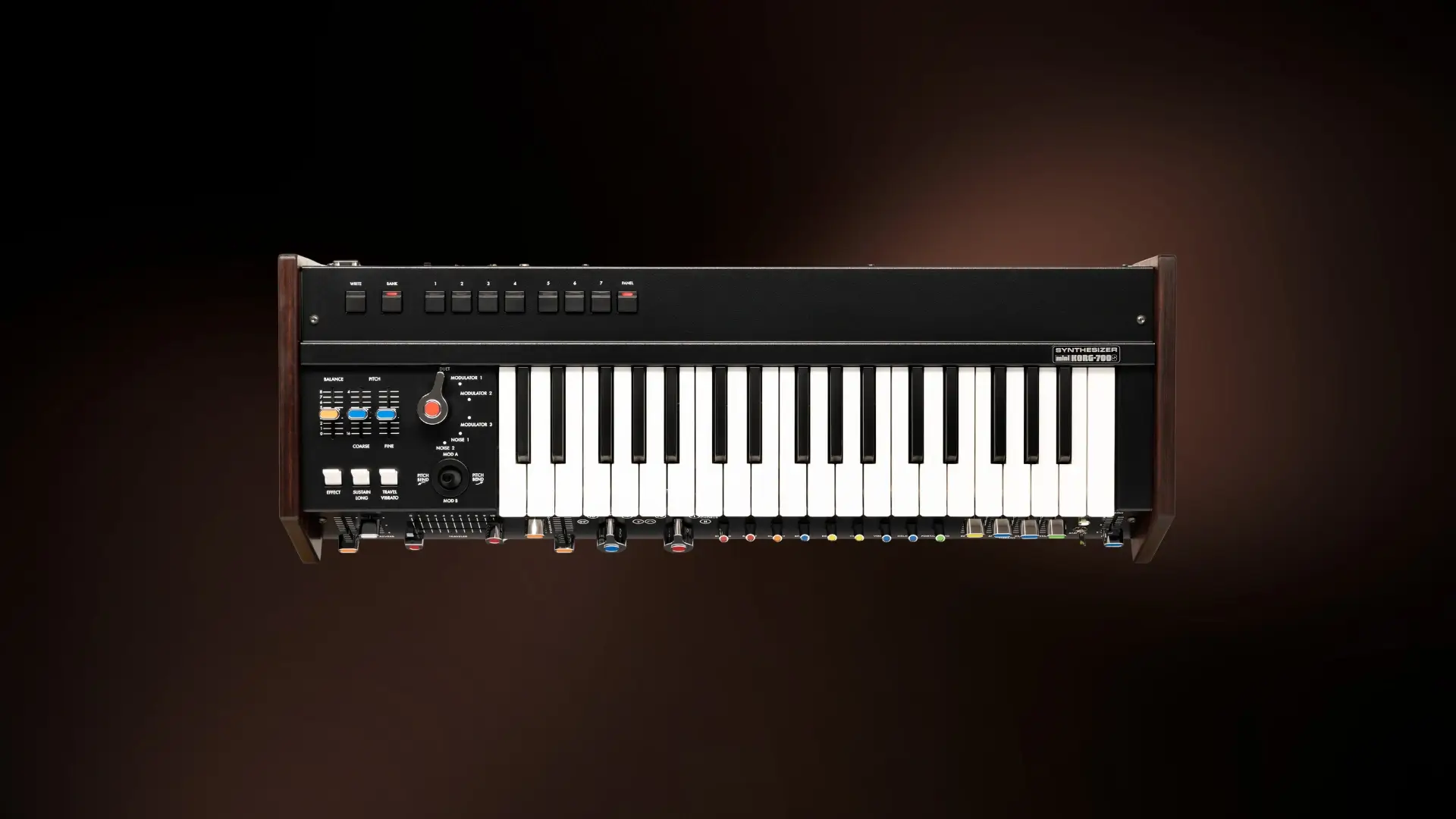
The Korg miniKORG 700Sm does not behave like a neutral modern monosynth designed to cover every familiar subtractive-synthesis category. Its central sound is concentrated, bright and unusually penetrating. Bass patches can be forceful without becoming shapeless, while lead sounds possess a vocal, slightly nasal edge that remains audible inside a busy arrangement. Independent reviews consistently identify basses and leads as its strongest territory, but its ring-modulation modes, noise options and spring reverb allow it to move into metallic effects, unstable drones and early electronic-music textures.
The first oscillator supplies triangle, square and sawtooth waves alongside the animated Chorus I and Chorus II options. These chorus waveforms introduce movement before the signal even reaches the filter, helping the Korg miniKORG 700Sm sound larger than its single-voice architecture suggests. The second oscillator can reinforce the first through detuning and interval relationships or enter several modulation modes derived from the 700S ring-modulator circuit. The resulting tones range from dense unison basses to clangorous, inharmonic colors that sound closer to primitive electronic percussion or science-fiction effects than conventional solo patches.
Its defining component is the Traveler, a paired low-pass and high-pass filter controlled by two horizontal sliders. Moving the sliders together shifts a narrowed frequency region across the spectrum, creating wah-like, muted and formant-shaped sounds. Separating them opens the spectrum, while more extreme combinations can thin or nearly extinguish the signal. There is no continuously variable resonance knob in the modern sense; instead, the Bright function introduces a predetermined emphasis around the cutoff region, and Expand applies the Korg miniKORG 700Sm’s envelope to the filter. This architecture is less flexible than a modern multimode filter, but it encourages continuous physical movement rather than static programming.
The spring reverb is similarly simple. Its level can be adjusted, but there are no decay, tone or damping parameters. That limitation gives the effect a specific role: it surrounds bright leads and ring-modulated sounds with a grainy mechanical space rather than functioning as a general-purpose ambience processor. Combined with portamento, delayed vibrato and the Traveler, it pushes the Korg miniKORG 700Sm toward the expressive vocabulary of 1970s electronic music without making the Korg miniKORG 700Sm sound fragile or poorly controlled. Reviewers have also noted that its analog oscillators remain notably stable in use.
Features and Architecture
- Manufacturer: Korg.
- Year introduced: 2025. The Korg miniKORG 700Sm was presented around the 2025 NAMM Show and subsequently entered retail distribution.
- Production years: 2025 to the present, as of August 2026. Korg continues to list and sell the model through its official store.
- Synthesis type: Fully analog subtractive synthesis with analog oscillators, a paired low-pass/high-pass Traveler filter and an analog signal path.
- Category: Compact monophonic keyboard synthesizer and modern recreation of the miniKORG 700S architecture.
- Polyphony: One voice. Although the second oscillator can be tuned to an interval, the Korg miniKORG 700Sm is not genuinely duophonic because both oscillator pitches do not respond independently to separate held notes.
- Launch price: European launch information placed the Korg miniKORG 700Sm around £1,169 and €1,399. Early US reports varied between approximately $1,199 and $1,300.
- Current new-price signal: Korg’s official US store and Sweetwater list it at $1,499.99. A 2026 UK review listed a price of £999, while other European listings have remained closer to £1,069 or €1,229. Regional taxation and distribution account for part of that variation.
- Current used-price signal: Reverb has indicated an estimated range of approximately $714 to $1,271, while Sweetwater’s used-gear guide has shown a narrower typical range of roughly $780 to $1,155. The market remains young and relatively thin.
- Oscillators: Two analog VCOs. VCO1 offers triangle, square, sawtooth, Chorus I and Chorus II waveforms. VCO2 can be blended with VCO1 in Duet mode or used through three modulation modes and two noise settings. The available pitch range spans seven octaves through octave selection.
- Filter: Traveler system combining independently adjustable low-pass and high-pass cutoff controls. Bright adds fixed cutoff emphasis, while Expand introduces envelope modulation. Replacement slider caps without physical crossing restrictions are included.
- LFOs and cyclic modulation: A vintage-style vibrato system provides adjustable modulation speed and depth, with an additional delayed-vibrato function. Travel Vibrato applies cyclic movement to the filter, while Repeat can produce automatic retriggering and rhythmic modulation. It is not a modern multi-LFO architecture.
- Envelopes: An unconventional envelope controlled primarily through Attack and Percussion/Singing parameters rather than a standard ADSR layout. Sustain operates more like a release function, while Sustain Long greatly extends the available envelope times. Expand applies the envelope to the filter.
- Modulation system: Oscillator detuning, three ring-modulator-derived modes, noise, vibrato, delayed vibrato, Travel Vibrato, aftertouch, joystick-controlled pitch and modulation, portamento, auto-bend and filter-envelope modulation. There is no programmable modulation matrix.
- Sequencer and arpeggiator: No programmable step sequencer is documented. The Repeat system incorporates an arpeggiator with modes including up, down, up-and-down and random operation, accessed through secondary button commands.
- Effects: Mechanical spring reverb, vibrato, delayed vibrato, portamento and automatic pitch bending. Ring modulation forms part of the synthesis architecture rather than a post-filter digital effect.
- Memory: Fourteen program locations.
- Keyboard: Thirty-seven slim keys with aftertouch but no velocity sensitivity. The playable range can be shifted across seven octaves.
- Inputs and outputs: Audio input, left/mono and right audio outputs, headphone output, CV input, Gate input, Sync input and Sync output.
- MIDI and USB: Five-pin MIDI input and USB-B connectivity supporting bidirectional USB-MIDI communication. There is no conventional five-pin MIDI output.
- Display: No conventional screen. Program buttons and illuminated bank indicators provide memory and operating feedback.
- Dimensions: 641 × 227 × 107 millimeters.
- Weight: 5.8 kilograms, or approximately 12.8 pounds.
- Power: External 12-volt DC adapter with rated power consumption of 9 watts.
- Included accessories: AC adapter, two alternative Traveler slider caps and a fitted soft carrying case.
Strengths
- A genuinely distinctive analog voice: The combination of penetrating oscillators, chorused waveforms and the Traveler filter gives the Korg miniKORG 700Sm a tonal identity that is difficult to reproduce by treating it as another conventional two-VCO monosynth.
- Exceptional bass and lead presence: The Korg miniKORG 700Sm can produce thick detuned basses, narrow vocal leads and cutting solo tones that remain defined rather than simply becoming louder or more saturated.
- A performance-oriented filter: The paired Traveler sliders encourage real-time movement and can be manipulated together with one hand. This gives filter performance a physical quality that parameter encoders and menus rarely reproduce.
- More experimental than its simple panel suggests: Three modulation modes, oscillator intervals, noise, Repeat functions, Travel Vibrato and spring reverb produce metallic effects, drones and rhythmic pulses beyond the expected vintage bass-and-lead vocabulary.
- Modern integration without redesigning the Korg miniKORG 700Sm: Patch memory, aftertouch, USB-MIDI, conventional MIDI input, Sync and CV/Gate connections make the Korg miniKORG 700Sm substantially easier to use in a contemporary studio than an original 700S.
- Strong physical construction: Independent reviews describe a solid metal chassis, substantial switches and generally high build quality. The included fitted case strengthens its practicality as a secondary stage keyboard.
- A carefully preserved interface: Korg did not reorganize the controls into a standardized modern panel. The unusual nomenclature and front-mounted layout remain part of the Korg miniKORG 700Sm’s identity rather than being treated as defects to be corrected.
Limitations
- High price for a monophonic architecture: At $1,499.99 in the United States, the Korg miniKORG 700Sm competes with instruments offering more voices, deeper modulation, larger keyboards, sequencers and substantially more memory. Its value depends primarily on whether the buyer specifically wants this sound and historical design.
- No velocity sensitivity: Aftertouch adds expression after a note is held, but the lack of velocity means initial note dynamics cannot respond to playing force from the internal keyboard.
- Slim keys weaken the premium impression: The keyboard is playable and larger than a conventional mini-key mechanism, but reviewers have identified it as a compromise compared with the full-size 700FS keyboard.
- Deliberately restricted synthesis controls: There is no standard ADSR envelope, freely adjustable resonance, modulation matrix or broad selection of filter modes. Its limitations generate character, but they also prevent it from replacing a more comprehensive modern monosynth.
- Only fourteen memory locations: Patch storage is welcome, but fourteen programs are restrictive for musicians building large live sets or maintaining extensive studio libraries.
- Some functions are unnecessarily hidden: Arpeggiator modes require secondary button operations rather than dedicated controls, weakening the otherwise immediate panel design.
- The control layout favors seated use: The principal controls are positioned below the keyboard because the original instrument was designed to sit above an organ. That arrangement is visually distinctive but less convenient when the performer is standing directly over the Korg miniKORG 700Sm.
- Limited MIDI hardware implementation: The presence of MIDI input and USB-MIDI is useful, but the absence of a five-pin MIDI output reduces its usefulness as a controller for other hardware.
- Compact does not mean ultralight: At 5.8 kilograms, it is transportable but considerably heavier than many contemporary compact monosynths.
- External power supply: The 12-volt adapter is less elegant for a premium stage instrument than an internal universal power supply.
Historical Context
The miniKORG 700 appeared in 1973 as Korg’s first synthesizer. It was conceived as a supplementary keyboard that could be placed above an electronic organ, which explains both its shallow body and the unusual positioning of its controls below the keys. The original model used one oscillator. In 1974, Korg introduced the 700S, expanding the design with a second oscillator, noise sources, ring modulation and additional performance functions.
That development occurred before synthesizer interfaces had settled into the oscillator-filter-envelope conventions that became standard later in the decade. Terms such as Traveler, Singing, Percussion, Expand and Bright describe perceived musical behavior rather than engineering categories. The 700 family therefore documents a period when Japanese manufacturers were still inventing not only circuits but also the language through which musicians understood electronic sound.
The 700S also mattered because it lowered the economic barrier to electronic music. Phil Oakey later recalled that the Human League effectively began because the miniKORG 700S was a synthesizer its founders could afford. Daniel Miller similarly acquired a 700S as an accessible alternative to expensive American instruments before creating “Warm Leatherette” and establishing Mute Records.
Korg returned to the architecture in 2021 with the full-size miniKORG 700FS. Developed with guidance from original designer Fumio Mieda, the FS added modern connections, memory, aftertouch, an arpeggiator, joystick control and spring reverb while preserving the analog character and physical design. Korg states that the limited production run sold out rapidly, leaving continued demand that the smaller Korg miniKORG 700Sm was intended to address.
The Korg miniKORG 700Sm consequently arrived in a market already crowded with inexpensive analog monosynths. Rather than competing through modulation depth or feature count, Korg positioned it as a compact continuation of the 700FS: easier to transport and manufacture, but still materially closer to a premium historical recreation than to a budget mini-synth.