

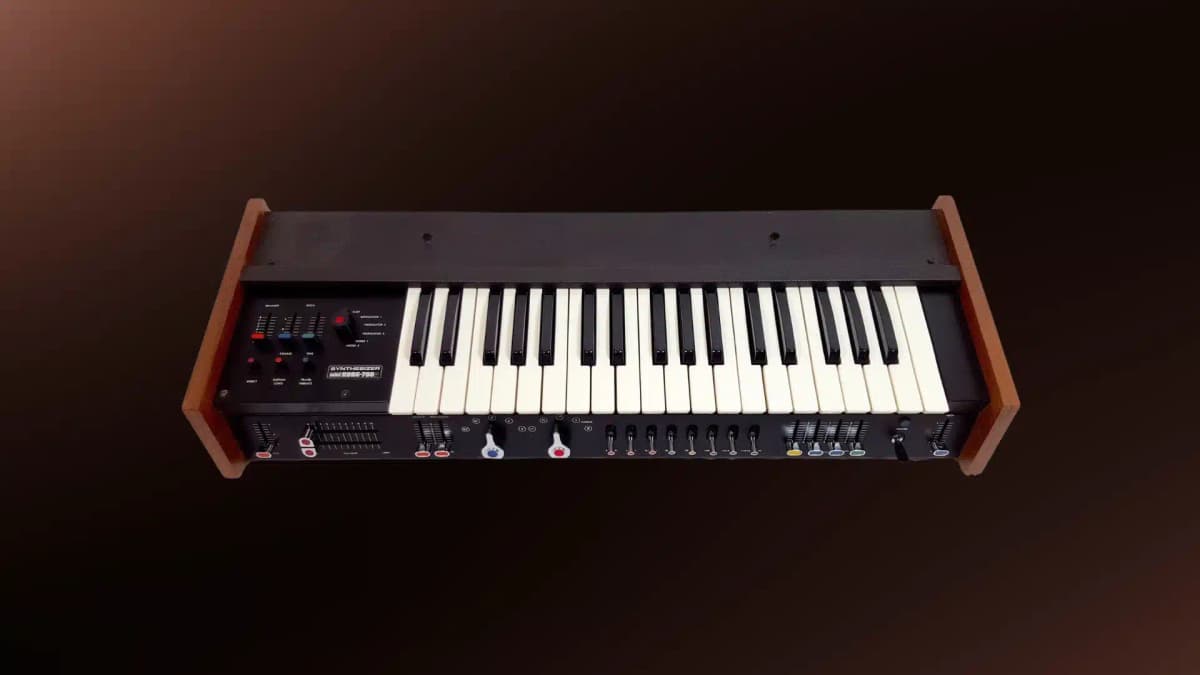
The Korg miniKORG 700S is a monophonic analog synthesizer that Keio Electronic Laboratories, the company behind the Korg brand, introduced in 1974 as an expanded version of its first synthesizer, the 1973 miniKORG 700. It kept the 700’s 37-note keyboard, organ-style controls beneath the keys and Traveler filter sliders, and added an Effects Section with a second, detunable oscillator, three ring modulation modes, noise, filter vibrato and a long-release option. At a glance it matters because it turned a quirky single-oscillator organ companion into a genuinely flexible synth, and because it is the version Korg chose to recreate decades later in hardware and software.
Table of Contents
Korg miniKORG 700S sound and character
The Korg miniKORG 700S has a bright, slightly nasal, very Japanese 1970s sound that is quite different from Moog or ARP instruments. Its oscillator starts from a triangle core that designer Fumio Mieda has linked to the series’ deep tone, and it offers several footages and waveforms including two pulse-width settings that Korg labeled Chorus. The second oscillator, a sawtooth with its own coarse and fine tuning and a Balance control, can be detuned slightly for a fat, beating bass or set to an interval for organ-like and brassy leads.
The Traveler is the heart of its character. Two sliders below the keyboard set a 12dB/octave low-pass filter and a 12dB/octave high-pass filter, and moving them together sweeps a band of frequencies in a way that sounds vocal and hollow. Resonance and envelope depth are switched on or off rather than dialed in, through the Bright and Expand controls, so the Korg miniKORG 700S excels at strong, defined timbres rather than subtle filter sweeps. Martyn Ware, recalling his Korg miniKORG 700S in a Red Bull Music Academy interview, praised its resonant filters for producing extreme sounds he compared to dying cats.
The Effects Section widens the palette considerably. Duet mode simply runs the two oscillators in parallel, while the three Modulator modes apply ring modulation: two follow the keyboard so the metallic timbre stays consistent, and the third detaches the second oscillator so every key produces a different clangorous tone. Add the Bender pitch swoop, the Repeat trill, delayed vibrato and portamento, and the Korg miniKORG 700S can move from round basses to piercing leads, bells and sound effects. It sits firmly on the vintage, characterful side of analog, warm in the low end but often raw and buzzy higher up.
Features and architecture
- Manufacturer: Keio Electronic Laboratories (Korg brand), Tokyo, Japan; related versions were also sold in North America under the Univox name
- Year introduced: 1974, about a year after the original miniKORG 700
- Production years: 1974 to 1978, according to the SMEM collection; production totals are not documented
- Synthesis type: analog subtractive
- Category: monophonic analog keyboard synthesizer, originally intended to sit on top of an electronic organ
- Polyphony: monophonic
- Original price: £499 in the UK, according to Sound On Sound; the original 700 had been sold in the US for under $1,000
- Current market price: a serviced Japanese unit was recently listed on Reverb at about A$2,700 (roughly US$1,800); Equipboard tracks the simpler original 700 at around $945, and prices vary widely with condition and voltage
- Oscillators: two; the main VCO with footages from 32′ to 2′ and sine, square, sawtooth and two pulse-width (Chorus) waveforms, plus a second sawtooth oscillator with coarse tuning over about three octaves, fine detune and a Balance control
- Noise: white and pink (or scaled) noise in the Effects Section
- Filter: Traveler pair of 12dB/octave low-pass and high-pass filters on two sliders, with Bright (resonance) and Expand (envelope) switches; the cutoffs are normally blocked from crossing
- LFOs: vibrato with speed, depth and delay; Traveler modulation (filter vibrato); Repeat for trills and gated effects
- Envelopes: one envelope with attack and a Percussion/Singing control, a Sustain (release) switch, and a Long setting that extends envelope times roughly tenfold
- Modulation system: switched and preset rather than patchable: three ring modulation modes (Modulator 1 to 3), Bender pitch envelope, portamento
- Sequencer / arpeggiator: none
- Effects: no onboard effects; the Effects Section is a synthesis section
- Memory: no patch memory
- Keyboard: 37 keys, no velocity or aftertouch; no pitch or modulation wheels
- Inputs / outputs: audio output; stock units have no standard CV/gate interface
- MIDI / USB: none
- Display: none
- Dimensions / weight: about 29.3 x 11 x 4.3 inches and 19.8 lb, according to Sound Programming
- Power: internal supply, about 15 W; many surviving units are 100V Japanese models
Strengths
- The second oscillator transforms the Korg miniKORG 700S. Detuned or interval settings give the thickness and movement the single-oscillator 700 lacked.
- Its ring modulation is unusually accessible. Two keyboard-tracking modes keep metallic tones playable across the range, something many synths of the period made awkward.
- The Traveler filters give it a recognizable voice. Combining high-pass and low-pass sweeps produces hollow, vocal and nasal tones that stand apart from American low-pass designs.
- It can still behave like a 700. Switching the Effects Section off returns the basic single-oscillator sound, so it covers both versions in one instrument.
- Oscillator tuning is notably stable for its age. Sound On Sound’s Gordon Reid praised the family’s tuning stability, which matters on an instrument with no memory or MIDI.
- Its sound is well supported today. Korg’s 700FS and 700Sm hardware revivals and its software recreation make it easy to learn the Korg miniKORG 700S before buying an original.
Limitations
- It is strictly monophonic, so chords and pads require overdubbing.
- Resonance and filter envelope depth are switches, not knobs, which limits the gradual sweeps that other synths of the era offered.
- The controls sit beneath the keyboard in an organ-style strip, with nonstandard names and inverted, drawbar-like faders that take time to learn.
- There are no wheels, no CV/gate on stock units and no MIDI, so expression and integration depend on switches or modifications.
- There is no patch memory, and recreating sounds means noting every switch and slider position by hand.
- Most surviving units are 100V Japanese models, so transformers and a full service are usually part of ownership outside Japan.
Historical context
Korg’s synthesizer line grew out of organ work. Founded in 1962 by Tsutomu Kato to build rhythm machines, the company began exploring analog synthesis around a programmable organ project led by engineer Fumio Mieda, later famous for the Uni-Vibe. A 1970 prototype shown at the All Japan Audio Fair became the Korgue organ, and its synthesizer section evolved into the miniKORG 700 of 1973, a single-oscillator instrument designed to sit on top of an organ with its controls below the keys.
The 700 sold strongly because it cost far less than an ARP Odyssey or Minimoog, and Sound On Sound’s Gordon Reid wrote that for about a year it may have been the most popular synthesizer in the world. In 1974 Korg followed it with the Korg miniKORG 700S, filling the blank space left of the keyboard with an Effects Section. The new features, a second oscillator, noise, ring modulation, filter vibrato and long sustain, answered the obvious weaknesses of the 700 while keeping its layout and price bracket.
The Korg miniKORG 700S anchored a growing family. The duophonic 800DV, essentially two Korg miniKORG 700S voices in one case, appeared in 1974 or 1975, and the 770 of 1975 put a similar architecture into a compact, conventional panel. As Korg moved toward the PS polyphonic series and, in 1978, the patchable MS-10 and MS-20, which also replaced the miniKORG’s idiosyncratic naming with standard terms, the Korg miniKORG 700S was retired; the SMEM museum gives 1978 as the end of production.