

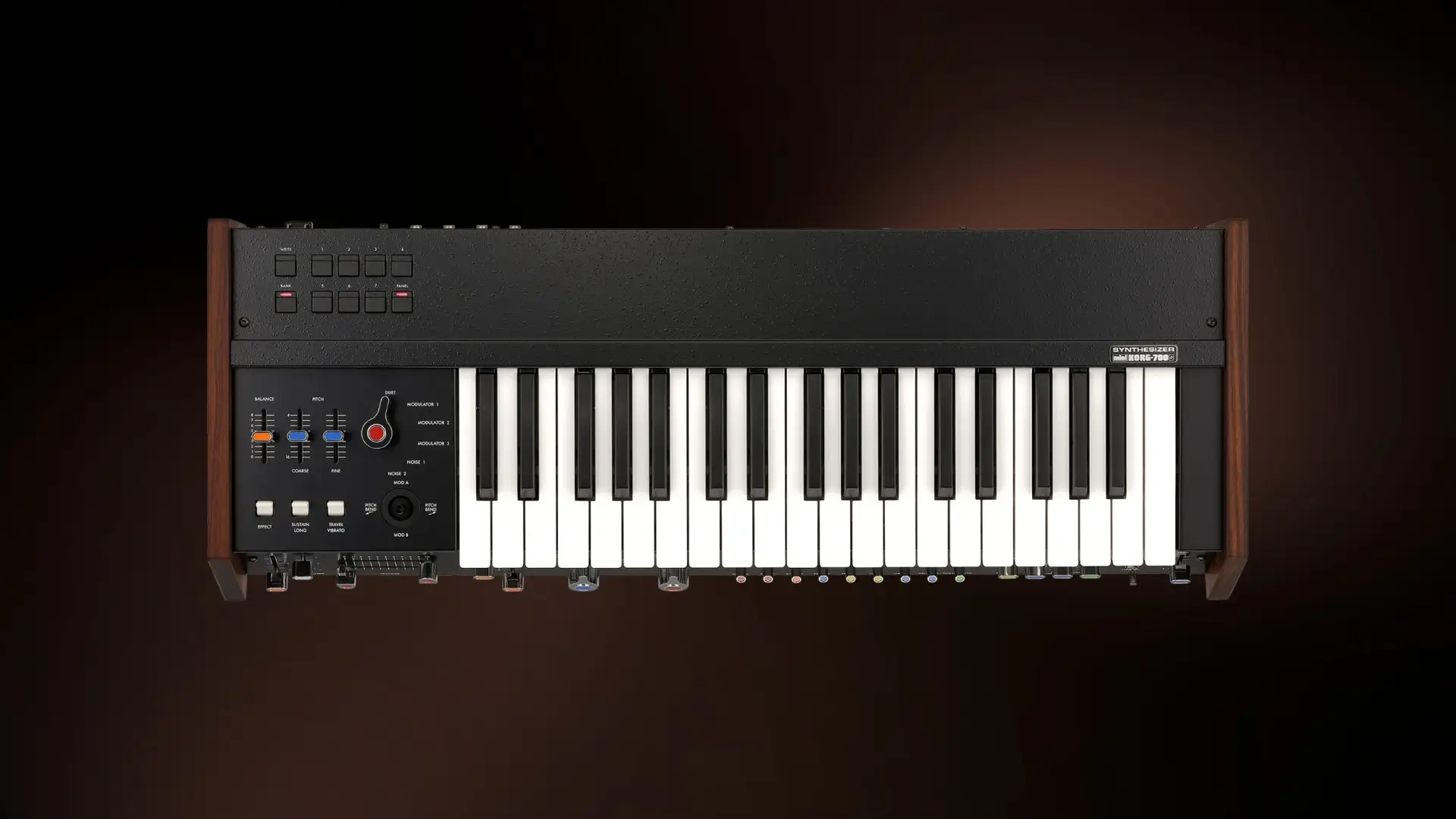
The Korg miniKORG 700FS is a limited-production, monophonic analog synthesizer introduced in 2021 as a full-scale revival of the 1974 miniKORG 700S, the expanded successor to Korg’s first mass-produced synthesizer. Developed under the supervision of original designer Fumio Mieda, it preserves the unusual two-oscillator architecture, Traveler filter controls and performance vocabulary of the early instrument while adding patch memory, aftertouch, an arpeggiator, spring reverb, MIDI, USB and analog control connections. It matters because it restores a formative branch of Korg’s history that is frequently overshadowed by later instruments such as the MS-20.
Table of Contents
Korg miniKORG 700FS sound and character
The Korg miniKORG 700FS has a dense, forward and highly identifiable tone. Its strongest territory is monophonic bass, lead and melodic sequence work, where the oscillators produce substantial low-frequency weight without losing the cutting upper-midrange presence needed to remain audible in a mix. Korg describes the oscillators as penetrating and the resulting bass and lead sounds as unusually thick, a characterization reinforced by the Korg miniKORG 700FS’s two-VCO Duet mode and the deliberately distinctive waveform generation inherited from the original design.
Its character is not simply the result of oscillator detuning. Fumio Mieda later reflected that the perceived depth of the original family may have come partly from the particular shape of its triangle wave. During development, attempts to produce a technically cleaner waveform repeatedly resulted in a weaker sound. That observation reveals much about the Korg miniKORG 700FS: it belongs to an era in which musical personality emerged from circuit behavior and engineering compromises rather than from an abstract ideal of waveform purity.
VCO1 provides triangle, rectangular and sawtooth waves, alongside Chorus I and Chorus II settings that introduce internally modulated pulse textures. The triangle is rounded but not anonymous, the rectangular wave produces nasal electronic and wind-like timbres, and the sawtooth supplies the overtone density required for forceful basses and leads. Chorus I adds movement without entirely obscuring the core pitch, while Chorus II uses faster modulation for a more animated and conspicuously synthetic texture.
The second oscillator is where the Korg miniKORG 700FS moves beyond straightforward vintage subtractive synthesis. In Duet mode, VCO2 can be blended and tuned for unison, intervals, beating and weight. Three Modulator positions exploit ring-modulation behavior for metallic bells, chimes, gongs, gamelan-like tones and unstable effects, while additional noise modes create either pitched or unpitched material. Modulator 3 deliberately breaks normal keyboard tracking, producing different timbres and irregular pitch relationships across the keyboard.
The Traveler is the defining component. Rather than offering a conventional single cutoff knob, the Korg miniKORG 700FS places low-pass and high-pass filter sliders directly beneath the keyboard. The upper slider removes high-frequency content, while the lower slider removes low-frequency content, allowing the player to isolate and emphasize the region between them. The result can behave like a manually shaped band-pass response, moving from open and vocal to narrow, muted and almost absent as the sliders converge.
The Traveler is particularly effective as a performance control. Small movements can introduce tremolo-like fluctuations, broader sweeps create swelling transitions, and gestures synchronized with the keyboard produce wah and mute effects. The Bright switch introduces a fixed increase in resonance around the cutoff region, while Expand applies the Korg miniKORG 700FS’s contour to the filter. This is less precise than the continuously variable resonance, envelope depth and keyboard tracking found on many modern monosynths, but it encourages large, audible movements rather than microscopic programming.
The built-in spring reverb completes the Korg miniKORG 700FS’s period character. It does not offer elaborate decay, tone or modulation controls; it simply adds a physical resonant space around the sound. Used sparingly, it gives leads and plucked tones dimension without converting them into polished digital ambience. Because it is a genuine spring system, Korg warns that it may also pick up electromagnetic interference, making its occasional noise part of both its attraction and its practical limitation.
Features and architecture
- Manufacturer: Korg.
- Year introduced: Announced in January 2021.
- Production years: A limited production run beginning in 2021. Korg has not published a precise final production date, but later stated that the run sold out quickly.
- Synthesis type: Fully analog, subtractive synthesis with ring modulation, noise generation and an external-audio signal path.
- Category: Full-size monophonic keyboard synthesizer and modern revival of the miniKORG 700S.
- Polyphony: One voice.
- Original price: The initial January 2021 announcement did not confirm pricing. Subsequent US retail and regular-price listings placed the Korg miniKORG 700FS at approximately $1,999.99.
- Current market price: Korg’s US store lists a former sale price of $1,599 against a $1,999.99 regular price, but the Korg miniKORG 700FS is sold out. Reverb’s current price guide estimates used examples at approximately $899 to $1,467, excluding shipping and taxes.
- Oscillators: Two analog VCOs. VCO1 offers triangle, rectangular, sawtooth, Chorus I and Chorus II settings. VCO2 includes balance, coarse and fine tuning, Duet operation, three Modulator modes and two noise modes.
- Filter: Traveler system combining independently controlled low-pass and high-pass filters. Bright applies a fixed resonance increase, while Expand introduces time-based cutoff movement from the contour controls.
- LFOs and cyclic modulation: Adjustable vibrato depth and speed, delayed vibrato, two internally modulated Chorus waveforms and a Travel Vibrato function that automatically recreates rapid Traveler movement.
- Envelopes: An unconventional two-control contour based on Attack/Slow and Percussion/Singing rather than a standard ADSR. Sustain and Sustain Long switches extend the articulation, with Sustain Long multiplying attack and decay times by ten.
- Modulation system: Pitch and modulation joystick, assignable joystick Y-axis modulation, assignable aftertouch, adjustable modulation range and polarity, Traveler modulation, ring modulation and oscillator detuning.
- Sequencer and arpeggiator: No internal note sequencer. The arpeggiator provides Single, Manual, Up, Down, Up/Down, Up+Down and Random modes.
- Effects: Physical spring reverb, ring modulation, portamento, pitch bender, vibrato, delayed vibrato, oscillator chorus modes, Hold and Repeat functions.
- Memory: Fourteen editable and storable programs, organized as two banks of seven.
- Keyboard: Thirty-seven keys with aftertouch but without velocity sensitivity. The oscillator range covers seven octaves.
- Inputs and outputs: Audio input, CV input, Gate input, Sync input and output, L/Mono and R audio outputs, and a dedicated headphone output.
- MIDI and USB: Five-pin MIDI input and USB Type-B. USB transmits and receives MIDI data, but there is no conventional five-pin MIDI output.
- Display: No screen. Programs and operating states are communicated through buttons and colored LEDs.
- Dimensions and weight: 744 × 280 × 122 mm and 8.5 kg.
- Power: External 12-volt DC adapter, with 9-watt power consumption.
- Included accessories: AC adapter, alternate unrestricted Traveler knobs and a fitted hard case.
Strengths
- A genuinely distinctive analog voice: The Traveler filters, forceful oscillators and unconventional contour system create timbres that do not reduce easily to a generic two-oscillator monosynth description.
- Exceptional bass and lead presence: Duet mode can reinforce fundamentals or introduce controlled beating, while the filter architecture removes excess low or high content without automatically hollowing out the central tone.
- Sound design beyond conventional subtractive synthesis: Three ring-modulation behaviors, pitched and unpitched noise, non-keyboard-tracking modulation and extreme envelope times make the Korg miniKORG 700FS capable of bells, metallic percussion, drones and effects as well as traditional basses and leads.
- Direct physical performance control: Traveler gestures, portamento, bender, Repeat, aftertouch and the joystick allow a single monophonic line to change continuously rather than remaining a static recalled patch.
- A useful modernization of a historically restrictive design: Fourteen memories, USB MIDI, standard MIDI input, CV/Gate control, synchronization and an arpeggiator integrate the Korg miniKORG 700FS into contemporary studios without removing its original operating logic.
- The full-scale playing experience: Compared with the later reduced-size 700Sm, the Korg miniKORG 700FS offers the larger chassis, full-sized control spacing and heavier keyboard construction that defined Korg’s initial premium revival.
- A physical spring reverb rather than a cosmetic digital simulation: The reverb has a limited control set, but it responds as a mechanical component and reinforces the Korg miniKORG 700FS’s identity as a self-contained performance object.
Limitations
- Strictly monophonic: The Korg miniKORG 700FS cannot produce chords or independent polyphonic lines without multitracking. Its arpeggiator reorganizes held notes but does not change the one-voice architecture.
- No velocity sensitivity: Aftertouch adds expression after a note has been triggered, but initial dynamics cannot be controlled through keyboard velocity.
- A deliberately nonstandard envelope system: Attack/Slow and Percussion/Singing can be musically effective, but they offer less independent control than a conventional ADSR architecture.
- Limited patch capacity: Fourteen memory locations are helpful compared with the original instrument, but remain restrictive for players who build large performance libraries.
- No conventional MIDI output: The keyboard can receive external MIDI and communicate through USB, but it is not a complete five-pin MIDI controller for other hardware.
- Restricted filter programming: Resonance is introduced through the fixed Bright switch rather than a continuous control, and the modulation system does not offer the depth or routing freedom of a modern modulation matrix.
- Large and heavy for a monosynth: At 744 mm wide and 8.5 kg, the Korg miniKORG 700FS occupies more space than many modern monophonic instruments, even before accounting for its hard case.
- External power supply: The premium metal-and-wood construction does not extend to an internal power supply.
- Spring-reverb noise is possible: Korg specifically warns that electromagnetic fields can introduce noise into the reverb system, requiring careful placement near computers, transformers and other equipment.
- Pricing reflects historical reconstruction rather than feature density: Its approximately $2,000 original retail position placed it above many polysynths and monosynths offering more voices, memories and modulation, making its value dependent on sound, construction and historical fidelity rather than specifications alone.
Historical context
Korg’s synthesizer history did not begin with the MS-20, Polysix or Mono/Poly. The company’s first mass-produced synthesizer was the miniKORG 700, released in 1973, followed by the two-oscillator miniKORG 700S in 1974. In the United States, the instruments were distributed by Univox as the Mini-KORG K-1 and K-2. The Korg miniKORG 700FS is technically a revival of the expanded 700S rather than the original single-oscillator 700.
The original design emerged from Korg’s experiments with electronic organs. Mieda’s early prototype combined a polyphonic organ section with what would now be recognized as a monophonic synthesizer voice. The eventual miniKORG was conceived as a supplementary keyboard that could sit above an organ, which explains why its principal controls were placed in a row beneath the keys, facing the performer rather than occupying a conventional horizontal panel.
That origin also explains its terminology. Instead of adopting the standardized oscillator, envelope and modulation vocabulary that would later dominate synthesizer design, the miniKORG used labels such as Traveler, Singing, Percussion, Expand and Bright. Mieda recalled that Korg eventually adopted more conventional terminology on instruments such as the MS-20, although he regarded the loss of individual naming systems as a painful compromise.