

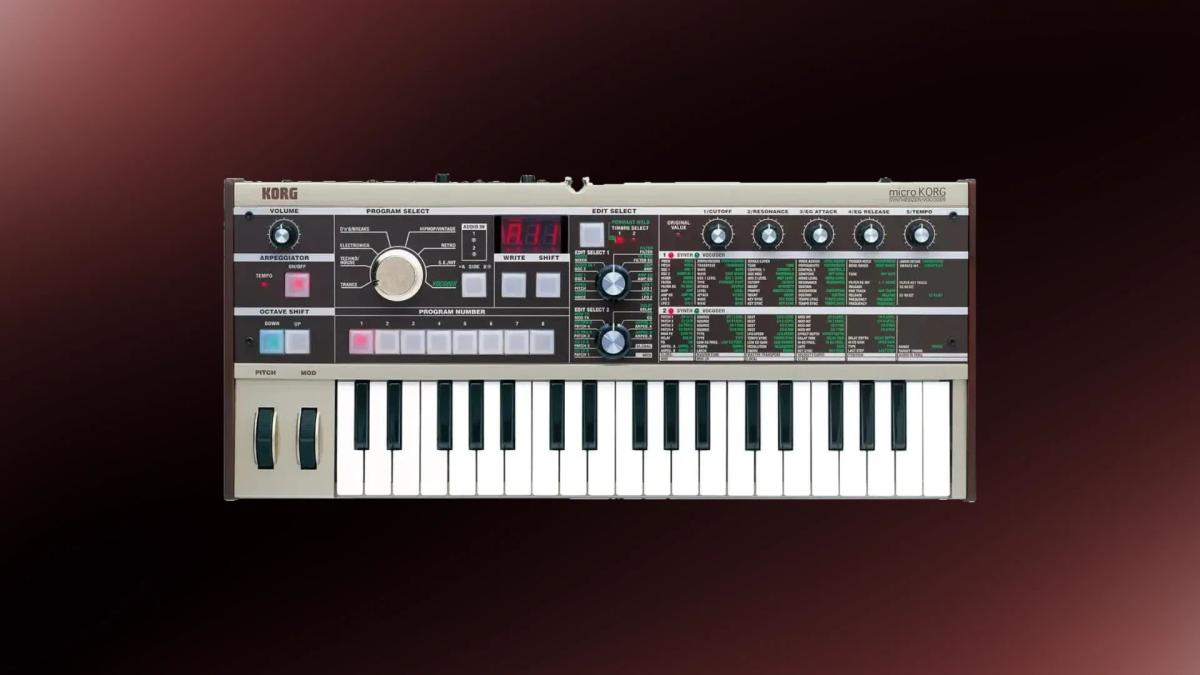
The Korg microKORG is a four-voice virtual analog synthesizer and vocoder that debuted at the Summer NAMM show in July 2002 and went on sale in Japan on October 30 of that year. Built on the analog-modeling engine of Korg’s MS2000, it squeezed two oscillators per timbre, a multimode filter, an eight-channel vocoder with a gooseneck microphone, effects, an arpeggiator and battery power into a 37-mini-key body weighing about 2.2 kg. What makes it meaningful is less any single feature than its staying power: Korg sold it essentially unchanged for around two decades, and the company itself has described it as the best-selling synth of all time.
Table of Contents
Sound and character
The Korg microKORG sounds more serious than its toy-like dimensions suggest. Sound On Sound’s original review called the synthesis engine “first class” and singled out basses that were “superbly fat,” along with leads that had enough edge to cut through dense mixes. That character comes directly from the MS2000 lineage: a pair of oscillators with sync and ring modulation, a filter that offers a 24dB/octave low-pass alongside 12dB/octave low-, high- and band-pass modes, and an amp section with built-in distortion.
Its tonal range is wider than a typical “analog clone” because Oscillator 1 is not limited to classic waveforms. Alongside saw, square, triangle and sine, it offers a vox wave and 64 DWGS digital waveforms, a nod to the additive-derived waves of Korg’s DW-8000. These give the instrument glassy bells, hollow organ-like tones and thinner digital textures that a strictly analog-modeled palette would not reach. Oscillator 1 can also be replaced by external audio, so the filter and effects can process incoming signals.
Where the Korg microKORG is weaker is in lush, wide pads. Sound On Sound found self-programmed pads “acceptable, if slightly ‘cold’,” and the four-voice ceiling, halved when layering both timbres, limits how thick a chord can get. It is at its best on basses, leads, arpeggiated sequences, and above all the robotic, formant-heavy vocals of its vocoder, which the same review placed “up there with the best of the current breed.” The modulation effects add character too: the reviewer compared the phaser’s grainy quality to an MXR stompbox.
Features and architecture
- Manufacturer: Korg
- Year introduced: 2002 (shown at Summer NAMM in July 2002; Japanese release October 30, 2002)
- Production years: from 2002, sold essentially unchanged for about two decades; major retailers now list the standard model as no longer available following the arrival of the microKORG 2 in 2024
- Synthesis type: virtual analog (analog modeling), based on the MS2000 engine, with additional DWGS digital waveforms
- Category: compact keyboard synthesizer and vocoder
- Polyphony: 4 voices; 2 voices when two timbres are layered; Mono and Unison modes available
- Original price: £399 including VAT in the UK at launch (Sound On Sound, January 2003)
- Current market price: recent U.S. street price around $549.99 before stock dried up
- Oscillators: 2 oscillators plus noise per timbre; Oscillator 1 with saw, square, triangle, sine, vox, 64 DWGS waves, noise or external audio input; Oscillator 2 with saw, square and triangle, plus sync and ring modulation
- Filter: multimode with 24dB/octave low-pass and 12dB/octave low-pass, high-pass and band-pass; resonance and self-oscillation
- LFOs: 2 per timbre, with key sync and tempo sync
- Envelopes: 2 ADSR envelopes per timbre (filter and amp)
- Modulation system: Virtual Patch matrix with 4 routings, each with source, destination and bipolar amount
- Sequencer / arpeggiator: arpeggiator with 6 patterns (Up, Down, Alt 1, Alt 2, Random, Trigger), up to 8 steps that can be switched on or off, gate, swing, 1 to 4 octave range and latch; no sequencer
- Effects: modulation effect (chorus/flanger, ensemble, phaser), delay (stereo, cross, L/R), 2-band EQ, plus distortion in the amp section
- Vocoder: 8-channel vocoder with per-channel level and pan, formant shift and formant hold; condenser gooseneck microphone included; external carrier and modulator signals supported
- Memory: 128 programs, arranged in genre-labelled banks selected by a large rotary dial
- Keyboard: 37 velocity-sensitive mini keys, no aftertouch; pitch and modulation wheels
- Inputs / outputs: L/Mono and R outputs, 3.5mm headphone output, 2 audio inputs (one switchable for the microphone)
- MIDI / USB: MIDI In, Out and Thru; no USB
- Display: small LED display with an Edit Select system and five edit knobs
- Dimensions / weight: 524 × 232 × 70 mm; about 2.2 kg without batteries or microphone
- Power: 9V DC adapter or 6 AA batteries
Strengths
- The engine is more capable than the format implies. Two oscillators per timbre, a proper multimode filter, a modulation matrix and layered timbres give real depth, and patches are compatible with the larger MS2000.
- The vocoder is a genuine feature, not a gimmick. With eight channels, per-band level and pan, formant shift and an included microphone, it made vocoding accessible to players who had never owned a dedicated vocoder.
- It is truly portable. Battery operation, a 2.2 kg body and an onboard mic let it work for rehearsals, small stages and outdoor setups without extra gear.
- The front panel is a printed map of the architecture. Sound On Sound later noted that having every parameter printed on the panel made it one of the most approachable menu-driven synths, even without a screen.
- The genre-sorted program dial makes the factory sounds fast to reach on stage, which helped beginners and cover-band players alike.
- Audio inputs and MIDI Thru broaden its role. External signals can run through the filter, effects and vocoder, and the unit can double as a MIDI controller.
Limitations
- Four voices is a hard ceiling, and layering two timbres drops it to two. Big chords, sustained pads and two-handed playing quickly hit the limit.
- The 37 mini keys are compact but cramped. Sound On Sound’s reviewer felt the engine had been “delivered in the wrong box,” mainly because of the keyboard.
- Editing beyond the basics is slow. With only a handful of knobs, a small LED readout and a matrix-style Edit Select system, deep programming can be tedious.
- The two timbres cannot be addressed on separate MIDI channels, so it is not truly multitimbral.
- There is no aftertouch, no sustain or expression pedal input, and no USB, all of which date the design.
- Its pads and lush textures sound cooler and thinner than those of polysynths with more voices.
Historical context
The Korg microKORG appeared at a moment when Korg was turning its analog-modeling technology, first heard in the Electribe grooveboxes, into affordable keyboards. The earlier MS2000 had already brought a modeled analog engine and vocoder to a full-size panel. The Korg microKORG took that engine and repackaged it as a small, battery-powered instrument with an included microphone, retro knobs, wooden side panels and a name that, according to Korg, deliberately recalls earlier models such as the Korgue and the miniKORG 700.
The timing mattered. In the early 2000s, laptops and software instruments were taking over many studio tasks, and plenty of musicians wanted something smaller and cheaper than a flagship workstation. The Korg microKORG answered with ready-to-use sounds sorted by style (Trance, Techno/House, D’n’B/Breaks, Hiphop/Vintage, Retro, SE/Hit and Vocoder) and a price well below larger virtual analog rivals. Sound On Sound compared it with Novation’s A-Station and second-hand Roland JP-8080 and Korg MS2000 units, placing it in a crowded field that it would eventually outlast.
It also founded a product family. Korg’s own timeline shows the Korg microKORG followed by the microKONTROL in 2003, the microX in 2006, the microKORG XL in December 2008 and the XL+ in 2012. Variants of the original kept appearing: a reverse-key black edition in 2007 for the fifth anniversary, tenth-anniversary colors in 2012, a gold microKORG-GD limited to 2,000 units in 2013 for Korg’s 50th anniversary, the microKORG S with built-in speakers and 256 program slots in 2016, and the semi-translucent microKORG Crystal for the 20th anniversary in 2023. Its eventual successor, the microKORG 2, was announced at NAMM in January 2024 and is covered in its own article.