

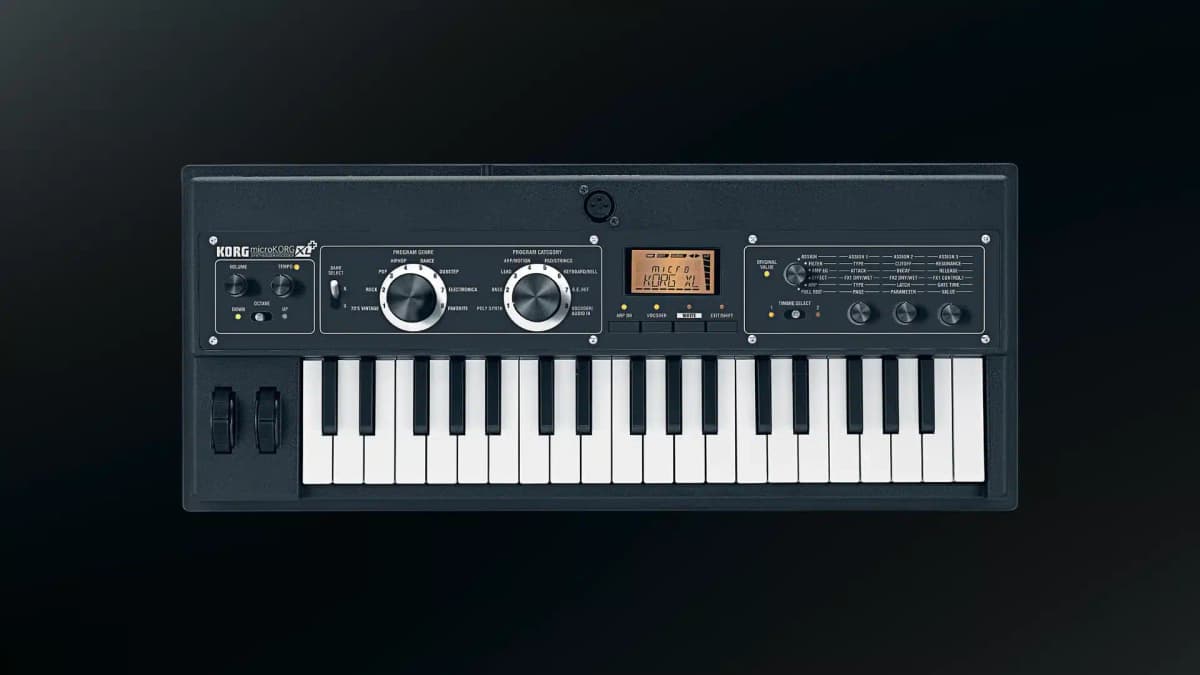
The Korg microKORG XL is a compact virtual analog synthesizer and vocoder that Korg announced in December 2008 and shipped in spring 2009, followed in late 2012 by the cosmetically and sonically refreshed microKORG XL+. Despite the family name, it is not an expanded version of the original microKORG engine. Instead it borrows Korg’s MMT (Multiple Modeling Technology) synthesis from the RADIAS and R3, adding PCM keyboard sounds, a 16-band vocoder with a gooseneck microphone and Kaoss-derived effects, all in a 37-key, battery-powered case of about 2 kg. It doubled the original’s polyphony to eight voices and became Korg’s main pocket-sized synth of the 2010s, sold alongside rather than instead of the microKORG it was meant to top.
Table of Contents
Korg microKORG XL sound and character
The Korg microKORG XL sounds cleaner, brighter and more detailed than the original microKORG, which was built on the older MS2000 engine. That comes from MMT, the modeling platform Korg introduced in the RADIAS in 2006 and described as sharing its sawtooth and pulse waveforms with the OASYS. Basic analog-style patches are tight and well defined, and Sound On Sound’s Paul Nagle found it definitely more of a synth than its small size suggests. The trade-off is that it rarely sounds dirty or unstable on its own; the Analog Tune parameter, which simulates pitch drift, and the drive/waveshaper section are there to rough it up.
Its range comes from oscillator 1, which can produce classic analog waves, formant waves, noise, DWGS and PCM waveforms or process external audio, with cross modulation, unison stacking of up to four detuned voices and VPM, Korg’s phase-modulation-style mode, for glassy and metallic tones. Oscillator 2 adds ring modulation and sync. Two multimode filters can run in series, in parallel or per oscillator, and a waveshaper offers sub-oscillator, octave-saw, clipping and decimator shapes. Leads, sync sweeps, aggressive basses and bell-like digital textures are its strongest ground.
The PCM layer gives the Korg microKORG XL a practical side the original lacked: acoustic and electric pianos, clavinet, organs, strings and brass. Bonedo’s reviewer singled out the Wurlitzer-style piano, and the XL+ added sounds based on the Korg SGproX piano, the M1, VOX organs and tape-replay strings and flutes. These are useful sketching and stage sounds rather than replacements for a dedicated keyboard.
The vocoder remains central to its identity. It moved from the original’s eight bands to 16, with formant shift and formant hold, and both Sound On Sound and Bonedo praised it, the latter noting some hiss on sibilants. Its weak points are sonic in a quieter way: there is no reverb, so patches can sound dry without outboard processing, and Bonedo reported audible stepping on some slow filter sweeps and modulations. It sits firmly in the modern, digital modeling camp: polished, versatile and portable rather than warm in the vintage sense.
Features and architecture
- Manufacturer: Korg
- Year introduced: announced in December 2008 and shipping from spring 2009; Wikipedia ties its introduction to NAMM 2008 and Korg’s own page says 2008, while Sonicstate gave April 2009 availability
- Production years: microKORG XL from 2009 to 2012; microKORG XL+ from late 2012 (US retail in December 2012), with no clearly documented end date; major retailers now list it as discontinued
- Synthesis type: virtual analog modeling (Korg MMT) with PCM/DWGS waveforms, plus vocoder
- Category: compact 37-key virtual analog synthesizer and vocoder
- Polyphony: 8 voices, reduced to 4 when the vocoder is in use
- Multitimbrality: up to 2 timbres in Layer, Split or Multi modes
- Original price: £436 in the UK and $750 list in the US at launch, per Sound On Sound; the XL+ arrived at $499.99 street in the US and £407.99 RRP in the UK
- Current market price: Reverb’s price recommendation for the Korg microKORG XL sits around $306 with listings up to about $440, and Sweetwater’s Gear Exchange guide gives roughly $260 to $385
- Oscillators: 2 per timbre plus noise; oscillator 1 offers sawtooth, pulse, triangle, sine, formant, noise, DWGS/PCM and audio input, with waveform, cross, unison and VPM modulation; oscillator 2 offers four analog waves with ring, sync or ring plus sync
- Waveshaper: drive, decimator, hard clip, octave saw, multi-triangle, multi-sine, four sub-oscillator shapes and level boost
- Filter: 2 multimode filters; filter 1 is continuously variable across low-pass (24 and 12dB/octave), band-pass and high-pass, filter 2 is switchable LPF, HPF or BPF; serial, parallel or individual routing
- LFOs: 2, with tempo sync
- Envelopes: 3
- Modulation system: six-slot virtual patch matrix
- Sequencer / arpeggiator: arpeggiator with six types and step on/off over up to eight steps; no modulation sequencer, unlike the R3
- Effects: 2-band EQ per timbre plus 2 master effects with 17 Kaoss-derived algorithms (delay, tape echo, chorus, phaser, flanger, decimator, ring modulator, grain shifter and others); no reverb
- Vocoder: 16 bands with per-band level and pan, formant shift and formant hold; gooseneck microphone included
- Memory: 128 programs selected by Genre and Category knobs across banks A and B; the editor/librarian adds downloadable libraries, including converted microKORG and MS2000 programs
- Keyboard: 37 velocity-sensitive Natural Touch mini keys, no aftertouch; pitch and modulation wheels; sprung octave switch
- Inputs / outputs: stereo 1/4-inch outputs, headphone output, 1/4-inch audio input with mic/line switch, front XLR mic input; no pedal inputs
- MIDI / USB: MIDI In and Out (Sound On Sound noted the absence of Thru) plus USB-B for MIDI and editor control
- Display: backlit custom LCD
- Dimensions / weight: 556 x 231 x 73 mm; about 2 kg without batteries and microphone
- Power: 9V DC adapter or six AA batteries, for about four hours on alkalines
Strengths
- It packs a serious engine into a small box. MMT from the RADIAS and R3 gives it two oscillators, two filters, a waveshaper and a patch matrix, far more depth than the panel suggests.
- The vocoder is one of the best in its size class. Sixteen bands, formant controls and a bundled gooseneck mic make it immediately usable on stage or in the studio.
- Eight voices changed what it could do. The original microKORG’s four-voice limit made pads and chords cramped, while the Korg microKORG XL can handle basic keyboard parts and layered sounds.
- The PCM pianos, organs and strings make it a practical utility keyboard as well as a synth, particularly in the XL+ version with SGproX, M1 and VOX-derived sounds.
- It is genuinely portable. Battery operation, light weight and onboard mic mean it can be used almost anywhere.
- The free editor/librarian exposes the whole engine on a computer and opens up hundreds of extra programs, including converted microKORG and MS2000 patches.
Limitations
- The build quality is modest. Sound On Sound and MusicRadar both commented on wobbly knobs and a plasticky feel, and the large selector knobs are not made for rough handling.
- The mini keys are light and short. Bonedo liked the action, but Sound On Sound and MusicRadar found it cheap feeling, and there is no aftertouch.
- Front-panel editing is slow. A few small knobs and a menu matrix stand in for dedicated controls, and Bonedo found the edit knobs scroll too quickly.
- There is no reverb, a notable omission given that the R3, which shares the engine, has one.
- Only 128 program slots are available, organized in a rigid genre and category grid that does not always suit how players file sounds.
- Connectivity is basic: no pedal inputs and, per most spec sheets, no MIDI Thru.
- Using the vocoder halves the polyphony to four voices.
Historical context
The Korg microKORG XL grew out of Korg’s mid-2000s modeling line. The original microKORG of 2002, based on the MS2000, had become one of Korg’s most successful synths, with Wikipedia citing an estimated 100,000 units by 2009. In 2006 Korg launched the RADIAS, a 24-voice synth built on the new MMT engine derived from its OASYS flagship, and in January 2007 it followed with the R3, which CDM described at its NAMM debut as a successor to the microKORG with a larger keyboard and better controls. The Korg microKORG XL brought that MMT engine back down to the microKORG’s size, competing in a crowded small-synth market that included the Alesis Micron and, soon after, the Akai Miniak.
Korg presented it in December 2008 as “the new top of the range microKORG,” with Sonicstate reporting April 2009 availability. Reviews in 2009 were respectful but mixed: Bonedo awarded four out of five and praised the engine and vocoder, while Sound On Sound admired the sound but questioned the build, keyboard and price. Korg kept the original microKORG on sale alongside it, so the Korg microKORG XL became a step-up model rather than a replacement.