

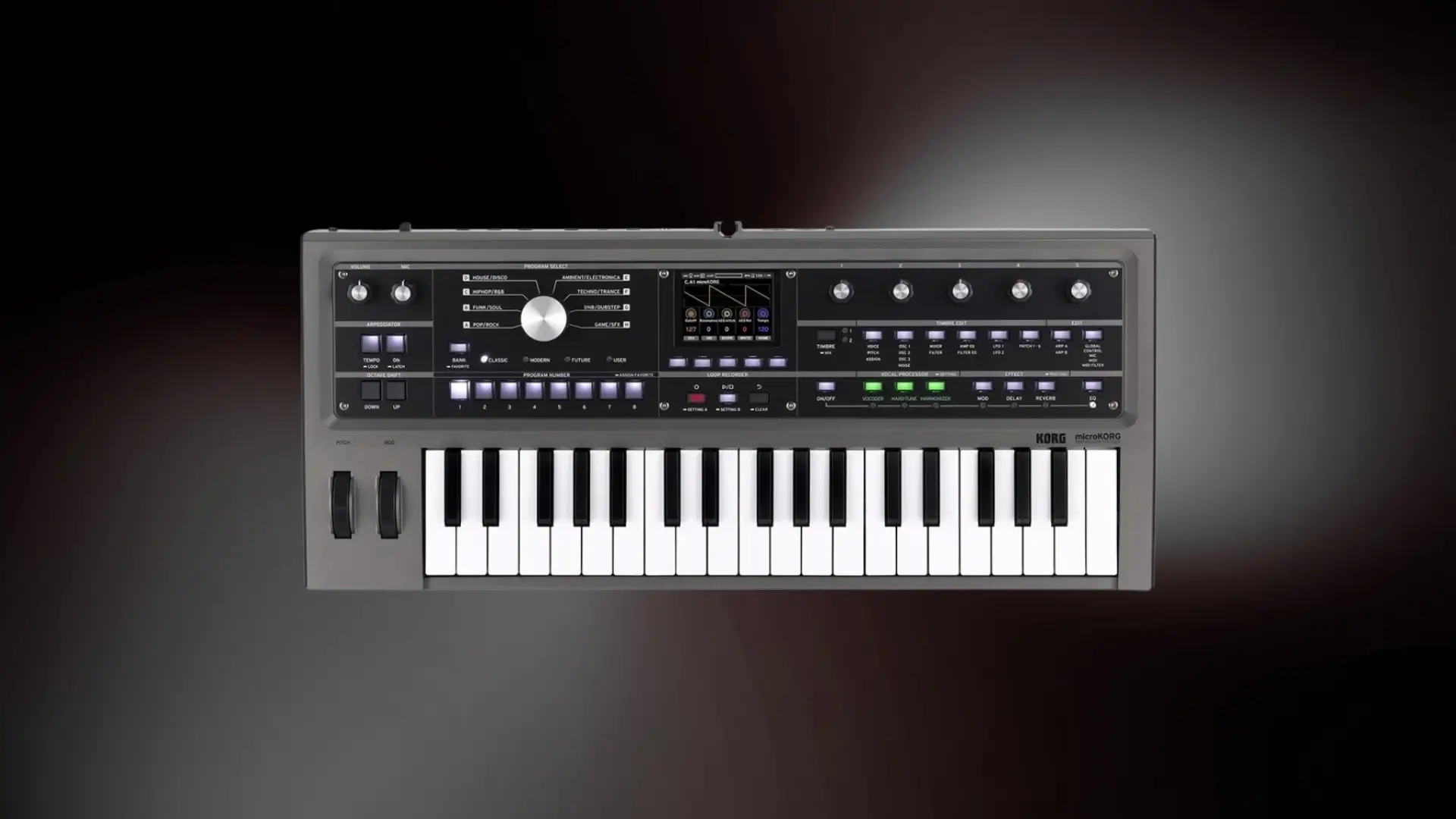
Introduced publicly in January 2024 and reaching United States retailers later that year, the Korg microKORG 2 is a compact 37-key digital analog-modeling synthesizer, vocoder, vocal processor, and audio-looping instrument. It retains the genre-selection dial, miniature keyboard, portable format, and microphone that defined the 2002 microKORG, but replaces the original synthesis engine and cryptic editing system with three oscillators per timbre, eight-voice polyphony, dual-timbre programs, a color display, expanded modulation, and a substantially broader effects architecture. Firmware 2.0 later added logue SDK expansion, keyboard splits, and deeper loop manipulation, turning what began as a cautious sequel into a more open-ended instrument.
Table of Contents
Korg microKORG 2 sound and character
The Korg microKORG 2 speaks the language of analog synthesis without disguising its digital identity. Its strongest patches tend to sound controlled, bright, immediate, and mix-ready rather than weighty, unstable, or convincingly vintage. Sawtooth and square waves provide the familiar foundation for basses, leads, pads, and electronic keyboard sounds, while triangle and sine waves support softer fundamentals. Three oscillators allow detuning, octave stacking, interval construction, and denser harmonic structures than the two-oscillator architecture of the original instrument.
The engine becomes more distinctive when it moves away from conventional virtual analog. Each oscillator can access 64 DWGS digital waveforms and 32 one-shot PCM waves. The DWGS material introduces glassy electric-piano colors, metallic basses, bells, synthetic voices, and harmonically complex digital tones, while the one-shot waves can add percussion, clicks, attacks, and transient information to otherwise sustained sounds. Ring modulation, oscillator synchronization, and variable phase modulation allow oscillator 3 to impose sharper, more metallic overtones on oscillators 1 and 2.
Its filter is continuously variable between five reference points: four-pole low-pass, two-pole low-pass, two-pole band-pass, two-pole high-pass, and four-pole high-pass. Intermediate values blend adjacent responses rather than forcing the player to select isolated filter modes. This supports animated spectral movements, gradual thinning, vocal-like transitions, and more nuanced filtering than a conventional low-pass-only design. Resonance, drive, envelope modulation, and extensive keyboard tracking give the filter enough flexibility to move from restrained subtractive tones to harder, more synthetic textures.
The result is versatile but not universally flattering. WIRED found that some factory sounds could become thin or conspicuously digital, while also observing that this relative leanness helps the Korg microKORG 2 occupy a mix without overwhelming surrounding parts. That assessment captures the central tension of the Korg microKORG 2: it is more capable than its predecessor, but its character comes primarily from clarity, flexibility, modulation, and layering rather than from the physical density associated with a fully analog signal path.
Firmware 2.0 widened that character considerably. Oscillator 3 can operate in a low-frequency mode, including rates fast enough for audio-rate amplitude and frequency modulation, and the logue SDK permits custom oscillators and effects developed specifically for the Korg microKORG 2. These additions push the Korg microKORG 2 beyond fixed virtual analog and toward a hybrid software-platform mentality, although the resulting sound depends increasingly on third-party development rather than on the factory engine alone.
Features and architecture
- Manufacturer: Korg.
- Year introduced: Announced in January 2024 and commercially available later in 2024.
- Production years: 2024 to present as of August 2026.
- Synthesis type: Digital analog-modeling synthesis, expanded in firmware 2.0 with custom digital oscillators and effects through the Korg microKORG 2 implementation of Korg’s logue SDK.
- Category: Compact virtual-analog polysynth, vocoder, vocal processor, arpeggiator, and audio-looping performance instrument.
- Polyphony: Eight voices in single-timbre mode and four voices when two timbres are layered. The official specifications list four-voice vocoder polyphony, one hard-tune part, and two harmonizer parts.
- Original price: Early announcement coverage reported a target price around US$699, but the standard gray model reached United States retail in October 2024 at approximately US$549.99, with the white version around US$599.99.
- Current new-price signal: Major United States retailers listed the standard model at US$599.99 in August 2026, while Thomann showed a substantially lower regional price of US$469 before destination-dependent costs.
- Oscillators: Three oscillators per timbre plus a dedicated noise generator. Each oscillator offers saw, square, triangle, sine, 64 DWGS waves, and 32 one-shot PCM waves. Oscillator 3 can modulate oscillators 1 and 2 through synchronization, ring modulation, combined ring-and-sync processing, or variable phase modulation. Firmware 2.0 also allows oscillator 3 to work as an additional LFO and supports custom SDK oscillators.
- Noise generator: Dedicated low-pass, high-pass, band-pass, and decimator processing, with adjustable noise color.
- Filter: Continuously morphing digital filter moving through four-pole low-pass, two-pole low-pass, two-pole band-pass, two-pole high-pass, and four-pole high-pass responses, with cutoff, resonance, drive, and keyboard tracking.
- LFOs: Two LFOs per timbre, each offering triangle, downward saw, upward saw, square, and sample-and-hold waveforms. They can run freely, synchronize to tempo or MIDI clock, or operate in one-shot mode. Firmware 2.0 adds oscillator 3 as another modulation source through its Low mode.
- Envelopes: Separate ADSR envelopes for amplifier and filter sections in each timbre. Both envelopes can also serve as virtual-patch modulation sources.
- Modulation system: Six virtual-patch routes per timbre. Each route can combine two modulation sources, multiply them to create a modulation curve, assign the result to a destination, and set positive or negative intensity. Sources include velocity, keyboard tracking, wheels, envelopes, LFOs, noise, and analog-style random variation.
- Multitimbrality: Up to two timbres per program. They can be layered, and firmware 2.0 adds a keyboard-split mode.
- Arpeggiator: Ten arpeggio types with an eight-step arpeggiator editor, latch operation, timbre targeting, and synchronization with LFO and delay timing.
- Sequencer and loop recorder: There is no conventional multitrack MIDI note sequencer. Instead, the Korg microKORG 2 includes an audio loop recorder with overdubbing. Firmware 2.0 adds step recording, keyboard-mapped slicing, and WAV import and export at 16-bit/48 kHz.
- Vocal processing: A 16-band vocoder, hard-tune pitch processing, and a two-part harmonizer. Vocal signals can be routed through the internal modulation, delay, and reverb effects.
- Effects: Factory architecture consists of nine modulation-effect types, six delay types, six reverb types, and a final two-band equalizer. The signal path runs modulation, delay, reverb, then EQ. Firmware 2.0 adds user-loadable SDK effects; Korg and Sinevibes announced 15 compatible Sinevibes plugins, including two free titles.
- Memory: 256 programs arranged as four banks, eight categories, and eight programs per category. One 64-program bank is reserved for user sounds.
- Keyboard: 37 velocity-sensitive mini keys without aftertouch. Korg revised the spacing and proportions of the black and white keys compared with the earlier microKORG format.
- Controllers: Pitch and modulation wheels, five assignable edit knobs, genre and bank selectors, dedicated arpeggiator controls, and three loop-recorder transport buttons.
- Audio outputs: Unbalanced 6.3 mm left/mono and right outputs, plus a 6.3 mm stereo headphone output.
- Audio inputs: Powered 3.5 mm condenser-microphone input, 6.3 mm dynamic-microphone input, and 3.5 mm stereo auxiliary input.
- Pedal connection: 6.3 mm damper or assignable switch input.
- MIDI and USB: Five-pin MIDI input and output plus USB-C for computer connectivity, MIDI communication, updates, loop transfer, and the Sound Librarian application.
- Display: 2.8-inch color IPS LCD with animated parameter graphics and a selectable oscilloscope display.
- Dimensions: 542 × 238 × 65 mm.
- Weight: Approximately 2.2 kg without batteries and microphone.
- Power: Included 9V DC adapter or six AA alkaline or nickel-metal hydride batteries. Korg estimates at least four hours of operation with alkaline batteries.
- Current system version: Korg released firmware 2.0.2 in December 2025 with stability and quality-of-life improvements following the larger 2.0 feature update.
Strengths
- The synthesis architecture is far deeper than the exterior suggests. Three oscillators, dual timbres, DWGS waves, one-shot PCM material, oscillator modulation, morphing filters, two envelopes, two LFOs, and six virtual patches provide enough range for conventional subtractive synthesis and more overtly digital sound design.
- Editing is substantially clearer than on the original microKORG. The display identifies the five current knob assignments, shows parameter movement graphically, and reduces dependence on printed parameter matrices or memorized menu codes. Reviewers from WIRED and Sound On Sound both regarded the new workflow as a major practical improvement.
- It balances immediacy and depth unusually well. A player can select sounds quickly through the large category dial, adjust five performance parameters, or enter deeper oscillator, filter, modulation, effects, and routing pages without changing instruments.
- The vocal section is more than a token vocoder. Hard tuning, harmonization, a 16-band vocoder, separate microphone inputs, and effect routing allow the keyboard to function as a compact vocal-performance processor as well as a synthesizer.
- The 2.0 update materially changed the Korg microKORG 2 rather than merely correcting bugs. SDK oscillators and effects, keyboard splitting, oscillator 3 modulation, loop slicing, step recording, and WAV transfer addressed several limitations of the original release and improved its long-term usefulness.
- The portable format remains genuinely practical. At roughly 54 cm wide and about 2.2 kg, with battery power, full-size MIDI ports, microphone connections, and dedicated audio outputs, it can operate independently of a computer without becoming difficult to transport.
- Its relatively controlled digital sound can be an advantage in arrangements. Even when it lacks the density of a larger analog polysynth, its basses, arpeggios, digital keys, processed vocals, and animated layers can remain intelligible in a crowded production.
Limitations
- Eight voices are adequate rather than generous. Selecting a dual-timbre program reduces available polyphony to four notes, which restricts long-release pads, sustained chords, and layered performances precisely when the architecture becomes most interesting.
- There is no aftertouch. The velocity-sensitive keyboard is improved over the original, but the lack of channel or polyphonic aftertouch limits direct expressive control unless modulation is assigned to the wheel, velocity, a pedal, or external MIDI hardware.
- The five-knob interface remains assignable rather than knob-per-function. The screen makes it comprehensible, but sound design still involves selecting pages and reusing the same controls. Sound On Sound specifically noted that endless encoders would have been preferable to conventional knobs in a system with many reassigned parameters.
- The genre-based preset system is nostalgic but structurally awkward. Four banks, eight categories, and eight programs preserve the recognizable microKORG method, yet WIRED found the navigation unnecessarily convoluted and the 64 user positions restrictive for customized live sets.
- Its analog modeling is versatile but not consistently convincing as analog sound. Some patches are polished and useful, while others can sound thin, overtly digital, or dependent on effects. Players seeking organic oscillator drift, analog filter saturation, or a physically imposing unison sound may find the character restrained.
- The included microphone is functional rather than studio-grade. WIRED reported weak pickup and inconsistent hard-tune results with the supplied gooseneck microphone, making an external dynamic microphone preferable for serious vocal work.
- The loop recorder is not a replacement for a full sequencer or sampler. It records audio rather than editable MIDI notes, and the original workflow requires tempo and loop-length decisions before recording. Firmware 2.0 adds substantial manipulation, but it still does not provide a conventional multitrack pattern sequencer.
- Recorded loop audio is volatile. The original owner’s manual states that loop-recorder audio is deleted when the Korg microKORG 2 is powered off, although firmware 2.0 allows loops to be exported through the Librarian before shutdown.
- The SDK ecosystem is not interchangeable with earlier logue instruments. Korg states that Korg microKORG 2 plugins are not directly compatible with those created for the minilogue xd or NTS series because the effects and sound architectures differ.
- The price places it against unusually strong alternatives. Its ease of use remains persuasive, but buyers in this bracket can also consider instruments offering higher polyphony, full-size keys, more elaborate modulation, true analog circuitry, or deeper sequencing. That competition did not exist at the same intensity when the original microKORG appeared.
Historical context
The original microKORG arrived in 2002 as a compact four-voice analog-modeling synth and vocoder derived from ideas associated with Korg’s MS2000 architecture. Its small keyboard, genre-based preset dial, battery operation, accessible price, and included microphone placed hardware synthesis within reach of musicians who might never have considered a larger programmable instrument. Sound On Sound later described it as the world’s best-selling synthesizer, and Korg kept the underlying concept alive through limited colors, the microKORG S, and the separate microKORG XL lineage.
The Korg microKORG 2 therefore arrived under unusually heavy historical pressure. It was not merely another compact Korg but a successor to a product that had remained culturally visible for more than two decades. Korg preserved the visual and behavioral symbols that made the original recognizable, especially the category dial, mini keys, vocoder microphone, and compact proportions, while replacing almost every major internal and interface assumption.
The timing also made the task harder. In 2002, an affordable, portable hardware virtual-analog synthesizer with a vocoder was comparatively unusual. By 2024, compact synthesizers had become a dense category populated by wavetable engines, granular systems, hybrid analog-digital instruments, powerful modulation matrices, desktop modules, and inexpensive analog recreations. The Korg microKORG 2 could no longer succeed merely by being small and capable; it needed to explain why the microKORG workflow still mattered.
Its initial answer was accessibility. The display and visual parameter language were developed with French designer and musician Sylvain Stoppani of BLINKSONIC, whose Reaktor instruments were known for graphical interfaces. Korg used that collaboration to transform the original’s parameter-chart logic into an animated visual environment. This was historically appropriate: the Korg microKORG 2 did not abandon the limited-control-panel concept, but attempted to make limitation legible.
Firmware 2.0 represented a second answer. By adding SDK expansion, splits, oscillator 3 modulation, loop slicing, step recording, and file transfer, Korg effectively repositioned the Korg microKORG 2 after launch. The update acknowledged that approachable presets and a vocoder were no longer sufficient in the modern compact-synth market.