

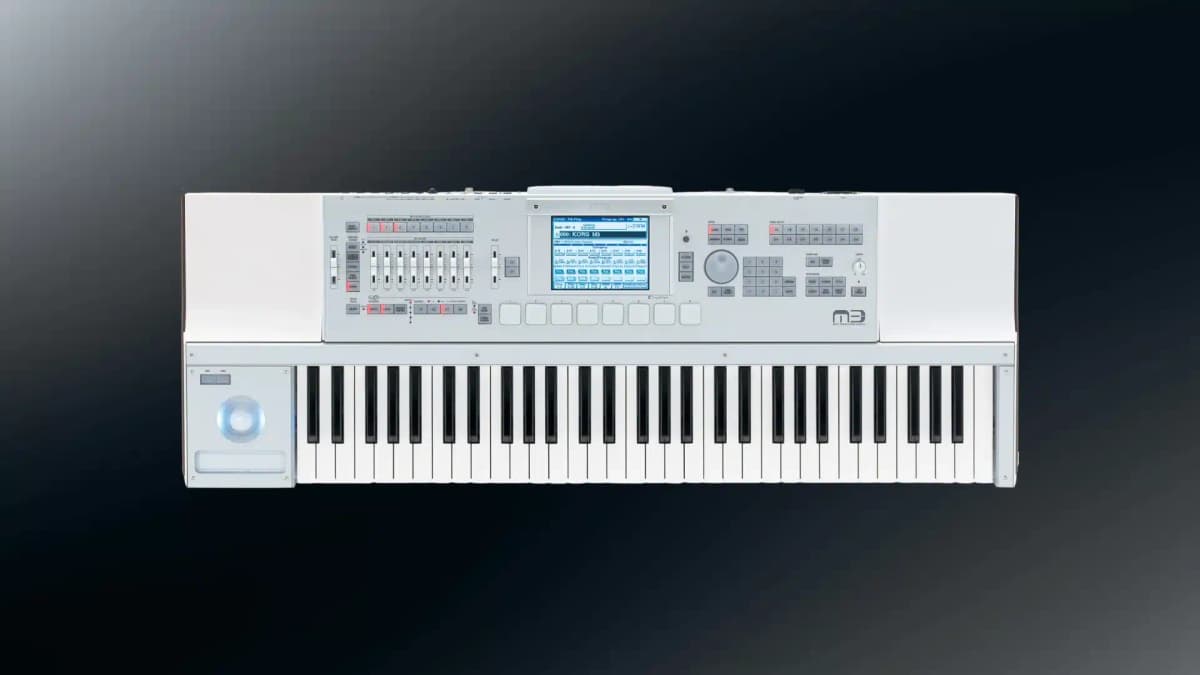
The Korg M3 is a music workstation that Korg introduced at the NAMM show in January 2007 and began shipping a few months later. It was built on the Korg Komponent System: an M3-M sound module, with its own touchscreen and controls, docked into 61-, 73- or 88-key keyboard frames and could be detached to work as a desktop module. Its Enhanced Definition Synthesis (EDS) engine was a hardware distillation of the HD-1 engine in Korg’s OASYS, paired with 256MB of compressed PCM, 120 voices, KARMA 2, Drum Tracks, sampling and an optional RADIAS analog-modeling board. A free 2008 operating system update turned it into the M3 Xpanded, covered here as part of the same instrument.
Table of Contents
Korg M3 sound and character
The Korg M3 sounds polished, wide and detailed, closer to the OASYS than its price suggested. Gordon Reid wrote in Sound On Sound that EDS sounded very much like the OASYS’s HD-1 engine, and that some programs even improved on their OASYS counterparts; MusicRadar said it simply sparkles across acoustic simulation, synthesized loops and soundscapes. The engine keeps the OASYS’s voice structure: each program uses one or two oscillators, each able to switch or crossfade between up to four stereo multisamples by velocity, and each oscillator feeds its own pair of multimode filters, with five LFOs and five envelopes available to a voice.
Its raw material came from 256MB of compressed ROM, with 1,028 multisamples and 1,606 drum samples by Sound On Sound’s count, and an effects section with 170 algorithms spread across five insert effects, two master effects and a total effect. That combination makes the M3 strong at layered combis, synth pads, electric pianos, organs, orchestral splits and the dense, processed textures that KARMA generates in real time.
The weak points were well defined at launch. Reid singled out acoustic pianos and lead synths as the least convincing areas, and AudioTechnology’s Brad Watts noted that Korg instruments can sound a little too nice. The piano problem was largely addressed by the Xpanded update in late 2008, whose new Stereo Grand Piano library Reid called a massive step forward for Korg. The lead and analog-style limitations were the job of the EXB-RADIAS board, which added Korg’s MMT virtual analog engine and vocoder inside the Korg M3 and gave it a rawer, more synthetic voice than its PCM engine alone.
Overall, the Korg M3 sits firmly in the clean, modern workstation tradition: hi-fi, versatile and production-ready rather than gritty. Its character comes as much from the effects and KARMA’s generated phrases as from the samples themselves.
Features and architecture
- Manufacturer: Korg
- Year introduced: 2007, announced at Winter NAMM in January and shipping from around May; the M3 Xpanded update followed in late 2008
- Production years: 2007 to around 2013 according to Wikipedia; its role was taken over by the Kronos in 2011
- Synthesis type: sample-based (PCM) synthesis via Enhanced Definition Synthesis (EDS), derived from the OASYS HD-1 engine; optional MMT analog modeling via EXB-RADIAS
- Category: music workstation with sampling, built on the modular Korg Komponent System
- Polyphony: 120 voices in single mode, 60 in double mode; the EXB-RADIAS board does not add to the total
- Multitimbrality: 16 parts in Combi and Sequencer modes
- Original price: in the UK, £1,644 for the M3-M module, £1,879 for the 61-key, £2,232 for the 73-key and £2,584 for the 88-key (Sound On Sound, 2007); Wikipedia gives US list prices of $2,375, $3,000, $3,475 and $4,000
- Current market price: Sweetwater’s Gear Exchange price advisor suggests about $987 to $1,462 for an M3-61 and about $831 to $1,231 for the M3-M; Equipboard tracks Reverb averages around $800 to $864
- Oscillators: one or two per program, each with up to four velocity-switched or crossfaded stereo multisamples; 256MB compressed PCM ROM with 1,028 multisamples and 1,606 drum samples
- Filter: two multimode filters per oscillator with four routing types
- LFOs: two per oscillator plus a common LFO
- Envelopes: five per voice, covering pitch, filter and amplitude
- Modulation system: assignable routings from the joystick, ribbon, sliders, pads, LFOs and envelopes, with KARMA also able to drive program parameters
- Sequencer / arpeggiator: 16-track MIDI sequencer at 480ppqn, 128 songs and 210,000 events, with no audio tracks; KARMA 2 (updated to 2.2 with Xpanded); Drum Tracks with 522 preset patterns at launch (later listings give 617) and 1,000 user slots
- Sampling: 16-bit, 48kHz mono or stereo; 64MB RAM as standard (about 5 minutes 49 seconds stereo), expandable to 320MB with the EXB-M256; In Track Sampling, Time Slice, and import of WAV, AIFF, SoundFont 2 and Akai data
- Effects: 170 algorithms; five insert, two master and one total effect, with up to 16 three-band EQs
- Memory: 512 factory programs, 384 combis and 32 drum kits at launch; capacity of 1,664 programs, 1,792 combis and 144 kits
- Expansion: EXB-RADIAS (MMT synth and vocoder), EXB-M256 (RAM), EXB-FW (FireWire audio and MIDI for plug-in use); RADIAS-R or a second M3-M could dock in the larger frames
- Keyboard: 61 or 73 keys, semi-weighted with velocity and aftertouch; 88-key version with Korg’s RH3 graded hammer action
- Controllers: 320 x 240 color touchscreen doubling as an X-Y pad with motion recording, eight velocity-sensitive pads, eight sliders, eight switches, joystick, ribbon
- Inputs / outputs: stereo main plus four individual outputs, two inputs with mic/line switch, optical S/PDIF in and out (48kHz), headphones, damper and two assignable pedal inputs
- MIDI / USB: MIDI In, Out and Thru; one USB 2.0 Type-B for the computer and two Type-A for storage; editor runs standalone or as VST, AU or RTAS plug-in
- Display: 5.7-inch, 320 x 240 color TouchView screen on the M3-M
- Dimensions / weight: varies by frame; the 88-key is described as the lightest 88-key keyboard Korg had made, but published figures differ by configuration
Strengths
- It delivered much of the OASYS sound at about a third of the price. EDS kept the HD-1 voice architecture and many of its programs, which reviewers found remarkably close to the flagship.
- KARMA 2 at this price was new. Sound On Sound called it the first affordable workstation with KARMA 2 and OASYS-style sequencing, and KARMA’s generated phrases remain hard to match in other hardware.
- Drum Tracks made composing faster. Every program and combi can carry a rhythm and kit, a feature that started on the M3 and carried into the Kronos.
- The Xpanded update was a major free upgrade. It added the stereo grand piano and brass and woodwind libraries, piano-roll editing in the sequencer and KARMA 2.2 at no cost.
- The EXB-RADIAS board widened its range sharply, adding a virtual analog engine and vocoder that Reid argued it would be daft to leave out.
- The modular frame was practical. The M3-M can be lifted out as a desktop module, and the larger frames can hold a second engine or a RADIAS-R.
Limitations
- The standard 64MB of sample RAM is small, and the expansion libraries and serious sampling really need the EXB-M256 board.
- There is no audio track recording, so the sequencer is MIDI-only, unlike the OASYS it borrowed from.
- Sampling and digital I/O run at 48kHz only, which complicates CD-standard work and some studio setups.
- Vector synthesis, wave sequencing and the OASYS’s extra synth engines were left out, and EDS cannot load OASYS EXi instruments.
- The 61-key’s plastic body and the module’s styling divided opinion; Reid’s first reaction was that it was ugly, though he grew fond of it.
- The touchscreen is a single point of failure on an ageing instrument; an owner review on zZounds reports screen problems and complains that many basic functions are hidden behind it.
- Expansion options were limited by the single EXB slot structure, a point Sound On Sound listed among its cons.
Historical context
Korg had defined the affordable workstation with the M1 in 1988 and carried the idea through the T series, 01/W, Trinity and Triton. In 2005 it launched the OASYS, a flagship built on a PC-based platform with the HD-1 sample engine, KARMA and several modeled synthesizers, but priced far beyond most players. The Korg M3 was Korg’s attempt to bring the core of that instrument down to the Triton’s price class: the HD-1 engine was reworked as EDS running on Korg’s own chipset, and KARMA 2 came along with it. The name deliberately recalled the M1, although the Korg M3 has nothing to do with the M3R rack module of 1989.
Shown at NAMM in January 2007, the Korg M3 shipped in stages, with the M3-M and 61-key version first and the 73- and 88-key models following in mid-2007. It won keyboard of the year at the 2007 Musikmesse International Press Awards, and Sound On Sound declared the Triton Extreme superseded at a stroke, while setting the M3 against the Yamaha Motif XS and Roland Fantom X. Korg added the EXB-RADIAS, EXB-M256 and EXB-FW boards, and in late 2008 released the Xpanded update with new sounds, libraries and sequencer editing. Reid suspected even then that the Korg M3 had not become a global success, partly because dealers and buyers did not fully understand what it offered.