

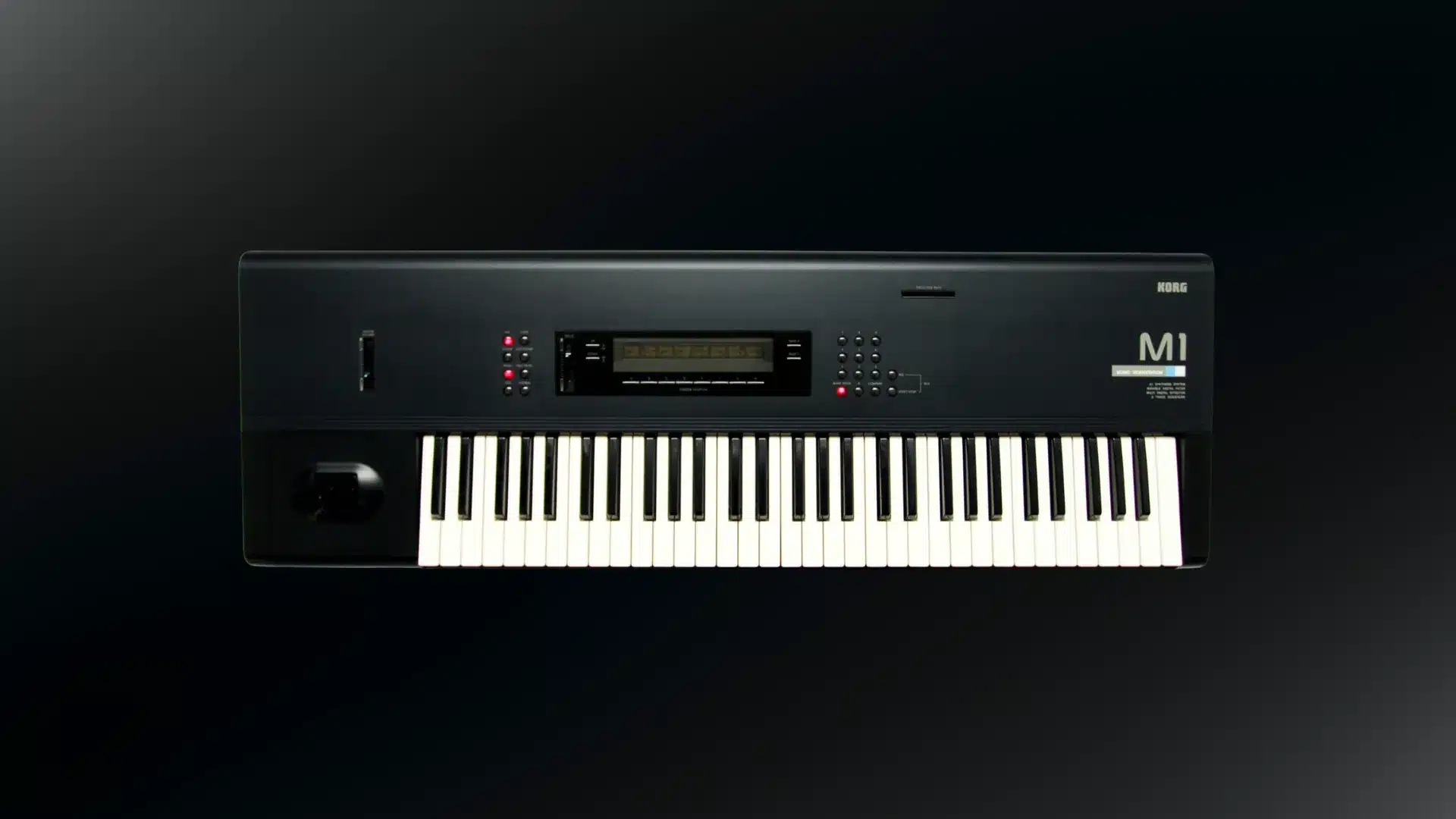
The Korg M1 is a 61-key digital synthesizer introduced in 1988 and built until 1995, combining 4MB of 16-bit PCM samples, a digital filter and amplifier, two multi-effects processors, drum kits, and an eight-track sequencer in a single instrument that Korg called a “Music Workstation.” None of those ingredients was new on its own, but the way the M1 joined them was, and the result became one of the most commercially successful synthesizers ever made. Its factory sounds, above all the bright Piano 16′ and the Organ 2 bass, went on to define the sound of late-1980s pop and early-1990s house.
Table of Contents
Sound and character
The Korg M1 sounds polished, bright, and unmistakably of its moment. Its engine plays back multisampled recordings of real instruments, including acoustic piano, strings, guitar, woodwinds, sitar, kalimba and drums, alongside synthetic DWGS waveforms inherited from Korg’s earlier digital synths. In 1988 that realism was the main attraction: Sound On Sound’s launch review called the sounds “sensational.” Heard today, the same samples read as stylized rather than lifelike, and that stylization is a large part of why the M1 remains recognizable.
The character comes as much from what the engine lacks as from what it contains. The digital low-pass filter has no resonance, so the Korg M1 cannot produce the squelchy sweeps of an analog synth. Instead, timbre is shaped by velocity, key tracking and multi-stage envelopes that work on the attack and decay of the sample itself. Two onboard effects processors then do a great deal of the work, adding the reverbs, choruses, delays and rotary-speaker treatments that make the presets sound finished straight out of the box. Sound On Sound’s retrospective notes that the rich samples and effects mask the filter’s limitations.
It excels at hard-edged pianos, punchy organ basses, glassy pads, breathy pan flutes, slap basses and layered “Combi” textures of up to eight programs, and is less convincing for evolving synthetic sound design. It was voiced to sound complete in a 1988 mix, not to be an endlessly malleable source.
Features and architecture
- Manufacturer: Korg
- Year introduced: 1988
- Production years: 1988 to 1995 according to Korg and Sound On Sound (some references list 1994 as the end)
- Synthesis type: “AI” (Advanced Integrated) synthesis, sample-based subtractive synthesis using PCM multisamples and DWGS waveforms
- Category: keyboard music workstation (synthesizer, drum sounds, effects and sequencer in one unit)
- Polyphony: 16 voices in single-oscillator mode, 8 voices when a program uses two oscillators; 8-part multitimbral
- Original price: £1,499 in the UK; commonly cited at around US$2,166 in the United States at launch
- Current market price: used units typically sell in the mid hundreds of US dollars, with Reverb’s price-guide estimate around $646
- Oscillators: one or two per program, drawing on 4MB of 16-bit PCM ROM with 100 multisounds and 44 drum sounds; no sync or cross-modulation
- Filter: VDF (Variable Digital Filter), a non-resonant low-pass filter with velocity sensitivity and key tracking
- LFOs: two modulation generators, one for pitch (vibrato) and one for the filter
- Envelopes: multi-stage pitch, filter (VDF) and amplifier (VDA) envelopes, with velocity and keyboard tracking
- Modulation system: joystick for pitch bend, filter and modulation; aftertouch; velocity; assignable pedal inputs
- Sequencer / arpeggiator: 8-track sequencer with 10 songs and 100 patterns, real-time and step recording, quantize down to 1/48, time signatures from 2/4 to 6/4; no arpeggiator
- Drums: four drum kits, each with up to 30 sounds mapped to MIDI notes
- Effects: two digital effects processors running in series or parallel, with 33 effect types including reverbs, early reflections, stereo delays, chorus, flanger, phaser, distortion, exciter, EQ, symphonic ensemble and rotary-speaker simulation
- Memory: 100 Programs, 100 Combinations and about 4,400 sequencer notes, or 50 Programs, 50 Combinations and about 7,700 notes; battery-backed
- Storage: one slot for RAM cards (programs, combis, sequences) and one for PCM cards (additional waveforms); no disk drive
- Keyboard: 61 keys with velocity and aftertouch
- Inputs / outputs: four audio outputs (1/L, 2/R, 3, 4), headphone output, damper pedal and assignable footswitch inputs
- MIDI / USB: MIDI In, Out and Thru; no USB
- Display: backlit 40 x 2 character LCD
- Dimensions / weight: approximately 1058 x 356 x 110 mm, about 13.5 kg
- Power: AC mains with internal supply; power consumption listed at 11 W
Strengths
- The M1 integrated an entire production setup into one keyboard. Sounds, drums, effects and sequencing lived in the same box, so a musician could sketch and arrange a complete track without a rack of separate modules.
- Its factory sounds were exceptionally usable. Voiced by an international team and identical in every country, many became recognizable because they worked in a mix without further programming.
- The onboard effects transformed sample playback. With two processors and a wide algorithm list, the Korg M1 could deliver spatial, finished sounds at a time when many synths still relied on external reverb units.
- Drums were part of the instrument. Sampled drum kits on a synthesizer were new, and four outputs let drums and instruments be processed separately.
- Eight-part multitimbrality and the Combi system made it a strong MIDI sound module, a layering instrument for live use and a sequencer sound source all at once.
- Card slots, Korg’s EX expansion and a broad third-party sound market kept the platform current well into the 1990s.
Limitations
- The filter has no resonance, which limits classic subtractive sweeps and makes the M1 a weak choice for analog-style sound design.
- Sixteen voices drop to eight when programs use two oscillators, so dense layered Combis and sequenced arrangements could run out of polyphony quickly.
- The sequencer was functional but awkward. Sound On Sound’s 1988 review found it clumsy, and later coverage noted fixed time signatures, a 250-bar limit and a less friendly workflow than Ensoniq’s ESQ-1.
- There was no floppy drive. Storage relied on RAM cards and SysEx dumps, a choice the launch review called short-sighted.
- Effects cannot be shared across programs within a Combi, a constraint Sound On Sound identifies as typical of early workstations.
Historical context
The Korg M1 arrived at a turning point. Yamaha’s DX7 of 1983 had opened the digital era, and Roland’s D-50 of 1987 had shown how much appeal sampled attack transients could add to synthesized tones. Korg had moved toward sampled sound with the DW-6000 and DW-8000, which used single-cycle sampled waveforms, and with the 1986 DSS-1 sampler. The M1 was Korg’s answer to that landscape, and MusicRadar describes it as a direct response to the D-50.
What changed was scope. Where the D-50 was a synthesizer, the M1 aimed to be a complete working environment. Korg’s founder Tsutomu Katoh and his son Seiki decided that every unit would ship with the same sounds worldwide, and Korg assembled an international sound-design team led by programmer Jack Hotop, who travelled to Japan eight times from late 1986 to work on the instrument. Hardware design was led by Korg chief engineer Junichi Ikeuchi.
The Korg M1 let one person write, arrange and demo a full piece on one keyboard, years before computer-based production became common. Korg then extended the concept quickly: the M1R rack version, the cheaper M3R module, the T-series in 1989, the M1EX and M1REX variants with T-series sounds, and in 1991 the 01/W, which built on the same synthesis approach with an expanded “AI2” system. The M1R was discontinued in 1992, three years before the keyboard.